Sunday, October 25, 2020

Growing Dream Bubbles in the Many Worlds


 I learn so much from my parallel selves, in dreams, in shamanic journeys,and in encounters in the liminal space between sleep and awake. I admire the writer Roberts who are highly accomplished in different genres, and the artist Robert who does great work in oils. I follow in the footsteps of the Roberts who are ahead of me on my present path, teaching things I have just started to master. I draw comfort from observing the plight of parallel Roberts who made choices that led to blighted relationships, illness or creative sterility.
    The parallel Roberts who intrigue me most are ones who are living full-time in the imaginal realm. It is likely they are Roberts who left the physical world before me. There is nothing surprising in that idea. If the Many Worlds hypothesis in physics is correct, and we are living right now in one of innumerable parallel worlds, then numberless versions of ourselves died before us, at birth or in childhood, through a heart attack or the virus or self-destruction, in easy or difficult ways.
     I love to check on the lifestyles, living arrangements and activities of my Roberts on the Other Side. I admire the residence of the Penthouse Robert who swims in an infinity pool in his rooftop terrace and then dives twenty stories down, like a sea bird, to swim in a turquoise bay. I am thrilled by the access of the scholar Roberts to a Total Library where they bring together knowledge from many realms. I am humbled by the service of the psychopomp Roberts who are devoted to helping people on both sides of death to find and follow their rightful soul paths. 
     I enjoy Robert the Literary Angel who loves to play muse to writers in the physical world, beaming them material that leaps effortlessly on to their pages. He enjoys seeing his ideas take form without having to tap them out on a keyboard and - amazingly - seems to take not pride in the assertion of authorship. Being in his mind gives me an inkling of why guardian angels do what they do. I try not to talk about him in my creative writing retreats because participants start looking at me hungrily, as if willing me to check out soon and start beaming new books to them. 
     I made a shamanic journey to visit a parallel Roberts who is one of the full-time residents of a School of Soul on the Other Side. I was delighted by his studies and his books, include many I have not yet written or published here below. It struck me that I had never consciously visited his bedroom. Does he even have one? After all, he has no need of sleep in this reality. He obliged me by showing me a bed in a pleasant room, with French doors opening onto a little terrace with flowering vines. So what goes on here?
     He invited me to lie down and dream as he does. I found that thoughts and images from inside me instantly took form around me, quickly composing a complete hologram that seemed entirely real, utterly alive. I played with floating in the waters of a wonderful sea cave, enjoying the scene with all of my senses. And then of enjoying the vibrant life of a great city where the arts are cherished. The scene grew until it became a whole world.
     I was reminded by this visit that there is a way of dreaming that is the inverse of receiving images from without and also quite different from making an excursion.. It is a way of projecting a dream reality from within and floating within it, inside a 360 degree bubble that can expand until it is as big as a world.


RM journal drawing: "Dream Box"


Wednesday, October 21, 2020

Dreaming with Swans


Among the Dane-zaa of northern British Columbia,  respected spiritual elders or shamans are called Naachin, Dreamers. When young members of the People (Dane-zaa simply means The People) are sent into the wilderness on a vision quest, a Dreamer will watch over them, traveling in his astral body. The Dreamers are the givers of the songs that bring the People together in sacred ceremony in alignment with the spirits of the natural world. A song may be a bridge between worlds. It may confer the gift of understanding the language of birds and animals. 
    As in the Upanishads [1], the Dane-zaa say that a powerful dreamer travels like a swan from and back to the nest of the body. ”The Dreamers are like swans in their ability to fly from one season to another. Like the swans that fly south in the winter, Dreamers fly to a land beyond the sky and bring back songs for the people on Earth.” [2]

I have been looking through my journals for my dreams of swans. Here are a few:

Swan Prince

The great white bird lowers itself, wings outstretched, until it is suspended over the waters, whose currents stream purple and vermilion and royal blue. I hurry to meet it, swimming in air. Now the giant swan transforms into the semblance of a beautiful man. The beak becomes the golden noseguard of a helmet. Is this how the god appeared to Leda?  [February 5, 2012]


Swan Flies from My Third Eye


Drifting in bed between sleep and awake in a hotel in Prague, I feel the start of a headache. It is in the center of my forehead. There is a rush of wings. The pain is forgotten as the great white bird emerges from the area of my third eye. I leave my human body on the bed and fly with it over the Vltava river. [November 8, 2019]


Swan Inlet

I stand in the woods near water's edge. The light over the bay is rosy gold, as are the waves. They move slowly. The water looks heavy and oleaginous. My guide explains that only swans are at home here. Other water birds avoid this inlet and don't swim in it. We watch a swan gliding into the swell, rocking with it, dipping its head and body after fish. 
     Everything is suffused with that golden and rosy light. There is healing and magic here and the secret is with the swans.
    Waking, I put myself back in the scene. I pick my way through roots and vines to stand at the edge of the bay. I take from it and the water in my cupped palm looks like olive oil in a spoon. It is lightly scented, a pleasing aroma. On my tongue it is warm and salted just right, like virgin dipping oil in an Italian restaurant. A swan is watching me closely. Will it share the secret? Can I rise on its wings as I did before?
    I hope that the guide who was instructing me before will answer. But the only voice I hear now is my own. Swans fly over the oily waters in arrowhead formation toward the pink sun on the horizon. [September 21, 2020]


Swan Rising 

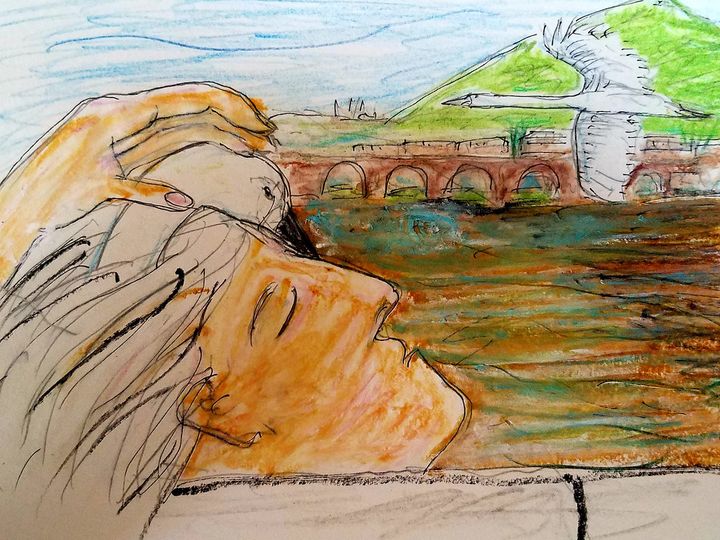
As I stir from sleep, I see with inner sight an old stone arched bridge over a green river. Not sure where. I am startled when I see a white swan standing, to my left, on the river bank. He is fierce and strong and definitely male. I think of Zeus and Aengus. He rises on beating wings and we fly together into a seascape of rosy light that reminds me of the light at Swan Inlet. Only Turner could do this scene justice in paint.[September 23,2020]


Notes


1. In the Brhadaranyaka Upanishad, or Great Forest Book, the dreamer moves between worlds and in and out of the nest of the body "like the lonely swan". The dreamer is godlike in the ability to create in the dream state. "In the state of dream, going up and down, the god makes many forms for himself." S. Radhakrishnan (ed) The Principal Upanishads (New Delhi: Indus, 1991) 259. A swan is the vehicle of Saraswati, goddess of wisdom and music. The Sanskrit title paramahamsa, "supreme swan", is reserved for the supremely enlightened.

2. Robin Ridington, “They Dream about Everything: The Last Dreamers of the Dane-zaa” in Ryan Hurd and Kelly Bulkeley (eds) Lucid Dreaming: New Perspectives on Consciousness in Sleep (Santa Barbara: Praeger, 2014) vol. 2,174.


Journal drawings by Robert Moss


Friday, October 16, 2020

The gift of "boring" dreams


 I often hear from dreamers who complain that their night dreams are boring or mundane. They feel they are missing the movies. “I’m forever dreaming of arguing with my mother,” writes one dreamer. “I’m fed up with having long-winded conversations with my boss,” writes another. “I get enough of him from nine to five. Why can’t I enjoy a dream romance in a tropical paradise, or go on an epic adventure?”

Of course we want the romance and adventure. But we also want to keep body and soul together on the roads of everyday life. Here’s another of my personal D.I.Y. mantras about dreamwork:

Ho-hum dreams are the most likely to offer help in navigating the future.

Why? Because much of waking life can be ho-hum too – until we start using the skills of dreaming and imagination to bring it more alive. So instead of complaining because you keep dreaming of arguments with your mother, you want to ask: how can I avoid getting into this situation again in the future? And perhaps also: how can I make peace with the part of myself that is like my mother?

Here’s one of my favorite examples of the need to examine a ho-hum dream as a preview of a possible future, and harvest information from the dream in order to navigate better in a developing situation and avoid an unwanted event in waking life.

A woman friend complained to me that she had a boring and irritating dream in which she was in her cubie at the office when her boss threw a temper tantrum. “He banged his fist down on  my desk, spilling my coffee over my work papers.” “What happened then?” “I called him a bad name and walked out.” She thought this over. “S–t. I think this may have cost me my job, in the dream.”

Suddenly the ho-hum dream sounded less boring than urgent. I asked the dreamer to run a reality check. Could her boss throw a two-year old temper tantrum? “He does that all the time.” Was there anything in the dream to indicate what he was mad about this time? “All I know is he wasn’t mad at me. He was just taking his rage out on me.”

If it were my dream, I now suggested, I would remember that next time my boss threw a hissy fit, his anger will probably not be directed at me, and I should keep my cool. The dreamer readily made this her action plan. “I’ll lay Miss Zen,” was her one-liner.

Not long after this conversation, the dream scene started to play out in exact detail. The boss came into the dreamer’s cubicle and banged his fist down on her work surface, spilling her coffee. Instead of swearing at him, she played Miss Zen.He exited later in some confusion. The boss returned later to apologize. “Sorry about how I behaved. It wasn’t about you.” Instead of saying, “I know,” the dreamer remained Miss Zen, sitting silent with a distant tight-lipped smile.

The boss came back with flowers. “I’m really sorry.” Miss Zen accepted the offering without comment, holding out a vase for the boss to fill.

At the end of the workday, the boss returned for the third time. “hey, I feel real bad. I want to invite you to come down to Cancun with the group I’m leading for the sales conference. You won’t have to do any work. You can just work on your tan and drink stuff that comes with little umbrellas.”

Because the dreamer did not discard a “boring” dream and worked with its information, she not only avoided an unpleasant scene and possible job loss but also collected an apology, flowers, and a free vacation.


RM journal drawing

I looked through my journals for a picture of a "boring"dream and this is about as close as I got. Here's a summary of my journal report: 

May 28, 2019

dream

Doing the Tarantella in line

I am in a vast space like the passport and customs control at an airport, in the fourth or fifth line from the front. The lines stretch across the whole space and as far back as I can see. Word comes that they are dancing the Tarantella somewhere behind us. There is a move to follow suit in the front rows.

Feelings: curious

Reality: I have been in airport lines almost as big as this,but I think this is the kind of airport where people take off for the Other Side.

Today's commentRecorded pre-pandemic, this dream may have some resonance at a time when some people in reckless superspreader events sometimes seem to be doing a dance of Death. The tarantella originated in Italy, where wild dancing was regarded as a cure for the deadly bite oi a spider. I am not likely to be getting in a line at an airport any time soon.


Sunday, October 11, 2020

"How does one learn to tell stories that please kings?"


Dreams set us research assignments.My dream last night of the Rawi and the Evil Queen might find its place in a collection of nested stories like A Thousand and One Nights, the proper title of the book we often call the Arabian Nights. So I am about to immerse myself again that immense book of wonders. On the way to sticking my head under this tent of visions, I found a note I wrote on a luminous memoir by Moroccan writer Fatima Mernissi. It seems that the engine of her best creative work was a question that welled up when she was first told, as a young girl, about Scheherazade, who had to come up with a new story every night on pain of death: 

  “How does one learn to tell stories which please kings?” 

In her account of a harem girlhood in Morocco, Fatima Mernissi gives us a stunning example of how storytelling can facilitate soul healing. Her text is  A Thousand and One Nights. As Fatima explains what these stories meant to her, and what they mean for Muslim women in general, we become aware that in the West, we have almost no inkling of what they mean.  

Scheherazade, the young bride of a savage tyrant who has killed her many predecessors, must spin a captivating tale every night to make the king postpone his plan to have her beheaded at dawn. Her husband, King Schariar, is possessed by the spirit of revenge. He discovered his first wife in bed with another man – a slave – and killing her was not enough to dissipate his raging hatred and distrust of women. He ordered his vizier to fetch, one by one, every virgin girl in the kingdom. He spent one night with each, then killed her. Now there are only two virgins left: the vizier’s own daughter, Scheherazade, and her little sister. Though her father wants her to escape, Scheherazade is willing to do her duty. She has a plan that will change everything. 

As Fatima Mernissi tells it: “She would cure the troubled King’s soul simply by talking to him about things that had happened to others. She would take him to faraway lands to observe foreign ways, so he could get closer to the strangeness within himself. She would help him to see his prison, his obsessive hatred of women. Scheherazade was sure that if she could bring the King to see himself, he would want to change and to love more.” 

Scheherazade keeps the King spellbound through a thousand one nights, and at the end he is changed. He gives up his habit of murdering women.

Fatima first heard of Scheherazade from her mother, in the closed world of a harem in Fez. The word “harem” here does not mean a stable of concubines and slave girls, but a closed male-dominated world in which women of all ages are kept under lock and key, forced at every turning to think about the hudud, the boundary enforced by religion, law and custom. When little Fatima  learns about Scheherazade, her first and eager question to her mother is: “How does one learn to tell stories which please kings?”

This, of course, is the question we all need to answer, to heal our relationships – with ourselves as well as others – and our world. 

Mernissi notes: “I was amazed to realize that for many Westerners, Scheherazade was considered a lovely but simple-minded entertainer, someone who relates innocuous tales and dresses fabulously. In our part of the world, Scheherazade is perceived as a courageous heroine and is one of our rare female mythological figures. Scheherazade is a strategist and a powerful thinker, who uses her psychological knowledge of human beings to get them to walk faster and leap higher. Like Saladin and Sindbad, she makes us bolder and more sure of ourselves and of our capacity to transform the world and its people.”


Quotations from Fatima Mernissi, Dreams of Trespass: Tales of a Harem Girlhood.  (Reading, Massachusetts: Addison Wesley, 1995)


Pictures: Sani ol Molk. "Scheherazade and the Sultan"(top); illustration for a Persian edition of the Thousand and One Nights (bottom).

The Rawi and the Evil Queen

 October 11, 2020

dream
The Rawi and the Evil Queen
In the dream from which I returned at 3:30 a.m., I am in the body and situation of a scholarly prince in a Muslim country. I am working on a new version of a text and tear up several drafts before I have the following:
The rawi came to the sultan with a composition he had forged. His recitation was false but once heard it became true.
In my dream, I do not get further because I have to deal with a plot being hatched by the evil queen, who wants to hold me captive. I need to reclaim a key from her. She has really scary war paint. The whorls of color around her dark eyes in her whitened face give the impression that you could fall into a black hole. I feel no fear in her presence. My dark-skinned, black-bearded cousins are on my side in this palace intrigue.
~

I come back from my dream excursion excited and intrigued. Good story, this one! No analysis required or appropriate. As is my habit, I write and email my full report to myself on my phone before getting out of bed.

Then I look for the meaning of rawi. I discover that in Arabic a rawi is a "reciter"or "announcer'. The rawis preserved great pre-Islamic literature through oral transmission. They might have the ear of sultans or of large audiences. They were often accused of fabrication.
I so love my dream-directed research assignments!


A Note on Practice: The Stories from Second Sleep

Much of my best night dreaming. as in this example, is done in or around a second phase of sleep, which used to be called simply, "second sleep". When I lie down at night, I am usually ready to have some industrial sleep for a couple of hours, with or without significant recall. Then, after waking and maybe reading for a couple of hours, I am ready for the adventures to begin.

My discipline is to record as much as possible when I return to where I parked my body, whether that is at 3:30 a.m. or 5:00 a.m., or whenever. I may linger in the dream locale for quite a while in the fertile hypnopompic state. I want a fresh story to write in my essential book, my journal. I agree with the ancient dreamer, Aelius Aristides, when he says in his Sacred Tales, “Each of our days, as well as our nights, has a story.”


Illustrations for Firdausi's Shahnama (Book of Kings) by Muhammad Zaman (top) and Mu'in Muhsavvir (bottom). What is going on around the eyes of the div (demon) in Muhsavvir's picture from the story of Rustam somewhat resembles the getup of the evil queen in my dream.

Friday, October 9, 2020

The Man in the Moon


Do you believe in the man in the Moon?

   No, not the face people imagine in the shadows of the craters, which is really the Great Rabbit, or Lunar Hare. Nor do I refer to those artful pictures, ever popular on greetings cards and in children’s stories, that add a nose and a grin and a wink to the crescent moon.

   I am speaking of something altogether different. I am inquiring whether you know anything (for worthwhile beliefs can only stem from knowledge) of the beings who live in the Moon. I am well aware that since humans in clumsy space suits first walked on the Moon, it has been commonly believed that the Moon is an astral desert, empty of organic life. This is merely a modern superstition, founded in the confusion of different orders of reality. Beyond appearances, the Moon is thickly settled. Its inhabitants do not live on the Moon in the way you live on the Earth. They cannot be found on the lunar surface from which astronauts and robots pick rock samples. The lunar population lives in the Moon, which is to say, in the Sphere of Luna, a frequency domain located a little – just a little – beyond the realm you can touch and smell and taste with your ordinary senses.

   I know what I am talking about, because the Moon is my home. If you happen to meet me tonight, because you happen to be looking up at the bright face of the Moon from under just the right tree at just the right time, or because you travel to my world on the wings of a dream, it’s quite likely you might see me as the man in the Moon, or at any rate a man in the Moon. I find it generally convenient, in my dealings with humans, to show myself as a human male, taller than average, with what I conceive to be a commanding – though not overbearing – presence, exquisitely tailored in a mode that is rarely encountered on Earth outside Jermyn Street and one or two most particular establishments in Buenos Aires. Yet I must disclose, at the beginning of my tale, that “man in the Moon” is a misnomer.

    I live in the Moon, but I am not a man. I am a daimon. I have lived very close to men, so close that I have sometimes forgotten my true identity. But I belong to a different and more ancient order of beings. When you turn to books, you will find the word daimon has several spellings. I prefer the oldest version, an accurate transliteration from the Greeks, who were close observers of traffic to and from my realm. Their witches – especially in the wild northern reaches – were adept at the dangerous art of drawing down spirits from the Moon. The most excellent shaman-philosopher, Plutarch, studied deep in our academies before he took up permanent residence and joined the faculty of one of our finest schools. Plutarch’s essay on the Sphere of Luna, De facie quae in orbe lunae apparet remains the best travel guide to our realm outside the closed stacks of the Magic Library.   

We know Plutarch well. It is a pity, for you, that his works are no longer taught in your schools, though he was read too often for what he wrote about tyrants and kings, instead of his essential work, which was all about us. He understood that the Moon and the Earth are as close as a man and his shadow. He knew that souls come and go constantly through our realm. He observed the descent of mind into the astral body in our dressing rooms, and the return of these energy suits to the suppliers when a traveler was given permission to return to the realm of mind. He watched all the souls that try to ascend to Luna after death and are rebuffed because they are dirty or confused. He saw souls that made it here, but reneged on their commitments, hurled from our ramparts through the black hole of Hecate. Do you know that great goddess’ scary sister, Melinoe. No? Well, be thankful if she does not visit you in the night with her train of spooks and nightmares.


Do please be careful with the word “daimon” now it is in the air, darting around you on dragonfly wings. Words have the power to call things into manifestation, and bring creatures from one world into another. You don’t want to say “daimon” out loud the wrong way; this can produce unpleasant effects, and sometimes unwanted visitors. I prefer to hear it pronounced “die-mon”, so it almost sounds like “diamond”, an elegant homonym. “Day-mon” is an acceptable alternative version.  To call me a “demon”, on the other hand, would be extremely rude, as thoughtless as calling a man whose chosen name is Robert “Bob”, and likely to produce more adverse effects than a frown and a growl. I did not mind being called a “demon” in demotic Greek in the age of Cleopatra, but since then a fog of fear and confusion spread by the morbid imaginations of the Dark Ages has made that version quite unusable. 


Excerpt from "Conversation with a Daimon of Luna" in Mysterious Realities by Robert Moss. Published by New World Library.


Journal drawings by Robert Moss.


Thursday, October 8, 2020

Time of the Dragon


Through the mist, there they were,

The sturdy ghosts, waiting for us

On the snow in their blanket coats. 

"Bring tobacco," they got to the point 

"We ride to the sky on a cloud of tobacco."

So we burned sweet and spicy tobacco 

Dried and cured in warmer lands 

And they said, when they drank the smoke,

"We will place a tree in your path

So you will stay with us till we are done."


The wind heard them and dropped pines

And birches across our trails

And took us off-grid and cut power lines

So we were in the big house of another time

In a world lit only by fire

Rubbing at smoke-seared eyes.

The old ones said, "To open the strong eye

You must close your everyday sight."

In the firepit cave I heard the heartbeat of the Mother. 

I closed my eyes and saw what I had come to see:


Earth begins in the womb of Ocean Mother, 

terrible to men but not to the man-boy

In his time of the Dragon. 

He follows the intent of minds

That have yearned for him,

Called for him, from many times

And many worlds. From the swirling deep

He raises the Shining One,

Silver-bright, in its winged glory.

He must gentle it to the purpose 

Of the Sisters who have called him

To ride a field of stars to the earth mountain 

Where they will make him

What they need him to be:

The bright warrior who can wield

Dragon fire without incinerating the world 


- from a work in progress


Journal drawings by Robert Moss