Showing posts with label subtle bodies. Show all posts

Sunday, April 9, 2023

Far Memory: Lessons in Time Travel, Bilocation and Seership from Joan Grant


She is conceived in the Blue Grotto on Capri, with Carabinieri standing guard over the site. This is because her parents, traveling in royal style, are mistaken for British Royals visiting Italy incognito. So Joan Grant begins the story of her life in her memoir Far Memory.
    I discovered her through her novel Winged Pharaoh which takes us vividly into a life lived in early dynastic Egypt by a girl who is trained as a dream seer in a temple of Anubis and grows to become a warrior-queen defending her country against invaders. This remains my favorite book on the practice of dreaming in ancient Egypt, though academic Egyptologists may cavil at some of its contents. It was a bestseller in its day, and the author initially kept mum about the fact that her novel, for her, was not fiction, but “far memory” of a past life in Egypt, triggered when she was allowed to handle a blue scarab. Much of the content came through in channeling sessions recorded by her then husband.
    I first picked up her memoir Far Memory to clarify how Joan Grant received her knowledge of ancient Egypt, and of other lives in other cultures. I recently re-read it, for the sheer pleasure of its bouncy narrative and to follow, in closer detail, how central the author’s own practice of dreaming became to her gifts as a writer, a psychic and a time traveler.
    As a young child, she remembered other lives. She dreamed of a French girl who died in Paris under the guillotine, and knew – through dreaming that experience – that “beheading does not hurt at all.” She received visitations from her deceased grandmother. 
    When her father took her to  a subway station on a family visit to New York, she glimpsed the remains of a man who had thrown himself in front of a train. She dreamed that she met this man, and took the form of the daughter he loved to comfort him, washing  him clean from blood and whiskey fog, and reattached his severed feet. She did this, not as the child Joan, but as a personality that was living as a girl born in 1906, with the knowledge of many other lives and a sense of identity that transcended any single body or life situation.
      During World War I, she traveled in dreams to a battlefield, where she took on the body of a Red Cross nurse, carrying out orders to deal with casualties in one of two ways: to explain to soldiers who had just been killed that they were “safely dead”, or to encourage the wounded to return to bodies that were not yet due to die.  “I had to get close, so close to the person I was trying to help that I became part of him: feeling, seeing, fearing as he did, until I could slowly instill my own faith in him.”
     And she wakes from these dreams in the body of a girl who is now eleven and can’t get the adults around her, apart from the occasional servant, to take her dreams seriously. The disconnect is so great that for a time she seeks to cut herself off from her dreams. But this plan can’t prosper because dreaming is a vital part of her calling. She starts getting confirmation of things she has dreamed but could not otherwise know about. Finding a young man in uniform alone at the breakfast table, she dares to tell him the dream from which she has just awakened in which she was with a soldier named McAndrew when he was killed. She describes his regimental badge and the slang name his unit gave to their trench. The officer at the table identifies the regiment as Canadian, and after checking is able to confirm all the details of the dream, the name of the soldier who was killed, even the slang name of the trench.
    She makes dream excursions, and she receives visitations. Jennie, her deceased grandmother, gives her music lessons and plays through her hands – an obscure piece that a Cambridge professor recognizes because Jennie played it for him. The sheet music no longer exists, and Joan could not know the piece in any ordinary way. “Quite extraordinary but completely evidential,” pronounces C.G.Lamb, the professor of engineering and amateur psychical researcher, giving her encouragement both to grow her clairvoyant gifts and to pursue academic studies.
    Another mentor was H.G. Wells, a house guest at Seacourt, her father’s immense estate on Hayling Island. Wells urged her to write – which she had not considered – while insisting that “you must live in order to write about living”.
    She dreams of places before she goes there, and of events unfolding at a distance in space or time. The night before Esmond, the lover she plans to marry, is due to return to her, she dreams he is staring at something on the floor, puzzled and angry. In the morning the news comes that he killed himself, apparently accidentally, cleaning his revolver. Later, she dreams of a kind of honeymoon with him in a beautiful environment he says is another planet, and delights in the kind of body she can enjoy here. “It was a material body, obeying a less stringent law of gravity, able to run faster, to leap higher, to swim farther under water, but still in its own place equally solid as the one I re-entered on waking.” She is startled when Esmond tells her that dream visitors aren’t especially welcome here. The residents call them ghosts, ‘earth-ghosts”.
    She develops the discipline of a real dreamer. She wakes herself several times during the night in order to record her dreams. She learns to distinguish “true dreams” from “the fustian and tinsel so dear to psychoanalysis”. In “true dreams”, she travels across time and space. She is with people at a distance . She visits the future. She enters or reenters life experiences of other personalities.
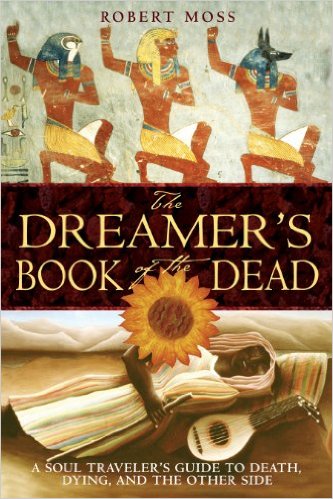
    In her development of “far memory” of those other lives, psychometry – the art of receiving impressions while handling a physical object – becomes increasingly important, after she first establishes that she can do it. But first and last, in the education of Joan Grant, is the dreaming. Reading her, we are reminded of just how important and just how practical this is. We urgently need many more people who can do pyschopomp work of the kind Joan narrates, helping the dead to find their way, and the best training for this is in dreaming, as I explain in my own "manual for the psychopomp" (Part III of Dreamgates) and in my Dreamer's Book of the Dead.

She was quite Egyptian in her insistence on the survival of a "supra-physical" body as well as the soul, and the possibility that a living individual can have more than one of these vehicles. A true pharaoh of Egypt, as I recall, was credited with having as many as 14 kas. It is "fun" to change your energy template, Grant informs us.
    "Another advantage of having more than one active, current supra-physical [body] is that it makes it easier to appear in two places at once." She gives a personal example. She was worried about a woman who was scheduled to undergo a C-section, an operation considered highly dangerous at the time. Although she could not be with her, she thought of her intently just before the procedure. Later the woman's husband thanked Joan profusely for the visit his wife said she had made, slipping in through the french doors from the hospital garden so as to be unobserved by the nurses, comforting her to the point that her fears dissolved and she slipped gently into a state of natural sedation.
    Joan waited some time after the birth before telling the mother that her visit was not an ordinary physical event. The woman responded, "Thank goodness I didn't know you weren't solid! I should have been simply terrified if I'd known I was seeing a ghost."
    We find this story in a recent collection of her occasional writings titled Speaking from the Heart. 
There are indications in the essays and memoirs here that Joan Grant experimented at least a little with what I find to be two of the most rewarding lines of exploration of our relations with a family of counterpart personalities, living in different times and dimensions. "Two personalities in the same series communicate with each other through their Integral - the Spirit." 
    This suggests that at the hub of many lives, playing out in different worlds, is a higher self that may operate outside time and may facilitate contact between personalities living in different times. We want to try to ascend to the perspective of that higher self, with its view over many times. And we want not only to understand how the legacy of past lives may work in our present lives - and may be healed, when seen for what it is - but how we can reach back across time to heal something in the life of a previous self. 

Tuesday, July 26, 2022

The dream calling of a Neoplatonist philosopher


Proclus (412-485) , one of the greatest of the Neoplatonist philosophers, taught that the true philosopher should become "a priest of the entire universe", honoring all forms of the divine. He was an immensely prolific author, whose collected works - many of which were destroyed by religious book burners - were longer than those of Plato and Aristotle combined. He instructed that there are two basic aspects of soul in each human being: the "fallen" terrestrial soul, focused in physical reality, and the "celestial" soul or "true self" that transcends time and space and is the source of creativity and spiritual wisdom. As a teacher, he sought to guide his students into ever-closer alignment with this higher self, or "good daimon". 

According to Marinus, his student and biographer, Proclus was called to his vocation in dreams. It was not an easy calling, since it connected him with gods and goddesses the triumphant Church was seeking to proscribe. But he believed that his dreams put him in contact with a lineage of teachers - the "hermetic chain" - who were able to communicate with each other across time and space.

The goddess Athena "appeared to him in a dream inducing him to follow philosophy". Proclus was born in Constantinople, but spent his early years at his family home in Lycia, the country of Homer's hero Sarpedon, beloved of Zeus. He had moved on to the great university city of Alexandria and was embarked on a promising career as a rhetorician when he accepted a friend's invitation to accompany him on a trip back to Constantinople. When Proclus reached his native city, the goddess Athena appeared to him in a dream in the form in which she was traditionally worshipped in the eastern capital. She instructed him to devote himself to philosophy and prepare himself for admission to the great school of Plato in Athens.

He had already received the gift of dream healing. When he was suffering from a serious illness as a child, a radiant boy appeared above his head. Leaning over Proclus' bed, his visitor announced his name - Telesphoros - and touched the child's head, releasing him from his sickness. 

On his return to Alexandria from Constantinople, Proclus applied himself to the study of philosophy and mathematics under new teachers. Later he followed his dreams of the goddess to Athens, and studied with Plutarch, Syriacus, and other renowned philosophers. When he had completed his apprenticeship, he applied himself to seeking to understand the mythologies and Mystery traditions of both East and West through direct visionary experience. Much of his creative work flowed directly from meditative states, conscious dreaming and the twilight zone of hypnagogia. Long before he rose to greet the sun, "alone, in his bed, he composed hymns, and examined certain theories, and searched for ideas, which he later committed to writing at the coming of the day." [1]

Proclus continued to be guided by Plutarch after his teacher's death. In dreams, Plutarch gave him advice on the commentaries Proclus was writing on the Chaldean Oracles - and on the probable length of his own life. His later teacher, Syriacus, with whom he had disagreed over the interpretation of Orphic materials, appeared in a second cycle of dreams that deterred him from continuing with his work in this area. [2]

In other dreams, Proclus communed with earlier philosophers and received training in the school of Pythagoras. These powerful dreams convinced him that he had experienced a previous incarnation as a member of Pythagoras' circle.

Through dream travel, he experienced dimensions beyond the physical and evolved a personal model of the subtle bodies as vehicles of consciousness. At the age of 42, he returned from one of his dream excursions shouting these lines:

I am possessed by a spirit that breathes into me the forms of fire, which, enfolding and entrancing my spirit in a whirl of flame, flies towards the aether, and with its immortal vibrations reaches in the starry vaults. [3]

In his later years, racked by arthritis, severe headaches and bouts of depression - partly induced by Church attempts to suppress the cult of the old gods and Plato's Academy - Proclus again received the gift of dream healing. His headaches and his despair were lifted when a serpent sacred to Asklepios wrapped itself around his head. When he asked for a healing dream to relieve extreme pains in his legs, he was rewarded by a dream in which "someone returning from Epidaurus" (the most famous temple of Asklepios) kissed his knees. He woke free of pain and reportedly did not suffer "even a twinge" of arthritis throughout the rest of his life.

When he traveled, Proclus asked his dreams to guide him. He especially sought dream guidance on the spirits of the land: on the names, rites and sacred sites of the guardian spirits of each place. In Lydia, the gods or daimons of a defunct shrine revealed lost rituals to him through a dream.

Proclus even allowed dreams to dictate the manner of his burial. His old teacher Syriacus appeared in a dream to remind him that though they had had disagreements, they had once lived together as family and had agreed to share a double grave. Proclus gave the appropriate instructions and their remains were interred together in a double sepulchre. 

While Proclus' major life choices and most enduring work were inspired by dreams, his biographer notes that he did not allow himself much conventional sleep, regarding long periods of sleep as a symptom of "psychic laziness". His most powerful experiences appear to have unfolded in hypnagogia - the fertile space between sleep and awake - and in conscious dream excursions beyond the body.

In his commentary on Plato's Timaeus and in other surviving works, Proclus left us a precise anatomy of soul and spirit, a Western counterpart to descriptions of subtle bodies or "sheathes of soul" in Eastern literature. Proclus may have been the first writer to use the term "astral body" though its meaning for him was different from its common usage today. For Proclus, the astral or "starry" body (astroeides) is a vehicle in which the soul descends from higher planes to animate a physical body, and also a vehicle in which it ascends after death or in transcendent experiences. 

In its descent towards physical incarnation, the soul takes on various garments (chitones) or vehicles (ochemata). These are material, as the body of flesh and bone is material, but woven of finer stuff. Among them is a subtle body associated with the breath (soma pneumatikon) that is also a vehicle of appetite and desire. It survives physical death but will decompose, in the natural course of thigs, when the soul has moved higher in its "starry" form. In this view, what follows physical death is a kind of spiritual striptease: an ascending soul casts off garments one by one, to rise higher in its vehicle of light. [4]

Proclus' insights are not the product of abstract speculation. He seeks to describe what he has experienced through direct vision, especially in the most natural form of altered consciousness: dreams and half-dream states. His language is difficult, but it is well worth the effort too recover the essence of his teachings. He is one of the lost teachers who can help us relate our contemporary adventures in the multiverse to ancient Mystery traditions and the kind of philosophy that is truly the love of Sophia. 


References

1. Marinus of Samaria, The Life of Proclus trans. Kenneth S. Guthrie (Grand Rapids MI: Phanes Press, 1986) 41.

2. ibid 43-44.

3. ibid 45

4. cf. E.R. Dodds, "The Astral Body in Neoplatonism". Appendix 2 to Proclus, Elements of Theology (Oxford: Clarendon Press, 1992. For a pioneer attempt to restore these teachings, see G.R.S. Mead, The Doctrine of the Subtle Body in the Western Tradition (London: John M. Watkins, 1919).

Tuesday, June 1, 2021

Subtle Bodies and Astral Sex in Killing Commendatore


Notes from a Reading Life

"An image of a color I should add came to me. The idea sprang up suddenly, all on its own. The color was like that of a tree with its green leaves dully dyed by rain. I mixed several colors together and created what I wanted on my palette..I was simply following ideas that sprang up naturally inside me, with no plan or goal. Like a child, not watching his step, chasing some unusual butterfly fluttering across a field."

This is how Haruki Murakami captures the moment a burned-out artist gets in the zone in his novel Killing Commendatore. While the book title might suggest a mob movie, it is the name of a painting inspired by a figure in Mozart's "Don Giovanni".

Amomg its many gifts and surprises Killing Commendatore gives us a wildly interesting perspective on the nature and travels of subtle energy bodies. It also dramatizes processes of materialization by which entities from realms beyond human perception can take up residence in  forms created by humans.

I thrilled to this observation by Menshiki the son of a great Japanese artist: "There's a point in everybody's life where they need a major transformation. And when that time comes you have to grab it by the tail. Grab it hard and never let it go. There are some people who are able to, and others who can't."

The action of the novel gets under way when a thirty-something commercial portrait artist leaves a broken marriage and an uncreative life to live in borrowed space, the mountain house of a famous artist who is now in a nursing home with dementia. He discovers a previously unknown painting by the artist hidden in the attic and tightly wrapped. Inspired by Mozart’s Don Giovanni, it depicts the stabbing of The Commendatore with amazing vividness, adding a figure sticking his long head out of a hole to observe.

The discovery of the picture, and a little grey horned owl in the attic, triggers a strange series of events. A bell-like sound from the woods behind the house before 3 am every night leads to major excavation -organized by the mysterious rich man in a white palace on a peak across the valley – that opens a pit with slick, unclimbable walls nine feet deep.This leads the narrator to recall a classic horror story of a Buddhist monk who had himself buried alive, ringing a  bronze bell to indicate he was still there until he wasn’t (but something else now walked the earth in his semblance).There is an old bronze bell in the pit. Who or what was buried here and why were all those stones and boards placed to hold it captive?

The question is enlarged rather than answered when a two-foot high character, the spitting image of The Commendatore in the painting, starts appearing to the narrator.

Late in the novel there is an astonishing description of the protagonist having astral sex with his estranged wife, flying from his eyrie on a mountain to her bedroom in Tokyo. It’s so real that he worries that he raped her while she was asleep. Nine months later she has a baby for which there is no physical father in ordinary reality since she had stopped having sex with her boyfriend.


Wednesday, February 10, 2021

Tales of the Double: Through the Net


Quite often, in the liminal state of hypnagogia I find myself looking at the patterns and textures of what appears to be woven cloth or webbing. Sometimes I find myself suspended in the mesh. The following experience was quite tactile:

I floated weightless, looking into a dark, grainy field, textured like hessian, a very palpable depth. I felt I was hanging in this, as in a hammock or net. I was uneasy, to begin with, hanging between worlds. I did not feel stuck in the net. I realized I could push through the net and travel in any direction. I eventually resolved simply to open myself to my creative source.
     The “hessian sacking” opened into a textile bazaar. I examined bolt after bold of richly textured patterns and designs.
     I heard noise in my house and realized I was operating with multiple consciousness, fully engaged in dream travel while safely tethered to my body in the bed.
     I spent the whole night slipping back and forth between dream locales, mediation, and long study sessions in which I devoured books and memorized material.
     One of the dream episodes involved the Egyptian Mysteries, especially the mysterious god Ptah, whose power is associated with the breath and who is said to be the Giver of the Ka.
      Another dream episode carried me into the realm of the Kabbalists. I tried out a thronelike chair with a hard wooden strut that stuck out low down at the back of the seat. This guaranteed that you would not get too comfortable or doze off. It was intended to assist Kabbalistic meditation.

These adventures sent me off into a spate of happy research. The palpable resistance of the web or net in which I had hung, and the fact that, once through it, I had access to Mystery teachings in corresponding locales, sparked many thoughts and speculations.
     The name of the temple of Thoth at Khemennu (the City of Eight) in ancient Egypt was Het Abdit, literally the House of the Net. This net confined unevolved humans to their lower natures. But to initiates, it became a kind of cosmic trampoline, a springboard to higher realms. In Thrice-Greatest Hermes, G.R.S. Mead suggests that “this Net was the symbol of a certain condition of the inner nature which shut in the man into the limitations of the conventional life of the world, and shut him off from the memory of his true self”.
      Mythologically, the net may also be the web of life or the Veil of the Goddess. The Egyptian goddess Neith wears a weaver’s shuttle on her head. The inscription at her temple at Saïs reads, “I am all that has been and shall be and no mortal has ever revealed my robe.” To go beyond the veil is to go beyond the ordinary human condition. It is possible that Neith, with her veil and her weaver’s shuttle, personifies the human energy web, spun from fine threads or lines of force or light;
     The net I encountered may evoke the web of the human energy field, woven from Faraday’s “lines of force.” Those familiar with neuroscience may think about the reticular (literally "net-like") formation that regulates states of awareness and attention.
    The net I pass through in lucid dreaming gives me the sense of being inside the cell walls of the larger reality, of testing the energy membranes that separate levels or dimensions of the multiverse. This may involve traveling from higher to lower astral planes, or - in deeper journeys - beyond the astral altogether.


Looking at late Egyptian mummies in the small but excellent Egyptian Museum in Barcelona in the spring of 2029, I was fascinated by the net draped over one of the bodies. Though damaged by time and weather, the blue mesh was still shiny. I had the immediate impression that this net was a garment for soul travel, spread to encourage the deceased to ascend beyond the lower bodies to higher realms, perhaps the realm of the Akhet or Shining Ones. 
    The dry and conservative museum caption of course gave no hint of such possibilities. So I made a shamanic journey across time and dimensions to see whether my hunch was correct. I saw the spirit of the deceased rising to fill the blue net as you might put on a robe.I made a sketch of my vision in my journal. When I shared it with a friendly and imaginative Egyptologist she said,"You nailed it", adding that when originally placed,  the blue net was probably covered with stars, indicating the desired destination of the spirit who put it on.


Photo and journal drawing by Robert Moss


Wednesday, April 29, 2020

Egyptian Gates to the Afterlife: Flying to the Sky Goddess

The Egyptian Book of the Dead is full of spells for becoming a bird - a swallow, a falcon, a heron, or the benu bird the Greeks identified as the phoenix, the bird that is reborn from the ashes of its own funeral pyre. Sprouting wings was clearly one of the preferred Egyptian ways of entering the Otherworld and embarking on a happy afterlife. The ba soul is already winged; it is depicted in many inscriptions as a human-headed bird coming or going from the body of the soul traveler.

I come to you, O Nut.
My wings have grown into those of a falcon.
My two plumes are those of a sacred falcon.
My ba-soul has brought me
and its magic words have equipped me.


- PYRAMID TEXT OF UNAS, Utterance 245

    In the Pyramid Text of Unas, the star traveler calls to the sky goddess that he is ascending to her on falcon wings, leaving the realm of Osiris below and behind. Nut, the great goddess , mother of Isis and Osiris, Set and Nephthys, is depicted as a naked woman or a heavenly cow whose body is filled with the starry sky. When the soul voyager calls to her, she gives him the following welcome:

May you split open a place for yourself
among the stars of the sky
for you are a star...
Look down upon Osiris
When he gives orders to the spirits,
you stand far above him
You are not among them

and you shall not be among them

    A true pharaoh ascended to the realm of the gods in such ways not only to rehearse for death, but to marry the worlds and return to the body with superabundant energy and insight. Initiates made the journey of ascent to enter the realm of the Akhet - the shining ones - and to be made "shining" (akh) in transformed energy bodies.
    The transformations recorded in the pyramid texts reflect a passage through several levels of reality, requiring movement beyond successive energy bodies and the putting-on of a celestial body. Like the shamanic journeyers who find that they are required to give up human or animal form to transcend the astral plane, the royal traveler becomes lightning in the Unas text, "a blinding light...a flame moving before the wind to the end of the sky and the end of the earth."


Text adapted from The Dreamer's Book of the Dead by Robert Moss. Published by Destiny Books.


Saturday, December 15, 2018

Flying to Nut

The Egyptian Book of the Dead is full of spells for becoming a bird - a swallow, a falcon, a heron, or the benu bird the Greeks identified as a phoenix, the bird that is reborn from the ashes of its own funeral pyre. Sprouting wings was clearly one of the preferred Egyptian ways of entering the Otherworld and embarking upon a happy afterlife. The ba soul is usually winged; it is depicted in many inscriptions as a human-headed bird coming or going from the body of the soul traveler.

I come to you O Nut
I come to you O Nut
My wings have grown into those of a falcon
My two plumes are those of a sacred falcon

My ba-soul has brought me
and its magic words have equipped me

- PYRAMID TEXT OF UNAS, Utterance 245

In the same passage in the Pyramid Text of Unas, when the star traveler calls to the sky goddess Nut that he is ascending to her on falcon wings, leaving the realm of Osiris below and behind, the goddess gives him the following welcome:

May you split open a place for yourself in the sky
among the stars of the sky
for you are a star...
Look down upon Osiris

when he gives orders to the spirits.
You stand far above him

You are not among them
and you shall not be among them.

A true pharaoh ascended to the realm of the gods in such ways not only to rehearse for death, but to marry the worlds and return to the body with superabundant energy and insight. Initiates made the journey of ascent to enter the realm of the Akhet - the shining ones - and to be made "shining" (akh) in transformed energy bodies.
    The transformations recorded in the pyramid texts reflect a passage through several levels of reality, requiring movement beyond several successive energy bodies and the putting-on of a celestial body. Like the shamanic journeyers who find that they are required to give up human or animal form to transcend the astral plane, the royal traveler becomes lightning. In the Unas text, "a blinding light...a flame moving before the wind to the end of the sky and the end of the earth."


Image: Nut on the lid of the sarcophagus of an Egyptian noble lady, Tararo. Necropolis of Thebes, 740-700 B.C. In the Museo delle Antichità Egizie, Turin.


Text adapted from The Dreamer's Book of the Dead by Robert Moss. Published by Destiny Books.


Tuesday, March 6, 2018

Unfinished Portrait of the Higher Self


Picture this: You are walking a spiraling path up a hill, past immense guardian figures, including a stone lion with a great carnelian in its back, flashing red fire. You enter a domed building that proves to be larger inside than outside. 
     Across the space you see an artist, working on an immense canvas that is set up against the opposite wall. At the bottom of the picture the artist has painted a human figure surrounded by bands of various colors, representing the body inside its multiple energy envelopes.
    This figure seems as small as a candle flame in proportion to the shapes above it, which represent the Higher Self, as encountered on successive levels. The finished area of the canvas is minute in comparison to the vast space of the canvas above, which goes up and up. It is impossible to see where it the picture in progress ends,
 if it ends.


I walked that spiral path, to the artist at work on a portrait of the Higher Self, in a dream.  It had terrific energy, plenty to share, and I felt that others might like to walk that path and meet their own version of the artist. In a workshop, I spread my dream over and around the group as a tent of vision within which we could visualize and explore successive levels of soul and Self.
      I invited the members of that circle to take the spiraling path, meet their own artist and inspect their own pictures of the Higher Self. While drumming for the group, I journeyed back inside my dream. I felt the great lion stirring, and the heat of the carnelian flashing fire. I reentered the domed building. I was surprised that it seemed to have acquired many windows that I did not recall from the original dream, in which the light streamed down from above, from a high skylight or a roof that was open to sun and moon. 

     When I looked more closely, I saw that the new windows were actually pictures that were being created by the artist selves of other dream travelers in our expedition. Some of these works glowed in translucent colors like stained glass.
     After I sounded the recall, and allowed a little time for people to make notes and sketches, I was eager to hear travel reports. One traveler reported that when she reached the stone lion, she mounted the carnelian on its back, like a saddle, and rode in this way through the entrance to the domed building. She found herself entering a triune state of consciousness: she entered the painting-in-progress, while at the same time merging with the artist and also maintaining a witness perspective that kept her alert to the activity of the other dreamers. 

    As the artist, she said, "I was painting on a swing hung from an unknown realm that swooped higher as I painted up. Abstract shapes in different colors brushed across the canvas and became pathways, river ways, forests that I could enter. Images from dreams, gods, goddesses, and infinite symbols exploded onto the panorama in full color, vibrant and alive. Inside the world I created my soul song. The experience was fast, expansive and filled with infinite joy."
    Another traveler reported: "The painter I encounter is at first a male Renaissance type but then the form disappears and it feels like me. I view a powerful, immense white light, looking something like a wide funnel or pillar, coming down from way high above where the ceiling should have been. Then it is as if I have become immense and the pillar of light is beaming through the top of my head permeating and surrounding me. 

     "There seems to be an entity invisible to me at the source of this light; it seems like a female entity. I am given to understand that this light-force holds the form of me in place, both as a "physical" image and energetically. Then I become aware that there are a number such as me attached to her and we are each living out possibilities that She dreams. They are as if attached by streams of light. They return into her when their lives are done."
     A third traveler reported: “I saw the smaller flame of the personality. Then I simply went into the painting. I found myself standing on one of the lines of a grid or net. The lines go up and down. I began to walk the grid. I realized that at the intersection of the lines there were other lines or pathways that went ‘in’. I could go up or down and then in. Those ‘in’ lines were paths along different timelines. I walked the times of Jeanne d'Arc. Another line took me to the times of Jesus of Nazareth. One pathway leads to the dawn of earth. There are so many lines and possibilities.
    "I saw people I do not know. The one I most want to know more about is not in the world we know. She turned toward me. She looked serene. She seemed to be a wise woman, a healer. She wears a beautiful garment, long and flowing. This robe or dress is lightweight, silky, a tapestry of blues and silvery colors, of a fabric unknown to earth. We communicate or make contact in a language I don't know when I'm back here. That contact felt more real than real. I think she can help me. I do not know if I can help her. She was not as surprised to see me as I was to see her."

     In my own journey, I was surprised that the painter looked like a figure from an earlier time, until part of my awareness fused with his. I studied the bands of color he had painted around the figure like a candle flame and was prompted by an inner voice to name the subtle energy bodies he had depicted in the manner of the Greek initiates: the sarkon pneumatikon, the sarkon astroeides, the sarkon augoeides. Above and beyond these, my artist had evoked a celestial body that has to be earned or re-acquired.
    High above, he had begun to depict a flaming sun-like disk. A shaft of light from this center reached down to the crown center of the figure at the bottom of the painting. Similar rays, or shafts of light, extended to other personalities embodied in different times and places. I understood that this represented a family of selves, joined by a common center - a self on a higher level - who have the same origin and whose fortunes are intimately connected even if they are never aware of each other in ordinary consciousness. They can have contact with each other through their subtle bodies, which are quite mobile, but the key to their deeper identity and life purpose is to be found at their common hub, which in turn is linked to a center on a yet higher level.
     

    The reports other dream travelers brought back from this group journey, were no less extraordinary. Traveling with them, while drumming for the circle, I was privileged to see them creating their own portraits of the Higher Self. Our shared experience confirmed some of the central insights of Active Dreaming. A dream is a place. If you have been there once, you can go there again. You can invite others to come with you. When you travel into the dream worlds, you don't have to go alone. And you can learn to maintain consciousness in two or more realities simultaneously.


Photo of lion in the Louvre by Robert Moss