Showing posts with label dream visitations. Show all posts

Friday, March 29, 2024

In the garden of Ottoman dreams


In the collective imagination of Islam, paradise is a garden. In the Ottoman world, gardens are places where friends come together, where wonderful parties unfold, where joy and romance are easy, where the seeker finds the spiritual master, where the living and the worthy dead rub shoulders. The maturation of a person in spiritual and life terms is likened again and again to the opening of a bud. The bud becomes a flower. Sometimes this sets a whole garden astir with blossoming, delighting the senses with color, perfume and the susurrus of silken petals.
    A book may be a garden of ever-living plants. Ottoman biographical dictionaries are often called gardens: The Garden of Roses, the Garden of Peonies, even the Garden of Truths. The last is the title of a biographical dictionary by the poet and provincial kadi (judge) 
Nev’zade ‘Ata’i (d. 1637). He studied a thousand lives, of people from the generation before his, and planted these in formal rows in the garden of his book. He took only subjects who had died and gone into the earth. The fact that his subjects were dead did not mean that they could not speak. He reports face-to-face encounters with the dead, in a garden, or at a gravesite, or at the threshold of a home.  

    We can enter his world, and the gardens of Ottoman dreaming, through the pages of Dreams and Lives in Ottoman Istanbul by Aslı Niyazioğlu, a history professor at Koç University in Istanbul. We learn that for Ottoman officials, dreams were especially prized as a way of gaining counsel on career decisions; there is a practical edge to how they compared dream reports. In a society that valued dreams, a dream report might be a way to promote a case or a cause.    
    Versed in current scholarship on dream sharing in other early modern societies, from Mughal India, Safavid Iran, Habsburg Spain, Ming China, Aslı Niyazioğlu makes an important contribution to the history of dream sharing and how identities are constructed in different societies. We can almost hear the dreams being swapped at garden parties, by Sufis in the dervish houses, by students in the religious schools, in private homes. 
    Ottoman biographers often included dreams in their narratives. “They referred to dreams as mirrors that reflected the divine world that was hidden from ordinary eyes.”  In times of opportunity, as in times of unease, students and officials looked for role models  as they sought tools to survive and thrive.
    The full title of 'Ata'i's compendium is Garden of Truths in the Completion of the Peonies. Why peonies? I thought of those thick, ruffled blooms, ability to come back spring after spring for a century or more, and traditional associations with abundance, prosperity, fullness.
    What did the Ottomans want to know about the people they read about? What made, in their minds, an interesting or worthwhile life? Niyazioğlu correctly insists that we must abandon contemporary expectations to enter a different era and mindset. Ottoman biographies are full of dreams and encounters with the dead. On one level, 'Ata'i's collection is a set of resume lives, chronicles of career steps and appointments,  "Yet, it is also a book where the dreamers woke up to another sight of their world, a fearsome and restless world where social networks and career paths are turned upside down.” 
    The purpose of biography – according to Taskoprizade [d.1561], author of the Arabic biographical dictionary Crimson Peonies, a model for ‘Ata’i, it is “to learn from those conditions [of individuals of the past], to seek advice from them and to form the habit of experience through acquaintance with the vicissitudes of time.” 
     In Ottoman lives, dreams are shown to be guidance on practical decisions and career moves. It is also recognized that dreams can open the eye of truth, what Ibn 'Arabi called the eye of the heart. The bureaucrat Latifi [d.1582] recounted a memorable case of how the voice of conscience may be heard in dreams. The case involved a judge who gave up his career after he dreamed that on the Day of Judgment water mills crushed the heads of corrupt judges; the mills were powered by the blood of their victims.
    In this period Sufi sheikhs used dreams in the training of their disciples, especially in the Halveti and Bayrami orders. The Halveti leader Sinan Efendi wanted disciples to tell all their dreams to their sheiks. 
    Dreams selected by Ottoman biographers are typically clear and direct. These were held to be characteristics of a true dream. 
    Asli sees Ottoman dreams as “bridges between different realms…between the living and the dead, the past and the future, the human and the divine". This is a world where dreams change lives, the dead appear in broad daylight, and biographers invited their readers into gardens of remembrance where the departed will bloom again like peonies in the spring.
    Interaction between the living and the dead is constant in Ottoman biographies. The dead may appear at your door, or in a dream or both; it’s not always clear which reality you are in at the moment of encounter. In one of ‘Ata’i’s stories, an Ottoman sailor in North Africa is woken from a nap by a servant who tells him that his beloved friend, a sea captain reported dead three years earlier, is at the door. They embrace, they pass a couple of delightful hours together, then the friend leaves and the sailor is overcome by sleep. When he wakes, he hastens to tell his friends about the visit. He is amazed when they insist that the captain is indeed dead. No reason is given for the visit except the natural desire of good friends to spend time together.
    Rumi appears to welcome and bless a sheikh who travels to Konya, the poet-mystic’s domain. He appears at a sema and draws a skeptical sheikh into the turning dance, making him a convert. “I could not stay still”. 
     A dead lover appears to his grieving boyfriend and leaves a physical token.
    ‘Ata’i visits the tomb of a sheikh, who appears to him and gives him a pen and assures him he can function both as a kadi (provincial judge) and as a leading poet. When ‘Ata’i is blocked composing a mesnevi, his deceased father, the poet Nev’i Efendi appears and addresses him as “O young bud of the garden of my heart.” Telling him “I built a fountain of pure milk in this house.Strive so that it continues to flow. Do not bring it to a halt.” 
     In 'Ata'i's time, one preacher condemned visits to grave sites from the minbar of Ayasofya, while another praised them from the Blue Mosque just opposite. For 'Ata’i the wise dead are “guardians of the world”. Their bodies are beneath the earth, but their spirits open like wonderful ever-growing flowers.  
    Let’s notice these were scary times. The paranoid Sultan roamed the streets of Istanbul at night with his guards, sniffing for any tell-tale trace of tobacco; if he catches anyone smoking he will have him killed. Anyone caught walking without a light was also subject to immediate execution.
    The author of the Garden of Truths steadies himself in dangerous times with the knowledge that he has allies and bonds beyond death. He presents himself as custodian and gardener for wise men accessible to him in dreams. As a gardener, he removes weeds, prunes, fertilizes, displays unique plants. Asli  Niyazioğlu has rendered a tremendous service to the history of dreaming - which must also be a history of the role of dreams in social interaction - in this careful and fascinating study of Ottoman dreams and biographies.


From Ottoman Istanbul: A Sufi cure for a dream drought

According to his biographers, when Ibrahim Tennuri wanted to become a disciple of the Bayrami sheikh Akşemseddîn (d. 1459), the sheikh asked him about his dreams. As he could not remember any, he was placed in a retreat for forty days. The retreat worked: he had a hundred dreams and remembered each with great precision.


The subject of this review article is Dreams and Lives in Ottoman Istanbul: A Seventeenth-Century Biographer's Perspective  by Asli Niyazioğlu. Published by Routledge for the Birmingham Byzantine and Ottoman Studies Series, 2016. 


Art: anonymous painted illustration of the garden of Sa'dabad at Kağıthane, Istanbul, ca. 1720.

Saturday, May 27, 2023

Socrates' Dream Woman


She was beautiful and shapely (καλή καὶ εὐειδής), Socrates tells Crito, the wealthy friend who has come to his prison cell. Crito bribed the guards to get in and has been waiting since before dawn for Socrates to wake up. Socrates has been waiting for nearly a month for his death, having been condemned on charges of impiety and corrupting the young. Execution of the death sentence will be caried out when a state ship that carried offerings for the festival of Apollo and Artemis at Delos returns from the island. Crito has dreadful news. The ship has been sighted off Cape Sounion. It will soon be in harbor and Socrates will die. However, Crito has the money and connections to arrange Socrates' escape to Thessaly, beyond the reach of Athenian justice. They are going to have a discussion about whether it is moral to resist the unjust application of just laws. But first, Socrates wants to correct the timeline. He is sure he won't die the next day, even if the ship from Delos is back. How can he know?

Crito: Where do you get your evidence for this?
Socrates: My evidence is something I saw in a dream a little while ago, during the night. It's probably a good thing you did not wake me.

Crito: What was the dream?
Socrates: A woman appeared, coming towards me, beautiful and shapely, wearing white garments. She called to me, 'Socrates, you shall arrive in fertile Phthia on the third day.'
Crito: What a strange dream, Socrates.
Socrates: It seems obvious to me.

Phthia was in wild Thessaly, home of Achilles. The phrase about arriving there on the third day was used in the Iliad when Achilles, piqued by Agamemnon's theft of a beautiful captive he had wanted for his prize, was threatening to abandon the siege of Troy and go home.
Home for the warrior might be a refuge for the philosopher, if he were willing to flout the laws. (Socrates, of course, is not.) But surely the shapely woman in white was preparing Socrates for his journey to a different home in a different world, as dream visitors often do. When his time comes, Socrates does willingly, discoursing on the immortality of the soul as he raises the cup of lethal hemlock to his lips.

Based on Plato's Crito 44ab. This is regarded by scholars as one of the most realistic of Plato's dialogues. It has only two speakers: Socrates and Crito. Curiously, it says little overtly about the soul. Illustration: "Socrates' Dream Visitor" by Robert Moss.

Monday, January 3, 2022

Trickster as Guide: In Praise of Marty


The other night, drifting in that liminal state between sleep and awake, I heard a car horn, honking several times. I was quite irritated. Who thought it was okay to beep for someone in a neighboring house in the middle of the night? Then I recollected that sounds from the street rarely reach my bedroom at the back of the house. And then realized that the sounds were coming from inside, not outside, my head.

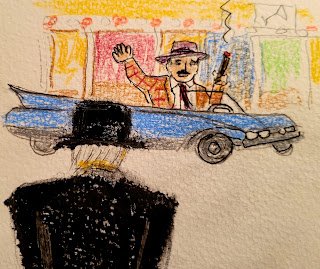
I closed my eyes again and a vivid scene immediately appeared. The centerpiece was a blue Cadillac convertible, with the fins of a previous era but in shiny new condition. At the wheel was a fellow sporting a loud plaid suit and a felt hat, and brandishing a fat cigar.

I knew him, of course. I have met him in dreams and dreamlike states over quarter of a century. I know him as Marty, pronounced in a distinctive New York way, as Morty. I suppose it could be spelled that way but I have always recorded it as Marty and he has never corrected me, so that's how it will stay.

"Put on a good suit," Marty instructed me. He was inviting me out for a night on the town. The blurred shapes behind him resolved into the facades of restaurants and bars and nightclubs, with a Cajun flavor.

Well, why not? I found my way to a wardrobe - not my regular one. When I opened it I saw that the clothes on the hangers were more than sets of jackets and pants. They were whole body suits. If I stepped into one, I would alter my physique accordingly. Nice kind of dress-up for an outing on the astral plane. I chose a body with strong broad shoulders and a trim waist, an idealized version of my younger, fitter self.. It came encased in a midnight blue double-breasted suit. Yes, this would do nicely.

What followed was simply a fun night out in a body that works better than my current one, fun for its own sake. This is one of Marty's specialities. Let me go back to the start of our relationship.


Marty first visited me when I set an intention for dreaming. The fancy name for this is dream incubation and in some traditions it is approached with great reverence, with ritual and purifications and offerings to deities and priests. I generally find it sufficient to just frame a clear intention and repeat it in my mind as I approach the night.

I really needed guidance from a wiser source that night. I was in the midst of writing the book that was published as Conscious Dreaming, the book that introduced the original blend of dreamwork and shamanic journeying that I call Active Dreaming. I had an enthusiastic publisher, but my editor had pointed out that "dream books don't sell many copies". I wanted to reach as many people as possible, not for fame and money, but to help break the dream drought that had become so pervasive in modern culture.

So I set this intention: Show me how to bring the gifts of dreaming to many more people.

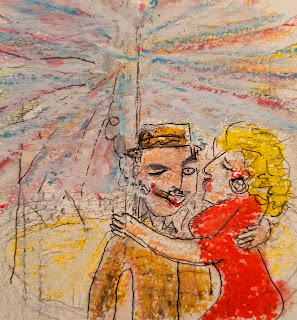
In the dream that followed, I found myself under the big top in a circus. The bleachers were packed. In the center of the ring, a man in a loud plaid suit, with a pork pie hat, a mustache and a huge cigar, was doing acrobatics. He turned cartwheels then somehow managed to bounce from the ground up to the very top of the tent. As he repeated these unlikely maneuvers, I became fully aware that I was dreaming. I remembered that I had asked for guidance.

I stared, incredulous, at the clownish acrobat performing impossible feats. I knew, in that instant, that his name was Marty, pronounced the New York way. Was he supposed to be my guide?

Marty vaulted into the bleachers, grabbed an attractive blonde, and started cuddling and smooching. As I watched this new performance, shocked. he blew out a great cloud of smoke. He gave me a wink and said, round the edge of his stogie, "It's about entertainment, kid. It's about entertainment."

I came back from the dream laughing. I recognized I had received exactly the guidance I needed. Keep people turning the pages. Give them stories they can live in for a while. Never forget that a story may be the shortest route between a human being and the truth. And that the deepest truths may "in laughing guise be dress'd".


So I'm always grateful when Marty shows up. His hat style changes, and he's not always in a suit that might be most appropriate for a racetrack tout. He sometimes appears in a top hat and a tuxedo, even full tails. Still there is always something a little louche about his appearance. Last year he turned up riding a bike around a circus ring. His attire was Edwardian-formal until you looked below the waist.

Marty confirmed my long-standing opinion that there is a Cosmic Costume Department for inner guides. They present themselves in the forms appropriate to our levels of perception and understanding, and the messages they intend to convey. 

It's about entertainment, kid.


Drawings (c) Robert Moss


Thursday, April 30, 2020

Dreaming with the departed

Many people in our society are hungry for confirmation that communication with the departed is not “weird” or “unnatural”, let alone impossible, and that it is possible to extend love and forgiveness and healing across the apparent barrier of death. We encounter our departed, especially in dreams, because they are still around (sometimes because they have unfinished business or are not actually aware they are dead); or because they come visiting; or because we travel, in dreams or visions, into astral realms where the departed are entirely at home.
    It’s not just that we dream of the dead; our departed are dreaming of us, and trying to reach us through dreams. Sometimes our departed return as counselors or “family angels”, as my father returned to me, many times, in the year after his death in Australia in 1987, with loving messages and practical guidance for the family. Sometimes our departed need us to play guides, because they are confused or stuck between the worlds, clinging to old appetites and attachments – which can be extremely unhealthy for the living, who may pick up the feelings and addictions and even the past physical symptoms of the dead.
    One of the cruelest things that mainstream Western culture has done is to suggest that communication with the departed is either impossible or unnatural.  There is nothing spooky or “supernatural” involved, though these experiences take us into realms beyond physical reality. It is especially easy to meet our departed in dreams for three reasons:                                                                                                                                 
Our Departed are Still With Us

Quite frequently dreams reveal that the departed are present because, quite simply, they never left. The departed may linger because they have unfinished business, or wish to act as guide and protector to the family, or are attached to people and places they loved in waking life, and this may be a perfectly happy situation for a year or two.
    But there comes a time when our departed need to move on, for their own growth, and so they do not become a psychic burden to the living. After death, we continue to be driven by our ruling interests, appetites and addictions. Some of those who have died but not truly “passed on” continue to try to feed their cravings via the living.  When the departed remain earthbound, the effects are unhealthy both for those who have died and those among the living to whom they are connected. 
    When the dead are enmeshed with the living, the result is mutual confusion, loss of energy, and the transfer of addictions, obsessions and even physical ailments from the departed to the person whose energy field he or she is sharing.
    Helping the departed may involve a loving dialogue, a simple ritual of honoring and farewell, and invoking spiritual helpers. As we become active dreamers, familiar with the geography of the afterlife, we may find we are called on to provide personal escort services and help to instruct some of our departed on their options on the other side. William Butler Yeats noted, with a poet’s insight, that “the living can assist the imaginations of the dead”.

Our Departed Come Calling

Most people who remember dreams can recall one in which someone on the other side made a phone call, sent a letter, or simply turned up at the door or the bedside. Our departed return to us in dreams for all the reasons they might have called on us in physical life – including the simple desire to tell us how they are doing and see how we are coping - and for larger reasons: to bring emotional healing, to bring us helpful information, to instruct us on life beyond death and the reality of worlds beyond the physical.
    Our departed may come visiting to offer or receive forgiveness. They may come to show us how they are doing on the other side.
    Our deceased friends and loved ones may appear in our dreams because they are trying to understand the fuller story of the life they have left. Yeats, with poetic clarity, called this stage in the afterlife transitions the "Dreaming Back."
    Our departed can be excellent psychic advisers when they achieve clarity on the other side and are aware that they are not confined to the rules of space and time.    Our departed may come as health advisers and family counselors.   They may visit us in dreams to help us prepare for our own deaths and reassure us that we have friends on the other side. 

In dreams, we travel to realms of the departed 

In our dreams, we are released from the laws of physical reality, and travel into other dimensions, including environments where the departed may be living. Through dreams of this kind, we can begin to develop a personal geography of the afterlife, which will be vastly enriched when we learn the art of conscious dream travel.
    In my workshops,  I often invite participants to focus on a dream or memory of a departed person and make it their intention to journey – with the help of shamanic drumming – to seek timely and helpful communication with that person and to learn about the environment where that person is now living.

Such visits and visitations have been a primary source, across the ages, for the widespread belief that consciousness survives the death of the physical body. This is too important a subject for us to rely on hand-me-down knowledge or blind faith. We want first-hand experience, and this is most readily available through dreaming. We will find that the realms of the departed may be no more distant from us than the thickness of our eyelids.


For much more on this subject please see The Dreamer's Book of the Dead by Robert Moss. Published by Destiny Books.

photo (c) Robert Moss

Wednesday, March 27, 2019

Dreaming with the departed


The number one reason men talk about dreams, in my experience, is that they have dreamed of someone who has died and the experience seemed so real that they desperately need help in understanding what is going on. I'm not talking about the brave men who come to dream classes and share their inner lives with a mixed group. I'm talking about the guy in the neighborhood pub or on the bleachers, the cop in the all-night diner, the commuter on the train.


When I was moving into a former home, I was startled by banging on the French doors of the study in which I was shelving books. I opened the doors and a huge, wild-eyed man introduced himself as a neighbor. He was a former basketball pro. "I've just come from the graveyard," he explained, breathing heavily. "My dad showed up in my bedroom last night and I had to go prove to myself that he's still in the ground." The cemetery was half a block away, not a long hike at all.


But in fact the distance between the living and the dead may be much shorter. It is exactly as wide as the edge of a maple leaf, said Handsome Lake, the Seneca Indian prophet.
Many of us yearn for contact with departed loved ones. We miss them; we ache for forgiveness or closure; we yearn for confirmation that there is life beyond physical death. This is one of the main reasons why people go to psychic readers.

Here's an open secret: we don't need a go-between to talk to the departed. We can have direct communication with our departed, in timely and helpful ways, if we are willing to pay attention to our dreams. We meet our departed loved ones in our dreams. Sometimes they come to offer us guidance or assurance of life beyond death; sometimes they need help from us because they are lost or confused, or need forgiveness and closure.

Dreams of the departed help us gain first-hand knowledge of what happens after physical death. One of the cruelest things that mainstream Western culture has done is to suggest that communication with the departed is either impossible or unnatural. There is nothing spooky or "supernatural" involved, though these experiences take us into realms beyond physical reality.

The easiest way for the departed to communicate with the living is through dreams -though sometimes the departed, as well as the living, fail to realize this. For once, Hollywood got this right. In the movie The Sixth Sense a psychically gifted young boy can see and speak with the departed. He plays counselor to a man who has died, is initially confused about his situation, and then dismayed that he cannot talk to his wife. The boy instructs the dead man, "Speak to her in her dreams, only then will she hear you".

In most dreams, the departed appear to be living, and very often the dreamer is unaware that the person he or she encounters is "dead" until after waking. The reason is that the departed are indeed alive, though no longer in the physical realm. The departed may appear as the dreamer remembers them from their last days of physical life, especially in the first dream encounters. But over time, it is quite common for the departed to alter their appearance, to shrug off signs of age and bodily ailments, and to present themselves as healthy and attractive. People who died in later years frequently reappear looking around 30 years old.


After my father's death, he appeared repeatedly in my dreams to offer counsel to the family, bringing specific and practical information to which I did not have access in waking life. For example, he gave me the name of the real estate broker on the other side of the Pacific - someone otherwise unknown to me - who moved with great speed and humanity (once we contacted him because of the dream) to help my mother sell her home and resettle in a community where she spent some of the happiest years of her life. My father also made a happy dream visit to one of my daughters, who bitterly regretted never having known him in physical life; he showed himself as a handsome horseman, about 30 years old, and took her riding. Through many dream encounters with my father, I was vividly reminded that a departed loved one can truly play "family angel".

I have been dreaming with departed people all my life, and have worked with thousands of dreams of the departed shared with me by others. While the departed person in some of these dreams may be an aspect of the dreamer's own personality or genetic inheritance - or a mask for a messenger from the deeper Self - the great majority of these dreams appear to involve transpersonal encounters.

There are three main reasons why dreams of the dead (and other forms of interaction with them) are entirely natural experiences:

1. The deceased are still with us because they have not yet moved on for reasons that may be good, bad or mixed.
2. The deceased come visiting for all the reasons we call on each other in everyday life, and then some.
3. In dreams, we travel to the Other Side and find ourselves in territories where the dead are alive.


Notice I speak of dreaming with the departed rather than dreaming of themWe are talking about interactive, transpersonal, social encounters that may be initiated by either party. They visit us and we call on them. Sometimes they turn up, in dreams or liminal space, to invite us to travel with them to see where and how they are living now. 

In The Dreamer's Book of the Dead, I discuss thirteen reasons the dead come calling. They may have messages for us, or need help from us. They may come seeking healing and forgiveness. When we engage with them with open hearts we find that healing and forgiveness are always available, across the apparent barrier of death.

Across the whole course of the human odyssey on the planet, the principal reason for the age-old conviction that consciousness survives physical death is that we receive visitations from the departed, especially in dreams, and that in dreams and journeys we find ourselves in realms where the dead are alive. What happens after death is too important for us to rely on hand-me-down belief systems. We need first-hand experience. It is available to us any night, through the portal of dreams.


- Dreaming with the Departed is a theme in my new online course for The Shift Network, "Active Dreaming: The Essential Training"; it starts on April 18.


Image: Victorian ghost comes through mirror. Provenance unknown. I could not resist the graphic. But let's notice that there is nothing spooky about most encounters with the deceased.


Sunday, November 25, 2018

Practicing Death


Dreaming is practice for immortality, perhaps the best we have available. Why? Because dreaming is traveling. We journey effortlessly beyond body and brain, into realms beyond the fields we know in ordinary life. We travel to territories in which the dead are at home. In this way we gain first-hand knowledge of the roads and conditions of the afterlife.
    In dreams, we also receive visitations from the dead. They come for all the reasons we may contact each other in ordinary life, and then some. They come for healing and forgiveness. They come for an update on family affairs. They come with warnings and information. Sometimes they need help and information from us, because they are lost of confused.
    Tremendous numbers of people who are living in the afterworld are seeking to communicate with the living. In one of my workshops, I led 40 active dreamers on a group shamanic journey, powered by drumming and focused by clear intention, to visit communications centers on the Other Side where the dead gather to try to contact the living. We found them using technologies both ancient and hyper-modern, according to earthly notions. Some were gathered in an old fashioned seance room, trying to call the living into their space, as Spiritists or mediums seek to call up the dead. In another space, the dead were trying to text and phone and make video calls to the living. I was especially intrigued by a special courier service. The dream messengers, called Zephyrs, are slim and elegant, almost diaphanous, in uniforms that recalled winged Mercury, but capable of putting on any costume that might help them to get into the minds and memories of the people to whom they are tasked with bringing dream messages.
    We may become open to contact with the dead in many ways: through the sense of a presence, through physical anomalies, through goosebumps, with the help of a go-between like a reputable psychic or shamanic practitioner. But the easiest way to communicate with the dead is in our dreams.
     We may be catapulted into afterlife situations by a near-death experience, or brave the gates of death in a shamanic journey or a ritual of deep initiation (which always requires death and rebirth). Yet, again, the easiest way to become familiar with the Other Side and develop a personal geography of the afterlife is through dreams and then by developing the practices of Active Dreaming.
    One of our core techniques is dream reentry.  This means using a personal dream or image as the portal for a shamanic journey or exercise in lucid dreaming. You dreamed that Granma came to visit but you are not sure why. You can go back into the space where you met her and initiate conversation. You found yourself with a deceased friend in a new home. You can go back to that place, take a full house tour and learn important things about conditions in the afterlife.
     Here is something vitally important you will learn as you consciously engage with the deceased through dreaming: healing and forgiveness are always available, across the apparent barrier of death.
    An old Lakota saying has it that "the path of the soul after death is the same as the path of the soul in dreams." This is exact. In quoting this, I have often added the thought "except that after death, you don't come back." But that is not entirely correct. Some who have died do return to the body. I did this as a child, as I describe in The Boy Who Died and Came Back, and so have millions of experiencers of what is now called the NDE. And the dead who have left their physical bodies behind for good return to us in subtle bodies.
    We need to know at least a little about what happens when we die, and before we are born, in order to live well. Death is an incredible teacher. Looking at our life choices in the clear knowledge that our story did not begin in this body and doesn't end with it can help us to develop a courage and clarity in approaching life choices that may otherwise be lacking. It can even enable us to look at the ups and downs of life as part of a divine comedy.
    These things are too important for us to leave to hand-me-down religious dogmas, or avoid through denial. Maps from recent travelers to the Other Side are good. If you are contemplating a trip abroad, it's good to hear the opinions of others who have stayed in that hotel, or taken that cruise. But the afterlife is infinitely malleable, ever-changing, even within the battlements of the collective belief systems, so we'll want to find out how things are for ourselves. The most reliable ways to do that are through contact with the dead, and through personal travel in the realms where the dead are at home. Both are most easily and safely accomplished through dreaming.
    You may say, why be in a hurry? We'll find out about the afterlife when we are dead, yes?
     Well, certainly. But I stand with Montaigne on these matters. Puisque nous ne savons pas ou la mort nous attend, attendons-la partout. "Since we do not know where Death is waiting for us, we must be ready to meet Death everywhere."


Photo by RM. Mist is the preferred Celtic portal to the Otherworld.

Sunday, September 10, 2017

Talk to the dead: they are alive and available


Many of us yearn for contact with departed loved ones. We miss them; we ache for forgiveness or closure; we yearn for confirmation that there is life beyond physical death. This is one of the main reasons why people go to psychic readers.
      Here’s an open secret: we don’t need a go-between to talk to the deceased. We can have direct communication with our departed, in timely and helpful ways, especially if we are willing to pay attention to our dreams and learn the arts of active and conscious dreaming.
Sometimes we sense the presence of a deceased person we have loved. Sometimes this is accompanied by physical signs, little anomalies that suggest that something is moving through the veil of our routine perception and our consensual reality. Full-fledged visitations often take place in the spacious reality of dreams and liminal states of consciousness, quite often in the hypnagogic zone.
     In whatever ways they can find to get through to us, our departed come to visit for all sorts of reasons. They come to offer us guidance or assurance of life beyond death; sometimes they need help from us because they are lost or confused, or need forgiveness and closure. Encounters with the deceased are generally our best way of gaining  first-hand knowledge of what happens after physical death.
     One of the cruelest things that mainstream Western culture has done is to suggest that communication with the departed is either impossible or unnatural.  There is nothing spooky or “supernatural” involved, though these experiences take us into realms beyond physical reality.
     The easiest way for the departed to communicate with the living is through dreams -though sometimes the departed, as well as the living, fail to realize this. In the movie The Sixth Sense a psychically gifted young boy can see and speak with the departed. He plays counselor to a man who has died, is initially confused about his situation, and then dismayed that he cannot talk to his wife. The boy instructs the dead man, "Speak to her in her dreams, only then will she hear you". As the film suggests, sometimes the living are required to play guides for the deceased.
     In most dreams, the departed appear to be living, and very often the dreamer is unaware that the person he or she encounters is “dead” until after waking. The reason is that the departed are indeed alive, though no longer in the physical realm.
     The deceased may appear as the dreamer remembers them from their last days of physical life, especially in the first dream encounters. But over time, it is quite common for the departed to alter their appearance, to shrug off signs of age and bodily ailments, and to present themselves as healthy and attractive. People who died in later years frequently reappear looking around 30 years old.
      After my father’s death in 1987, he appeared repeatedly in my dreams to offer counsel to the family, bringing specific and practical information to which I did not have access in waking life. For example, he gave me the name of the realtor on the other side of the Pacific – someone otherwise unknown to me – who moved with great speed and humanity (once we contacted him because of the dream) to help my mother sell her home and resettle in a community where she spent some of the happiest years of her life. My father also made a happy dream visit to one of my daughters, who bitterly regretted never having known him in physical life; he showed himself as a handsome horseman, about 30 years old, and took her riding.
      Through many dream encounters with my father, I was vividly reminded that a departed loved one can truly play “family angel”. After he made certain life choices on the Other Side - which he explained to me - he was no longer available in the way he had been for several years after his death. However, he surprised me by dropping in last year to give me an important personal health advisory on which I took immediate action.
     After his death, my favorite professor from my undergraduate days in Australia began to appear in my dreams as a different kind of history teacher, instructing me that each of us belongs to a family of personalities in different times and dimensions whose dramas are being played out now.
     From my early childhood, when I gained first-hand knowledge of the other side when I died and came back (in what are now described as near-death experiences) I have had had frequent contact with people who are living on the other side.I have worked with thousands of dreams and other experiences of encounters with the departed that have been shared with me by others. While the deceased person in some of these dreams may be an aspect of the dreamer’s own personality or genetic inheritance – or a mask for a messenger from the deeper Self – the great majority of these dreams involve transpersonal encounters.
     When you become an active dreamer, able to shift consciousness and travel to other realities at will, you'll know that you don't have to go to sleep in order to dream. You can make conscious journeys to the Other Side for timely and helpful communication with the departed, learning about their current environments and transitions. You can invite a loved one to have chat with you over tea or a glass of wine. You can entertain friendly spirits in the liminal space of sleep and awake, and will want to learn the arts of discernment and psychic screening to make sure that you don't invite any unwanted guests.
     Let's notice that among your friends on the Other Side are beloved animals who shared your life and can prove to be impeccable allies. 

Further Reading

Chapter 7, "Dreaming with the Departed", in my book Conscious Dreaming.

Part III, "A Little Manual for the Psychopomp" in Dreamgates: Exploring the Worlds of Soul, Imagination and Life Beyond Death


Photo: A boy psychic guides a dead man played by Bruce Willis in the movie "The Sixth Sense".

Wednesday, August 5, 2015

A dream prompt from a deceased scholar of the Iroquois


First of a series occasional notes on my rambles as a dream archaeologist. 

The Tuscarora ethnographer John Napoleon Brinton Hewitt was a fascinating figure who epitomized the Iroquois ability to live in two worlds. Hewitt sat patiently with the old Speakers on the reservations, married a Washington socialite, attended a Unitarian church, and, without a relevant diploma, awed droves of newly minted anthropology Ph.D.s at the Smithsonian with his inexhaustible scholarship and command of languages.
      He appeared to me in a dream when I was writing my book Dreamways of the Iroquois. He presented himself in an Edwardian wing collar and frock coat, to urge me to read his essay on Tawiskaron, the Dark Twin in Iroquois cosmology). This proved to be an invaluable source, previously unknown to me, when I was eventually able to locate in volume 2 of the long out-of-print 1910 edition of the Smithsonian Handbook of American Indians North of Mexico.


Wednesday, May 2, 2012

Thanks to the dream Brownies

Osamu Tezuka, "New Treasure Island" (1947)
Robert Louis Stevenson thanked his "Brownies" for some of his best creative work. He described them as laboring away on his stories when he was asleep or in half-dream states, so that better than half his work was done when he came to put pen to paper.
    I woke with a similar delightful sense of creative assistance around 4 am today, a time when I often rise to record and research my dreams and see what wants to stream into a story, an article or a poem. My dream reports from last night include this pair, with the recurring motif of creative help:


1. I examine a typescript I've been working on. I have left gaps in the narrative. Someone has filled in these gaps and inserted some further material. I can see at a glance where the new material is, because it looks like it has been highlighted in yellow, though the highlighting effect fades as I read it. I am at first annoyed that someone unknown has been fooling around with my text, and assume that the inserts are random. But when I study the new passages more closely, I see that they are just right. The penultimate paragraph is beautifully expressed. I try to figure out who has been working on my text. In the distance, I see a beautiful woman in a yellow robe. 


2. With a woman companion, I have been encouraging an older man to take up art. We have expressed enthusiasm over some colored drawings he has done, and are looking at a folder of these. Most are incomplete, and they are not especially well executed when we look at them more carefully. There is a spill; I think it is my companion who spills water or tea over some of the drawings. This makes the colors run and the effect is quite magical. I am excited that an accident has brought the drawings to life.

I stirred from these dreams in a state of excitement and delight. 

Reality check: I am currently writing a story and have left gaps in the text. I draw a good deal, often with colors, but my technical execution could do with improvement. 

Action plan: I'll fill in the gaps in my narrative, and let the colors run - by using oil crayons and perhaps watercolors - in some of my new artwork.

And I reopened RLS' "A Chapter on Dreams", included in his book Across the Plains, where he describes in detail the role of his dream Brownies, including this celebration:

And for the Little People, what shall I say they are but just my Brownies, God bless them! who do one-half my work for me while I am fast asleep, and in all human likelihood, do the rest for me as well, when I am wide awake and fondly suppose I do it for myself. That part which is done while I am sleeping is the Brownies' part beyond contention; but that which is done when I am up and about is by no means necessarily mine, since all goes to show the Brownies have a hand in it even then.