Showing posts with label archetypes. Show all posts

Sunday, October 1, 2023

Gods in disguise


We won't understand the archetypes if we reduce them to vague generalities, or fixed notions. They are patterns of psychic force that are constantly in motion and forever shapeshifting, something like the major arcana of tarot. Jung himself - as opposed to some Jungians - insisted on that last characteristic. "It [the archetype] persists throughout the ages and requires interpreting anew. The archetypes are imperishable elements of the unconscious, but they change their shape continually" [1]

Jung’s intellectual colleague, the physicist Wolfgang Pauli, suggested in his monograph on Kepler that archetypes are “instincts of imagination”.

He [Kepler] speaks in fact of ideas that are preexistent in the mind of God and were implanted in the soul, the image of God, at the time of creation. These primary images, which the soul can perceive with the aid of an innate ‘instinct’, are called by Kepler archetypal. Their agreement with the ‘primordial images’ or archetypes introduced into modern psychology by C.G. Jung and functioning as ‘instincts of imagination’ is very extensive.”[2].

Jung saw the play of the archetypes in synchronistic events. Aniela Jaffé observed that “one of the main points of Jung’s investigations on parapsychology is that synchronistic events are manifestations of an archetype. In other words, the archetype is their “organizer”.” [3]  

Jung cautioned that the archetypes, unrecognized and uncontained, have a raw, primal energy that can flood the narrow riverbed of ordinary consciousness.

The primordial image, or archetype, is a figure be it a daemon, a human being, or a process - that constantly recurs in the course of history and appears wherever creative fantasy is freely expressed. Essentially, therefore, it is a mythological figure. When we examine these images more closely, we find that they give form to countless typical experiences of our ancestors. They are, so to speak the psychic residua of innumerable experiences of the same type… It is like a deeply graven river-bed in the psyche, in which the waters of life, instead of flowing along as before in a broad but shallow stream, suddenly swell into a mighty river. This happens whenever that particular set of circumstances is encountered which over long periods of time has helped to lay down the primordial image.  [4] 

Robert A. Johnson, in Inner Work, counseled that “Each of us has all the great archetypal themes hidden inside. We all have the seeds of the heroic quest within us; we must live it out sometime, on some level. Each of us has the journey and labors of Psyche, the encounter with Eros and Aphrodite, built somewhere into our inner structure. One can’t avoid these leitmotivs; one must express and experience them.” [5]

The archetypes are neverending stories that, like all great stories, have countless variants. They may also be gods in disguise, cloaked in language that makes them half-decent to the modern mind. Jung lifted the hem of his own robe when he wrote in Archetypes of the Collective Unconscious that “Only an unparalleled impoverishment of symbolism could enable us to rediscover the gods as psychic factors, that is, as archetypes of the unconscious.” [6]


References

C. G. Jung, The Archetypes and the Collective Unconscious, Collected Works volume 9, part 1 trans R.F,C, Hull, Princeton: Princeton University Press, 1980) CW 9i, para 301).

2. C.A. Meier (ed) Atom and Archetype: The Pauli-Jung Letters 1932-1958 trans. David Roscoe, (Princeton: Princeton University Press, 208) 204

3. Aniela Jaffé, Apparitions and Precognition (New Hyde Park, NY: University Books, 1963) 192

4. C.G.Jung, "On the Relation of Analytical Psychology to Poetry" (1922) in The Spirit in Man, Art and Literature (Princeton: Princeton University Press, 1978)

5. Robert A. Johnson, Inner Work Using Dreams and Active Imagination for Personal Growth (New York: Harper & Row, 1989) 153

6. CW9.1 para 50


Art: "Eyebrows of Zeus" by Robert Moss


Tuesday, December 27, 2022

Robertson Davies' novel approach to Jung


Questions opened with a Weasel Scot who said: “D’ye really know anything about this Yoong, or did ye juist mug up eneuch o’ his stuff to write that noavel?” I replied winsomely that I had been reading Jung for 30 years , and that The Manticore had been kindly received in Zurich, where they were in a position to judge
.[1]  

“Do you dream much?” asks Dr. Johanna von Haller, a Jungian analyst, in their first session in Zurich. David Staunton, a wealthy Toronto barrister - and functioning alcoholic - has not been much of a dreamer, but he has one from the previous night. In this dream, he left secure and cozy surroundings to travel down back roads where he met a wild Gypsy woman in colorful rags whose whose speech is strange to him. He hurries away and is soon back on familiar ground, speaking from his brief as a barrister in court. Dr von Haller suggests this was an “anticipatory dream” – that the Gypsy was a preview of her, another foreigner whose language is strange to him and from whom he is inclined to flee. “Dreams do not foretell the future,” she observes. “They reveal states of mind in which the future is implicit.” [2] 

 With this exchange, we are in the midst of the liveliest account of the process of a Jungian analysis that I know. It's in The Manticore, the central novel in the Deptford Trilogy by the wordmaster Robertson Davies, one of my favorite novelists. Davies never underwent analysis - which he described in a letter as "barnacle-scraping" [3] - or any formal training in psychology. On the other hand, he had read Jung for thirty years, kept a portrait of Jung on the wall of his study and was a founder of the Analytical Psychology Society of Ontario. He was a depth psychologist in the classical sense of the word, a student of soul. Like his protagonist, he became increasingly attuned to his dreams and his inner life. 


It was a vision from reverie that gave him the image of the manticore and thereby gave the book its title - after he transplanted it into the mind and circumstances of a fictional character. Davies had completed part one of The Manticore when, dozing on his screened porch after lunch, he saw before him a gallery with an ancient picture, showing a beautiful woman in a classical robe, leading a strange beast on a golden chain. "It had the body and head of a lion, the clawed feet of a dragon, a tail which was barbed as the tails of scorpions are barbed in ancient art, and it had the anguished face of a man." Davies consulted an encyclopedia of mythology and identified the beast in his vision as a manticore. [4] 

In the version of the dream that Davies' character tells his analyst, the manticore has his own face and the woman commanding it is Dr Johanna von Haller. When she tells him the name of the beast, he asks, "How can I dream about something I've never heard of?" She responds: "People very often dream of things they don't know...It is because great myths are not invented stories but objectivizations of images and situations that lie very deep in the human spirit." [5] 

 Here we are deep into the Jungian understanding of the archetypes of the collective unconscious, but we have come here effortlessly and fluently, thanks to Robertson Davies' word magic and marvelous ear for dialogue. It must be granted that it is highly unlikely that many therapy sessions - and any patient autobiographies - will manifest the eloquence, wit and lightly-worn erudition of these pages. 

Here is how Dr. von Haller introduces the concept of archetypes: “You might call them the Comedy Company of the Psyche, but that would be flippant and not to do justice to the cruel blows you have had from some of them. In my profession we call them archetypes, which means that they represent and body forth patterns towards which human behavior seems to be disposed, patterns which repeat themselves endlessly, but never precisely in the same way.” [6] Later the analyst declares, "Our great task is to see people as people and not clouded by archetypes we carry about with us, looking for a peg to hang them on...You will recover all these projections which you have visited on other people like a magic lantern projecting a slide on a screen" [7] 

Davies wrote of this novel: "There have been other books which describe Freudian analyses, but I know of no other that describes a Jungian analysis." He added, "I was deeply afraid that I would put my foot in it, for I have never undergone one of those barnacle-scraping experiences, and knew of it only through reading. So I was greatly pleased when some of my Jungian friends in Zurich liked it very much." [8]  

The Zurich crowd were not unanimous, however. When Marie-Louise von Franz, one of the most brilliant of the women around Jung, arrived in Toronto, she was quite frosty to Robertson Davies because she was extremely annoyed by the suggestion that she was the model for Johanna von Haller. Davies had never previously met her, though he had read much of her work and admired her greatly as a classical scholar and interpreter of myth and fairytales, as well an excellent explicator of the Jungian psychology of projection and re-collection. [9] 

After meeting Swiss frost with Canadian froideur on their first evening, Davies charmed von Franz as he played genial host - as Master of Massey College at the University of Toronto - over the days that followed, and von Franz charmed Davies in turn, with her spin on a dream he recounted to her. In the dream, Davies (whose first career was on the London stage) found himself as an actor in a play. His cue has been given, the audience is waiting, but he does not know his lines and doesn't even know what play he is in. Davies told von Franz that he thought the dream expressed his deep sense of inadequacy. She told him robustly: "I would have said it is an indication to you that you don't go on stage to say what other people have written, but to say what you have to say yourself." [10]

References

[1]Robertson Davies to Arnold and Letitia Edinborough February 19, 1980 in For Your Eye Alone: The Letters of Robertson Davies edited by Judith Skelton Grant (New York: Viking, 2001)49. [
2] Robertson Davies, The Deptford Trilogy (New York: Penguin, 1990)276. The Manticore was first published in 1972. [3]Robertson Davies to Leon Edel, Thanksgiving (Canadian Style) 1981 in For Your Eye Alone 72.
[4] Judith Skelton Grant, Robertson Davies: Man of Myth (New York: Viking, 1994) 498.
 [5] Deptford Trilogy 404-405. 
[6] Deptford Trilogy 449. 
[7] Deptford Trilogy 450-451. [8] Davies to Leon Edel; For Your Eye Alone 72. 
[9] Von Franz's master work on this theme, Spiegelungen der Seele, had not yet been published, however. The German edition appeared in 1978; Projection and Re-collection in Jungian Psyxhology, translated by William H. Kennedy, followed in 1980 (LaSalle and London: Open Court, 1980). 
[10] Grant, Robertson Davies: Man of Myth 498.

Thursday, January 24, 2019

Know the myth you are living

As some people use the word, myth is synonymous with fake news, or superstition, or outmoded hand-me down beliefs. A myth may be a prevailing worldview – that the earth is flat or the still center of the turning universe, that humanity begins with Adam and Eve, that the world is enthralled by a dark Demiurge. For the Greeks, mythos was the spirit of the play, familiar to the audience yet as unpredictable as the gods in how it would unfold in a fresh drama.
      A myth may be a sacred teaching story that explains how the world came into being – and what is beyond it – and why bad things, as well as good, things happen, and what it means to be human. A myth may justify the ways of gods to humans, or those of humans before their Creator. A myth may introduce you, like the major arcana of tarot, to essential members of your archetypal family: to personified forces at play in your life and your universe.
      A myth may invite you to consider who among the gods defends you, and who has it in for you. A myth may also be a living reality beyond the realm of facts, a source of truth that cannot be confirmed in a laboratory experiment but may be evidenced by the data of raw experience.
      Your dreams can be a nightly screening of gods and archetypes. A dream may be your place of encounter with a Big story that is looking for you. It may call you to a tradition about which you previously knew nothing ."In the absence of an effective general mythology, each of us has his primary, unrecognized, rudimentary, yet secretly potent pantheon of dream," as Joseph Campbell wrote in The Hero with a Thousand Faces. Psychologist Betsy Meador was called to study Inanna and her priestess after a dream that involved the prayer flags of the great Sumerian goddess, Queen of Heaven and Earth, that were previously unknown to her.
       I was seized by Kali in a terrifying night vision – beginning with sleep paralysis – when I was fourteen. I wrote a cycle of poems in her honor. Later her brother-consort Kala, better known as Yama, became one of my principal mentors, reminding me to consider every life choice in the presence of Death. A little-known Celtic deity came into my ken in a series of dreams in which I was defending my property with a long-handled hammer, like a weaponized croquet mallet. Some shelf elf produced a Gallo-Roman statue of a god with a similar hammer, named in the inscription as Sucellos, which means the Good Striker. He seems to share some qualities with Thor. He is also the consort of a great goddess of abundance, called Rosmerta by the Gauls and Abundantia by the Romans.
       We confirm our relationship with a patron deity, or power animal, when it comes to our aid. Athena came to me like this in Anatolia. The Bear has come to me like this many times since it claimed me when I found the courage to step back into the space of a dream where it had terrified me.
       Myths are a cauldron of stories and symbols that hold superabundant energy for life. You want to become conscious of the myth you are living. If you are unconscious about this, then the myth is living you and you may be driven into confusion and disaster, like Odysseus when his men lose control of the winds. In different phases of life, we may inhabit – and be inhabited by – different myths. We may find ourselves in the play of rival stories. We may be able to match and mix.
        The great scholar of religions Wendy Doniger writes about the “seed text”, bija mantra. In her book Splitting the Difference: Gender and Myth in Ancient Greece and India, she describes how she found this in the story of an Indian goddess, Saranyu, who cloned herself in order to get away from a husband she detested, leaving a compliant Hindu version of a Stepford Wife at home while she ranged free as a wild mare. This story kept after Doniger for decades, prompting her to reach deeper and deeper into its well. Whenever she heard it, she would say, “That’s the story of my life.” 

      “Myth, by design, makes it clear that we are meant to be something more than our personal history,” declared P.L.Travers, the author of Mary Poppins.
       The myths we are living now swing on hinges into other lives, whose myths swing back at us. Because our present life dramas are connected with those of other personalities, in other places and times, within our multidimensional family, it is not surprising that “old” gods and “dead” religions feature in our spontaneous mythology, as mediated by dreams and visions and by moments on the roads of this world when we experience a hidden hand, pushing us forward or holding us back, or rearranging the stage set.

Art: Frantisek Kupka, "The Path of Silence"

Friday, August 18, 2017

Wotan Time: Being Seized by a Dark Archetype

In November 1932, Jung declared in a speech in Vienna that "the gigantic catastrophes that threaten us today are…psychic events. To a quite terrifying degree we are threatened by wars and revolutions which are nothing other than psychic epidemics.”
     Four years later, as the full horror of Nazism unfolded, Jung gave a name to the psychic epidemic that had seized Germany. He suggested that Hitler, in himself a hollow man, had been seized by a dark force and that through him the collective mind of the German people had been possessed. He expressed these thoughts in a 1936 essay titled “Wotan”.
     Jung brought out of Teutonic mythology a dark archetype, the wild and furious figure of a war god ever hungry for blood, who drives men to crazy and violent excess. “Because the behavior of a race takes on its specific character from its underlying images, we can speak of an archetype 'Wotan’... Wotan is an Ergreiffer [possessor] of men, and, unless one wishes to deify Hitler – which has indeed actually happened – he is really the only explanation."
     Jung observed, “We are always convinced that the modern world is a reasonable world, basing our opinion on economic, political, and psychological factors... In fact, I venture the heretical suggestion that the unfathomable depths of Wotan’s character explain more of National Socialism than all three reasonable factors put together.”
    In a letter to Miguel Serrano, he added, “When the belief in the god Wotan vanished and nobody thought of him anymore, the phenomenon originally called Wotan remained; nothing changed but its name, as National Socialism has demonstrated on a grand scale. A collective movement consists of millions of individuals, each of whom shows the symptoms of Wotanism and proves thereby that Wotan in reality never died, but has retained his original vitality and autonomy. Our consciousness only imagines that it has lost its gods; in reality they are still there and it only needs a certain general condition in order to bring them back in full force.”
   I wish we could say that none of this is relevant to our current conditions.

Note: We want to separate Odin, the shaman-god of the Eddas, from the bloodthirsty entity Jung was talking about. Just as we would wish to separate the swastika - a symbol of transformation in the Baltic, in India, and among the Pueblo - from the crooked cross of Naziism (though alas, thanks to the Nazis, it is now probably impossible to reclaim that symbol in the West).

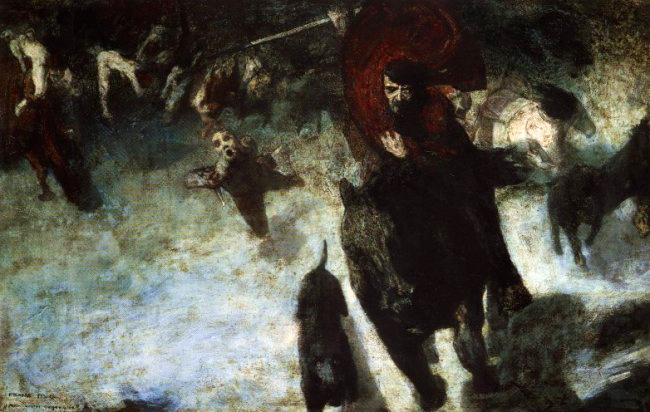
Illustration: This is also troubling. In the year Hitler was born, 1889, Franz von Stuck made a painting of the Die Wilde Jagd, the Wild Hunt, showing Wotan leading a crazed band of hungry ghosts. At 13, Hitler saw the painting and was fascinated. Von Stuck became his favorite artist. Some people see a strong resemblance to Hitler in the face of the leader of the mad and deadly hunt in the picture.

Sunday, February 7, 2016

The shimmer effect of gods among us


I observe powers of the deeper world moving among humans. Some of these powers are called gods in certain cultures. A Jungian might call them archetypes. Most humans are utterly unaware of their presence.
   When they are in the field - noticed or invisible, invoked or uninvoked - their simple presence effects a radical change in the ordinary world. It creates a "shimmer effect". The fabric of physical reality in their vicinity becomes fluid and unstable. It produces changes that may be experiences by humans as coincidences or anomalies.
    I realize the importance of being alert for the presence of these powers. If we can learn to make the right move during the period of "shimmer", we can help manifest extraordinary things.

I note in my journal: I woke from this dream in my second sleep thrilled with excitement

Reality check: I think this may be an entirely accurate glimpse of how things work when beings from multidimensional reality move close to the human sphere.

Thursday, January 7, 2016

Inanna at the breakfast table

The plot thickens, the veil of mystery flutters and closes and opens. The night before I posted my blog piece titled "A Dream Doorway to Inanna", a male friend dreamed that he saw me having to deal with a skeptic in a group. Dream Robert revealed he was wearing a jeweled necklace with something resembling a "letter opener", studded with lapis lazuli, hanging down from it. Using this power tool, Dream Robert invoked a goddess. She appeared, raging at the ignorance and stupidity of humans. Her rage brought skyscrapers tumbling down. When my friend sent his report, I remarked, "That sounds like Inanna in her take-no-prisoners mode." He did not know about Inanna, which makes it all the more interesting that - as I study the original sources again - it seems that the placement of the jewels in Dream Robert's outfit strongly resembles the placement of jewels on Inanna's outfit as she dresses to visit her dark sister. I'm now guessing that the "letter opener" studded with lapis lazuli may be Inanna's lapis measuring stick, which is in her hand as she begins her descent to the Underworld, or one her other rods and wands of power. Lapis lazuli has great significance in the Inanna story; it was believed to supports powers of seership and to light the way to the afterlife.  
We dream of Inanna, and maybe she dreams of us, whether we call her goddess or archetype. Once, when I was leading a retreat in the foothills of the Cascades, Inanna took possession of the breakfast table where our group was gathered for coffee, waffles and dreams.    "How is your dream recall?" I asked the first person to join me at the table.    She proceeded to recount a dream in which she is traveling through a dusty landscape to the home of a tarot reader. Instead of spreading the cards, the tarot reader shows her two fish tanks, each containing elaborate dioramas. At the center of each is a statuette of a goddess. The dreamer recognizes the goddess forms: Isis and Inanna. The tarot reader tells her she must choose one. She chooses Inanna. Immediately a great tornado whips up,swirling everything around her. She wakes excited and curious to know mor eabout the power and the attributes of the goddess she chose.     We started talking about Inanna and the great cycle of poems composed in her name in ancient Sumer. I spoke of the terrifying praise-poems in which Inanna goes forth into battle, with a flashing carnelian at her throat and the mace of a warrior raised in her hand, with the force of a tornado. I mentioned that in my carry-on bag for this trip there just happened to be a copy of the beautiful versions of the Inanna poems composed by Diane Wolkstein and Samuel Noah Kramer.     We were joined by a psychologist who had made a close study of the myths of Inanna and spoke about the story of the Descent of the Goddess as the model for a woman's journey to the depths to meet and integrate her Shadow side. She reminded us that one of the mysteries in this mythic cycle is that we are not given a clear reason why Inanna chose to make her descent to the darkest level of the Underworld, the realm of her dark sister, Ereshkigal, tobe hung in a meathook. We do know that she did this of her own volition. It was a choice she made freely.     We had now been joined by many other dreamers, all eager to take part in the weave of mythic associations that was taking place over the waffles and coffee. One woman shared that she was in the midst of a ritual journey through the Descent of Inanna organized by a women's group and unfolding over many days. She had made the descent, through visualization and ritual, through the seven gates of Inanna's descent, at each of which she was required to give up an aspect of her power and protection. As she made this mythic journey, she realized that it evoked many of her personal life dramas and passages - for example, losing a job and leaving a home - which now assumed even deeper resonance.    I confessed that Inanna, in full warrior mode, makes me, as a mere man, a little nervous. At that moment, a woman named Moon took the place at the table that someone had just left free. I smiled. Inanna is the daughter of Nanna, the Sumerian Moon god, and I am a very lunar man. We were at a mythic edge - with all the juice that brings - that was also a family situation.
We see again how dreams are only personal myths; they are swing doors between our world and the world of gods, archetypes and others. I am thinking again about my friend's dream of me invoking a goddess with a power tool that looked like a letter opener. In front of me now, as I write, is the letter opener I use every day. It has the form of the caduceus, twin serpents wrapped around a staff and here surmounted by wings. The earliest form of the caduceus was in Mesopotamia. It seems to have been one of the many forms of the staff or wand of power of Inanna. It turns up all over the world map later on, including as the want of Hermes and Mercury and Hermanubis. But it seems to begin with Inanna. Perhaps, without knowing it, I have been reaching to her every time I open mail.
That turns my mind to a famous statement from Jewish tradition, that a dream that is not interpreted is like a letter that is left unopened. We do better than interpret dreams, in our Active Dreaming practice. We engage with the dream world, we enter it at will, and we bring gifts from it into waking life. We are ready to act in the understanding that our dreams may be a nightly field of interaction with greater powers, and that those powers - even of often camouflaged - are at play in our ordinary world. I look at the letter opener again. Inanna's people in ancients times did not have paper or parchment or papyrus. They recorded dreams on clay tablets that were then baked, making them strong and durable enough for us to read of Inanna's Descent to the Underworld and the Dream of Dumuzi more than 5,000 years later. They had an interesting expression in Sumerian for dreams that defy understanding. Such dreams are inside "a closed archive basket of the gods" - that is to say, a basket of dream reports written in cuneiform with a read stylus on those tablets of baked clay." Sometimes the gods open the archive basket and give us a myth to live by, even in our modern lives.

Monday, December 8, 2014

Getting a second opinion from Jung on the Battle of the Giants


There is a commotion outside. I go to the window and see an army is encamped along the edge of a body of water where a battle is taking place between a giant turtle (the size of a dozen men) and a giant crocodile. I call to the others to come and see. When I turn back, I see that the army has saved the turtle, which is being transported to safer waters. They have constructed or opened a kind of raceway and the turtle is swimming between walls. Now I see that there are actually two giant turtles.
    I look out to the water again. Beyond military lines, the crocodile stands on a headland, tail raised like a scorpion, apparently triumphant for now. I understand that the conflict will be resumed. It's part of life. The role of the army is to ensure that neither party destroys the other.

I woke from this first dream of the night feeling both excited and satisfied. In the dream, I was an observer. I felt that I was being shown something of huge importance in life.
    I know both Turtle and Crocodile as members of my personal mythic bestiary. I have swum with sea turtles and I am from a country famous for crocodiles. I know that in life there are contests between opposing forces and attitudes that must continue if life itself is to go on.
    Instead of spending much time in self-analysis of the dream, I made a quick drawing and decided to ask Jung for a second opinion. Who better? I had already had it in mind to do my daily bibliomancy with Jung’s Memories, Dreams, Reflections, a book of seminal importance in my life and the most personal and accessible of his works. However, when I reached into the Jung section in a glass-fronted bookcase in my personal library, the shelf elves had other ideas. Another volume in Jung’s Collected Works came flying off the shelf, striking me lightly on the chest.
     Naturally, I changed my ideas about where to look for guidance and took this flying book to my desk. Its title is Two Essays on Analytical Psychology which seemed to match the revelation of the two turtles in my dream rather nicely. The volume is a dual edition of two of his early essays, Volume VII in the Collected Works. I opened the book at random and read this:

"There is no energy unless there is a tension of opposites; hence it is necessary to discover the opposite to the attitude of the conscious mind...Repressed content must be made conscious so as to produce a tension of opposites, without which no forward movement is possible…Just as high always longs for low and hot for cold, so all consciousness, perhaps without being aware of it, seeks its unconscious opposite, lacking which it is doomed to stagnation, congestion and ossification. Life is born only of the spark of opposites." 

I saw that there was no need to invent a snapper to carry the essence of my dream. Jung had given me one. Life is born only of the spark of opposites.

    This little incident from this dreamer’s life is a practical example of how we can turn to a book to give us a second opinion on a dream. Our curiosity may of course take us far beyond the initial passage we find when we open a book at random. I found myself drawn, irresistibly, to-read both the essays in that volume of Jung, in which we find his mind devising and developing theories of aspect psychology, the shadow and the relations between the ego-self and the collective unconscious which were to become fundamental to his approach.

Drawing by RM

Saturday, June 19, 2010

The Tarot Fool Comes to Connecticut


Sometimes we can't miss the play of the Greater Trumps that Jung called archetypes but for many centuries before him have been depicted on 22 cards in a deck of 78, and have a way of spilling out of the deck and into the world.

I sit in the library room in the dark for ten minutes to center myself and get clarity. I find myself looking at the scene outside the house from behind closed eyelids. It is all quite simple and realistic: the drive, the parked cars, the barns, the snow on the slope leading up to the road, under the night sky. Then I see a male figure coming long the drive. He looks rather like a tramp. This would not be surprising; all sorts of people wander through the wilderness preserve around this restored colonial manse and may camp out there in all seasons.

But when I look at the walker more closely, I see that he is dressed in soft deerskins. On his feet are long, soft-soled moccasin boots. His hat is shaped a little like a fawn-colored “Robin Hood” hat. He has a tobacco pouch, and a larger leather bag slung from a pole over his shoulder. I realize I am looking at the Tarot Fool, turned woodsman. The more closely I examine him, the larger and less foolish he seems. I know there is treasure in his bag. It seems to contain gold figures, perhaps the living patterns of the world.

I notice that a huge moving truck has come up the drive behind the Fool. The first thing they unload is a complicated machine protected by a glass hood with a gold lion couchant on top. The machine is gleaming silver, antique but impeccably clean and in perfect working order. I recognize it. I have seen a similar machine on a table in the House on the Canal in a big dream of long before. That machine was signed by “Israel Regardie”, who made public some of the papers of the Hermetic Order of the Golden Dawn. I understand that, now as before, I am looking at something constructed by the magicians of this great esoteric order.

I test its workings. For divination, what is required is to feed in a “ticket” at one end of the machine. The question is then processed by being shot and bounced back and forth through many Rube Goldberg-like procedures. When the “ticket” is at last spat out through a slot at the other end, one side contains a closely printed message that includes Hebrew letters, astrological signs, tags from ancient languages, and Masonic codes. However, the real answer is not to be found in the printed message. The true answer is to be sought on the “blank” reverse side. When the card is turned over, the “blank” side becomes a mirror that shows the images projected onto it by godlike beings who have now been drawn in close, possibly because they are entertained by the game with the machine. The archetypes behind the Tarot trumps are now moving in the field.

A beautifully carved box of pale wood, with silk lining, is brought from the truck. Inside is a cream-colored quilt or rug with “ribs” of old gold. The designs are distinctly Persian. Here a cycle of moving energies recalling the Tarot – but with many different images – is depicted in a sequence of rectangular panels.

I look inside the truck. There are stage sets inside. I recognize some of the Trumps moving back and forth. I had a brief interview with a Green Empress who reminds me that the Cave of Earth, a destination for shamanic journeying to which I am planning to lead people this weekend, is her domain.

I see a medieval Death, who looks like a rotting corpse under his black hooded robe. Mastering my fear and disgust,I embrace him. As soon as I do this, he turns into a young and radiant being. This looks good – until I realize that in this moment, I have become the rotting corpse. Fear returns, but I will myself to take my distance and look again. Now I have become young and radiant. My Death now looks on me with kindly and shining eyes. Perhaps they are my own. I remember how Octavio Paz sang that when he encountered Death, he wanted Death to be wearing his own face.

I become aware of a great stir of movement around me. I see that the four great families of the Tarot suits are gathering. The Disk people are distinctly indigenous, Native American and African. The Swords are men in armor from the European past, swinging and clanging metal – Grail knights, Teutonic knights, Highlanders with great killing irons, Romans and Vikings. The people of the cups are Mer-people. The Wands are a tribe of great cats, some in red liveries like the hunting cheetahs of the Nizam of Hyderabad I brought home from a model soldier shop.

Comment: This was a spontaneous vision at the end of an evening session at Great Hollow, a wonderful retreat center in a wilderness preserve near New Fairfield, Connecticut, where I am teaching a one-day playshop on "Writing as a State of Conscious Dreaming" in July. We turned the vision into dream theater the next day, with a company of twenty-two players (a good number for Tarot) from my workshop. The players who impersonated the Rube Goldberg/Israel Regardie Expresso Machine were hilarious. At the time I was also leading a series of classes titled Tarot for Dreamers, in which one of our assignments was to produce our personal Tarot cards. My treatment of the numbers cards was influenced by my Tarot vision.

Friday, June 11, 2010

Symbol Magnets:: Odin, Mercury and the Fox Girl


Symbols come alive for us through coincidence, which they help to generate. A symbol, in the original meaning of the Greek (symbolon) is that which is "thrown together" or "cast together". This is very close to the root meaning of "coincidence", which refers to things that "fall together". In a previous essay, I floated the term symbol magnets in an effort to describe the connecting and manifesting power that is involved here. It is a two- way process. When our minds are charged with a living symbol, we sometimes seem to attract related events. And because a true symbol has autonomous power, in the realm of the collective psyche, a symbol may burst into our ordinary reality.

Earlier peoples spoke of these things in a simpler language, as the interplay between humans and gods, spirits and elemental powers of nature. I confess to having sympathy for the older way of understanding, as did Jung, who invented the terms "archetype" and "psychoid" and "collective unconscious" in an effort to define these phenomena in a vocabulary acceptable to the modern scientific mind, yet loved to quote the old Latin tag omnia plena diis esse ("all things are full of gods").

A case in point: three incidents, played out over three weeks early in 2005, that I just unearthed in my journals:

1
I was called to work with a Danish man who had been physically crippled by a complex of diseases he developed after severe mercury poisoning. The collapse of his health contributed to the collapse of his marriage. Cynical, misogynist, reclusive - and fixedly atheist, denying the existence of the soul - he eventually sought to end his pain with a bottle of sleeping pills.

He needed a soul guide, and I made it my intention to call in a guide that he could perceive and trust and believe in.

Instantly Odin appeared, in a wide-brimmed hat and a flying garment, with his ravens flapping about him, swinging a staff. The figure of Odin was vividly real and unconsidered. His back was turned to me, because all his attention was on the suicide. The Dane had no hesitation in accepting Odin as his guide. Odin took him, not to any of the realms of the Aesir, but deep into the body of a primal goddess, under the waves. I was deeply moved to see this man's healing and rehab begin, in the deeps of the Divine Feminine, through a gate opened by one-eyed Odin.

Interesting - on the mythic plane - that his problems flowed from a toxic relationship with Mercury. The Romans identified Odin with Mercury. "Above all gods they worship Mercury, and count it no sin to win his favor on certain days by human sacrifice,” wrote Tacitus. It seemed the man who had suffered from mercury poisoning had healed his relationship with Mercury.


2
A week later, I met an editor for dinner at a seafood restaurant. During the meal he stabbed a lemon slice with a fork to season his fish - and shot a jet of lemon juice into my left eye, temporarily blinding me. He did not notice what happened.

I said, dabbing my eye with a napkin, "I wonder what it means when a supposedly friendly editor blinds you in the left eye?"

After a quick apology, he shot back without losing a beat, "It's the price Odin paid to Mimir for his wisdom".

I was impressed that his mind had gone straight to the myth of how Odin gave up an eye in order to drink from the well of prophecy and remembrance. After a mouthful of fish, the editor told me that some larger force must definitely have been at work with the lemon squirt, since he was trained to manage such things in a way that few of us are. “I know how to use a fork. I was trained as a sous-chef in Paris to get this kind of thing exactly right. I could not have shot you in the eye unless some powerful force was orchestrating this, a force such as Odin."


3


A week after the Odin squirt, I was on a plane bound to Minneapolis on the first leg of a trans-continental journey. The flight attendant seemed to have stepped out of the Otherworld. She was milk-white with reddish hair and moved like a fleet little woodland animal. I decided she might be an arctic fox - or the altered astral form of a fox, a fox's attempt to project a human double. When she served drinks I noticed that her left eye was brown while her right eye was blue. I told her she had magical eyes and looked like she had just come from Faeryland.

It's said that if your eyes are of different colors it can mean that they see into different worlds. This is a milder version of the Odin motif, where the seer loses one of his physical eyes - part of his ordinary vision - as the price of vision into the deeper world.

THE ODIN RUNE

I was wondering whether to post this sequence here, and played with writing a draft to see how it would come out. When I went to press the "Save Now" button, I hit "Publish Post" by mistake. I corrected this within a few minutes.

Not fast enough, however, to avoid being spotted in a way that suggests the movement of forces beyond the obvious - of Greater Trumps in play. When I next opened my email (still undecided about posting this essay) I found this message from my artist friend Steve Niner, in England: "Did you post a piece that involved Odin on your blog this morning or did I dream it? What ever way it was just what I needed."

I responded that it amazed me that he managed to catch a draft version of this piece during the three or four minutes it was visible.

Steve replied: "Shivery stuff, I have just started working with the runes. I stuck my hand in my rune bag and pulled out Ansuz which is Odin's rune I read the interpretation in the book I am working with ,it was highly pertinent. I then went to my computer looked at the blog reader and there is your Odin post. Had time to read that bit before my daughter kicked me off it to play. Did a drum journey later looking for a teacher to teach me magic guess who shows up. I am reading Dreamgates at the moment."

There's the Odin-Mercury connection again. Ansuz is also called the Messenger Rune, associated with all forms of communication.