Sunday, June 29, 2014

Life replays, dreams and parallel timelines

I just devoured a superior novel about time loops, Replay, by Ken Grimwood. Don’t know how I missed this when it was published in 1986. 

[SPOILER ALERT: some plot twists in Replay are disclosed in the next paragraphs.]


Jeff Winston, a radio journalist stuck in a lifeless marriage dies of a heart attack at 43. He finds himself in the body and life of his 18-year-old self in a college dorm, with full memory of the twenty-five years he lived in the freshman’s future. He remembers the horse that won the Kentucky Derby that year – Chateaugay – and makes a killing by betting on it at 11:1. Then he bets his winnings on the Dodgers to shut out the Yankees in all four games of the World Series, at 100:1. A precocious multi-millionaire, he drops out of school and founds a financial empire, investing based on his memories of startups and economic trends. And his life becomes more and more hollow, after he marries a suitable, sterile wife from money – until he reaches 43 and dies again.
    Once again, he’s back in the 18-year-old body, with slight time displacement: he’s now on a movie date with his college girlfriend. He makes different choices, has a happy marriage, cashes in on future knowledge more cautiously – then dies again at 43, this time with the anguish of losing the kids he had.    
    Next, he’s 18 again, once more with some time displacement. This happens again and again. He places different bets, makes different choices, ends up with - or without - different women. Sometimes he tries to stone himself out of awareness of what is going on. Sometimes he tries to save the world, with mixed results.
     Every time he is hurled back to a younger self, he retains full memory of what will happen over the years up to his fatal heart attack, and of the choices he made in his previous time loops. Though the evocation of America in the 1960s and 1970s is brilliant, this repetition could get tedious until there is a major game changer. Jeff meets another "replayer", someone who is experiencing the same time loops. This happens when he is persuaded to go see a movie called Starsea, a box office hit that he realizes could not have been made except by someone who was familiar with movies and cinematic techniques that are still in the future (Star Wars, 2001 etc). He seeks out the writer/producer, Pamela Phillips, and finds his time mate.
    So now the plot thickens as the two replayers fall in love and agree to find each other again in the next time loop, when she’ll be 14 when he becomes 18 again….and then in the time loop after that...until something happens I won't reveal here.
    One of the things they notice is that the parallel lives they are living, in this linear sequence, aren't so much better or worse than each other as simply...different.
   The loopers seek a scientific model of understanding for what is happening to them, and never get one, which may be a good thing for the reader. Dreams are not mentioned in the novel, and I don't know whether Ken Grimwood (who died of a heart attack at 59) was influenced by his own dreams.
    Yet active dreamers may find many familiar elements in this fictional scenario. In dreams, we sometimes find ourselves in scenes from our younger lives, back in the old place, with the old crowd, doing the old things. There may be anomalies. The "old place" is slightly different. The main players in our lives are shifting places. We are striking out in somewhat different directions than we remember.
    It is my impression that in dreams of this kind, we are sometimes walking paths not taken on our current timeline. We are entering the experience of parallel selves as they make different choices in what is "past" time for us but current time for them. We may follow these trails into what is "future" for us but is again current time for these other selves.
    When I took a nap in the midst of reading Replay, I found myself about thirty years younger. In the dream, I discovered a box containing power objects belonging to a notorious English black magician of the early twentieth century. I decided I needed to bury these so they could never be used again, and set off to an Egyptian museum - and then an archaeological site - to accomplish this. Despite sinister elements in the dream, I woke happy and exultant, relishing the adventure I had just had.
    The dream (of which this is only a bald summary) could be approached from many angles, but the one that interests me here is the possibility that I stepped into a life my parallel self is leading thirty years in my past, which is right now for him. Time moves differently in different realities.
    Maybe this is less like "replay" than like new play. It is certainly deep play.


The Antlered Christ and the Synchronicity Hammer


Sometimes synchronicity feels like a secret handshake from the universe. Sometimes it falls like a hammer. Synchronicity hammered me in a sunlit park, softly, to confirm the importance of a certain line of research.
     I had returned to studying the symbolism of antlers. 
Every world culture that knows the deer family has been fascinated by the horns that die and grow back. For many ancient and indigenous traditions, the antlers are a symbol of spiritual authority because they grow above the physical head, reaching towards the realm of spirit. They signify regeneration, because they die and grow back, bigger than before. They are worn by Cernunnos, the ancient Celtic Master of the Animals, by Mongol women shamans, and by the rotiyaner or "men of good minds", the traditional chiefs of the Six Nations of the Longhouse, or Iroquois. 
   
Visually, deer antlers suggest the shape of a tree, even the World Tree that shamans climb; the resemblance is in the French word for antlers, which are called the bois - wood - of the deer. There is a mystical connection between the deer, especially the flying deer (cerf volant) and the early kings of France. [1] In The Secret History of Dreaming, I describe how a mysterious stag, taking the English archers by surprise, helped Joan of Arc win a battle, and hint that this may have been an animal guardian whose form she could borrow.
     Studying religious iconography in France in 2005, I became fascinated by the moment in the history of the Western imagination when the old pagan image of the Antlered One fused with that of the Christ. You can view the results on the facade of the great Gothic church of St-Eustache at Les Halles, once the site of the famous market. Look up and near the top, lording it over the gargoyles, you'll find the figure of an antlered stag with the Calvary cross between his antlers.
    According to legend, St. Eustace (to give him the Anglo version of his name) was formerly a pagan Roman general named Placidus, who reveled in the hunt until one day he confronted a magnificent stag through whose deep eyes the Christ light shone. Christ spoke to him through the deer. The general gave up hunting and converted to the new religion. This moment of conversion through the agency of the deer has been memorialized in numerous painted and woven and sculpted images, including a marvelous 15th century painting by Pisanello that I viewed in the National Gallery in London.

    The St.Eustace legend may be an invention, designed to claim the luster of a commanding symbol of the old ways for the new religion, just as churches were placed on the sacred sites where pre-Christian rituals were celebrated. However, the theme of the power of the deer spirit to tame the killer in man resonated with me deeply, because on a mountain in the Adirondack mountains of New York, I had heard a similar tale from mountain men who knew nothing of Placidus or Eustace: that three hunters, on separate occasions, had come face to face with a great stag in that wild terrain, and that each time, something in the deep, steady eyes of the deer had persuaded the hunter to lay down his rifle and go home. 
   Not long after that trip to France, I was talking about the theme of Christ in the Stag on my cell phone, while walking my dog in a park in upstate New York that is notably clean. As I described the stag with the cross between his antlers on the church at Les Halles, I glanced down and saw an orange cardboard disk at my feet. It bore the image of a stag with a Calvary cross shining between his antlers. This was one of those moments when the universe gets personal. I knew that in that moment, the symbol that was blazing in my mind was shining back at me, on the grass at my feet.
    I put the cardboard disk in my wallet and have carried it ever since, a token from the world. I did not identify the source of this version of the stag with the cross until, on my way to give a talk at a bookshop in Vancouver B.C. some months later, I stopped at an Irish pub across the street. I needed to use what Canadians call the washroom, and as I did what boys do, I saw the image from the cardboard disk in front of my nose, in a framed poster for Jägermeister, a herbal liqueur whose name means "hunt-master" and (I later learned from my youngest daughter) is a favorite on college campuses with kinds who want to get "hammered."

1. Anne Lombard-Jourdan, Aux origines du carnaval (Paris: Odile Jacob, 2005) 139-141.

IMAGES

Pisanello, "The Vision of St. Eustace", c.1440.
Dream of flying deer in XIV century manuscript book in the Louvre. Photo (c) Robert Moss
Jägermeister coaster I found in the park.

Thursday, June 26, 2014

Doctors in Dreamland


Our doctors are dreamers. No one in Dreamland would consider diagnosing or prescribing without consulting dreams. In our medical schools, we learn, as Galen already knew,that the dreaming mind can travel throughout the body and report on its condition in exact detail. A change in a single cell can be detected in a dream many years before the condition has spread far enough to produce detectable physical symptoms.
Many of our physicians have a sign on their wall that reads “MY PATIENT IS MY COLLEAGUE”. Some have expanded this into a personal charter. One of the ways doctors and patients learn from each other is by swapping dreams.
But dream diagnosis begins long before a visit to a doctor’s office, in regular dream-sharing and – where the dreamer feels that specialist knowledge may be required – in wellness or pre-need clinics where the dream helpers are often nurses.
Imagery harvesting is central in the treatment of illness. Our approach is that any dream image can offer a path to healing, if it is worked correctly. This often requires continuing the dream, often with the aid of a helper who will accompany the dreamer on a conscious journey back into the dreamscape. Dream reentry is one of our core techniques for healing. A personal image provides the doorway for a conscious journey, in which the dreamer may be accompanied by a friend or guide, even a whole family of dream travelers. Relaxation and focused intention are the keys to this mode of conscious dream travel. In many cases, sonic driving (especially when generated by live shamanic drumming) is used to deepen and accelerate the journey.
    Some dreams provide portals for soul recovery, an essential mode of healing that the ancestor shamans helped us to reclaim, to save at least some of our kind from joining the march of the husk people, the living dead. Shamans know that soul loss – the loss of vital energy and identity – it at the root of illness and despair. We loss vital soul through grief and trauma and heartbreak, through wrenching life choices that leave us divided against ourselves, through habits of deceit and addiction that drive our bright spirits to abandon us in disgust. Soul loss can reduce us to the condition of the walking dead, passionless and dreary, forever trying to fit in with other people's needs and expectations, lost to any sense of purpose.
Dreams show us where our missing parts may have gone, and invite us to reach in and bring them back. When we dream again and again of the “old place” (maybe a childhood home, maybe a space we shared with a former partner), we may be learning that a part of ourselves is stuck in that place, or went missing at the time we lived there. By going back inside the dream of the old place, we may be able to locate that lost aspect of our own identity and energy, and find the way to bring it back into our hearts and our lives.
In the hearthfire circles where we gather with our intentional families at least one evening a week, we tend the dreams that show us where the soul has gone and help each other with fierce compassion to bring it home.
Our flying doctors work with the souls of the dead as well as the souls of the living. Our best clues to where we are needed come from spontaneous night dreams in which sleepers receive visitations from the departed and travel, often unconsciously, into realms where the departed are at home. Such encounters can be the source of much-needed healing, forgiveness and closure, as well as mutual guidance. When they are released from the second body, the departed may become wise counselors and “family angels”. Prior to that liberation, they may need help from our healers because they are enmeshed in the sticky stuff of old cravings, rancor and desire. “The living have the ability to assist the imaginations of the dead,” as the poet said. Our flying doctors operate in this understanding, on both sides of the swing-door of physical death.
    The First Peoples say that the Big stories – the stories that want to be told and to be lived – are hunting their tellers, like predators in the bush or sharks in the water. In healing, as in education and in family life, we are constantly engaged in helping each other to let the Big story come through.
All of us are living a story. If we don’t know what it is, it is likely to be a little story, a limiting one, woven from past disappointments and stitched tight by the people who are forever telling us who we are and what we can and cannot accomplish. If we fail to define ourselves, we let ourselves be defined by others. When we are seized by the Big story, we step beyond limiting definitions and beliefs. Great healing and great creativity become available because we can now draw on the immense energy that becomes available when we know we are serving a larger purpose.

Book excerpt from "Dreamland: Documents from a Possible Future" in Robert Moss, Active Dreaming: Journeying Beyond Self-Limitation to a Life of Wild Freedom. Published by New World Library.

Drawing: "Wolf Doctor" (c) Robert Moss


Saturday, June 21, 2014

Night flight with the Sultan of the Heart


Istanbul

I am getting deeper into Anatolia's many layers of culture and spiritual tradition. In the middle of the night I saw a statue come alive. The statue was of a bearded man in a Sufi-type hat, holding a lion and a deer or gazelle. I had never seen this statue, but I recognized the animal companions from paintings of Haji Bektash (Hacı Bektaş Veli) an Alevi Muslim mystic and poet who was a contemporary of Rumi and loved to break ranks with conventional religion, operating in the style of a shaman. He wrote that "an hour of meditation is worth more than seventy years of piety." He insisted that truth is not to be found in Jerusalem, or Mecca, or in religious observance, but within. His admirers called him the Sultan of the Heart. A teacher needed in our times.
     I had asked for guidance on healing relations, and he showed me that the answer was to embody the peaceable kingdom, by holding people in conflict together in the embrace of a larger healing power, as he embraces the lion and the gentle deer.
     He then whisked me over the vast city of Istanbul, under the crescent moon, and showed me the terrible lack of green space, especially on the European side. "They pray to God, but they forget that paradise is a garden," he told me. "You must help them to restore the lost gardens of Istanbul."
      All this unfolded before the mornig ezan, the call to prayer, filled my ears, coming from the loudspeakers in the mosque across the street before 5:00 a.m. . I don't know what they think of Haji Bektash in there. Contemporary Bektashis are renowned for flouting convention. They enjoy wine and include women in their zikrs and follow the master's injunction to seek light and truth in the heart rather than in ritual observance.
      I settled back in bed. The Sultan of the Heart was not done with me yet. A great white dove fluttered above his shoulder. He wanted me to acknowledge and receive it. "I'm much more of a hawk," I signaled, suddenly aware that a hawk I know well was on my shoulder.
      "You can hold the balance," his intent came to me.
      I complied. In my second body, in the air above the city, I clasped the white dove to my heart while the hawk, keen-eyed, stood sentinel on my shoulder.
      Time for a nap, a little industrial sleep, perhaps?
      Not yet. A quiet voice moved in my mind, the kind of voice I have learned to trust and has been the source of the most profound spiritual dialogues of my life.
      "You are one of us. You have no earthly order, yet you are one of our Order. You have no earthly guide. Like us, you find the Guide in the only place where the true Guide may be found."


Wine before Mosque photo (c) Robert Moss


When Sekhmet licked the hyenas

Istanbul

Imagery is healing. The trick is to find the right imagery that the body believes and will act upon lickety-split. The latest case from my travel journals:

I spent a very rocky night after my long journey to Istanbul. My body had been depleted by 23 straight hours of travel, more than half of it spent in the recycled air of airplane cabins. I had also been exposed to some rather murky psychic influences, not to mention a drunken neighbor who not only sprayed me with his miserable view of life but with some horrendous sneezing, insufficiently contained by the back of his grubby hand.
    I found myself coughing and coughing, and by three in the morning the infection had rushed down my bronchial chords, hurting my chest and making me rush to the bathroom sink to throw up. I was appalled to realize that whatever infection had gotten inside me, my body's exhausted immune system was letting it go where it wanted. What to do?.
    I lay on my back on the bed in my room and basically said in my mind, I could use a little help.
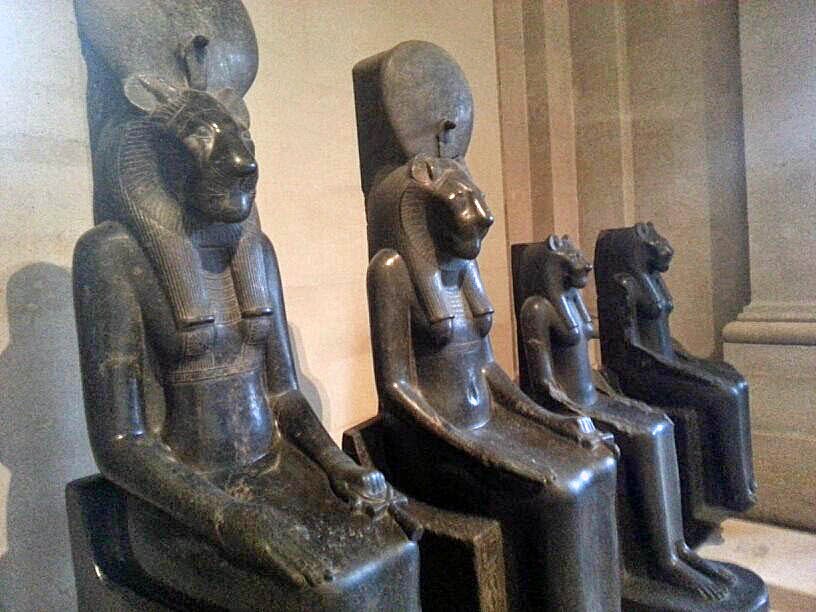
    The image of Sekhmet, as I had met her and led others to meet her in my Egyptian workshop the previous weekend, filled my inner screen and brought all my inner senses vividly alive.  Her eyes were red as carnelian, red as murder, as one of her praise poems has it. She was mad at the agents of my infection. With her came a whole pride of lions.
    They soon defined a field of battle. I understood that they were going to fight whatever was making me sick. Something slashed at me from behind. I turned to see a rabid hyena. Ah yes, the right form for an adversary of my lion protectors. Lions and hyenas are mortal enemies.
     There seemed to be hundreds of hyenas, but they had no real chance against Sekhmet, in furious Eye of Ra mode, and her pride. The lions slaughtered hyenas until the survivors fled the field, then moved over the ground of battle licking up any nasty stuff that remained. I felt this as deep healing inside my body.
     There was a small catch. I had been wounded by the hyena who attacked me from behind. But now Sekhmet tongued the wound, erasing it, restoring my energy field.
     I turned on my side, profoundly grateful, knowing that the crisis was over. My immune system was fully functional again, and I had all the help I needed.
     As I lay on my left size, a beautiful lioness my own size settled full-length on the bed, facing me. I felt the warmth of her body. I felt her breathing her energy into me. We lay together like lovers, hearts beating together.
    I have been more than fine since the night the lions licked the hyenas.


I have learned that I have an imaginal metabolism, a mythic constitution. My body responds at astonishing speed to the images I permit it to entertain. When the images come charged with mythic, transpersonal power, they work wonders. My experience with Sekhmet and the sickness hyenas is a fresh example. My book The Boy Who Died and Came Back contains many more. I think we are all alternately beneficiaries and victims of the power of imagination. We want to learn how to use it well, and how to draw on those greater powers. This starts with becoming more conscious of the stories we are living, and the images we invite to live in us.


Photo (c) Robert Moss. 

Thursday, June 19, 2014

Long night's journey to Istanbul


Ortaköy, Istanbul

I wake a few minutes before the ezan that calls the faithful to pray, amplified by speakers in the spires of the Ottoman mosque across the street in this neighborhood of shiny things - rings and necklaces, earrings and bracelets - laid out by the thousands on the jewelers' tables that are open day and night. I can smell the Bophorus. From the terrace, I watch launches and ferries and huge big-bellied container ships plying the double currents of this strategic passage between the Black Sea and the Sea of Marmara and, beyond it, the Mediterranean.
    4:17 a.m., Istanbul time. Not a bad time to reflect on what it required to get here. I left early for my home airport less than 36 hours ago, before noon on Wednesday. A good thing too, since they told me at the airport that my first flight was seriously delayed and I would never make my connection from Newark to Geneva. I suggested a change of itinerary, and managed to get the last seat on a flight to Washington-Dulles where I could board a different flight to Geneva that should enable me to make my original final connection, Geneva-Dulles.
    So far, all good and familiar. My antennae were twitching because I have noticed that whenever plans get scrambled, the Trickster comes into play. We want to be alert to the nature of this energy in our lives. The Trickster can be our devil if we are set in our ways, bound to plans, unready to improvise. When we are ready to expect the unexpected and turn on a dime (or something less), however, the Trickster can be a very good friend.
    Time for a beer and a snack at my local airport bar, where I am greeted by a familiar friendly face. Bonnie, the bartender, is a world traveler. "Never been to Istanbul,: she says, pumping the pale ale. "I'd love to go. But what I really want to do is go back to Tasmania. Tasmania is to die for."
    "I know," I allow. "I died in Tasmania when I was three years old." She knows that story.
    Just a dozy young geek with headphones for rowmate on the puddlejumper to Washington. No likely story here. We are slightly delayed, and further delayed when we are made to wait on the tarmac for a personage known as a gate agent to wave us down the steps of the little Dash propeller plane. The gate agent takes 25 minutes to appear, while we stand swaying in the super-heated cabin. It's 95 outside, 115, maybe, in the cabin.
    Sweat rolling down my face, I am finally released to hurry from the end of the A concourse to the end of the C concourse at the vast Dulles airport. This requires taking eight escalators, several moving walkways, and a train. When I get to my departure gate for Geneva, the last passengers are boarding. I sink into my seat on another plane that was not in my original itinerary with a sense of gratitude. What next?
    What's next is a fellow who is not quite falling-down drunk but certainly falling-over-himself drunk. He's been talking to relatives on the plane. He hands me a plastic cup of snacks to hold for him while he finishes lurching around in the aisle. When he tumbled into his seat, he immediately pulls out a couple of small airline bottle of wine and a vodka miniature. "I hope you don't mind," he breathes stale alcohol in my face. "They don't serve drinks until after takeoff."
    Now he is chugging red wine, from the bottles. "I had five wines in business class on my last flight," he confides with a dreadful leer. "And a couple bottles of champagne."
    This guy seems to be a serious wino. He starts pouring out his life, including his current travel plans to visit Italy to see the country of his ancestors. As I take another hit of wine-breath. I suddenly have the strong impression of some of the dead drunks this fellow is drinking for. Chief roisterer among them is a big hunk of sausage who calls himself Gianni. He worked as a stevedore - I see him wielding a crowbar, not only on the job. He loved to help out with making wine in his family village. I see his big,dirty feet stomping as they press the grapes.
    My rowmate's ramblings are becoming exhausting. he is venting his opinions about everything and asking for my agreement. Then he asks, "Are you going to Istanbul of vacation?"
    "My life is a vacation," I tell him. Then I decide to give it to him between the eyes. "I have a date as Death in Istanbul. I am going to guide people into conversation with their dead, and on a journey to explore what awaits them in the afterlife. Best of all, I am going to help to embody their personal Death. They will be required to brave up to Death and submit to his interrogation on how they have lived and not lived their lives."
     The wine drinker turns pale. His eyes roll around in his head. His lower jaw drops to his collarbones. Then, rallying himself, he orders champagne from the flight attendant. When it comes, he adds a hit of vodka and a variety of colored pills.
     "Salute," I say. "But you know Gianni prefers red wine."
     Conversation languishes. By popping Ambien into his cocktails, my neighbor manages to knock himself out for an hour or so. The price for me is that, in his sleep, he shoots out a leg or an elbow, making it impossible for me to protect my physical space though - after picking up some awful, despairing images from the dreams he rarely remembers - I am moved to ward my psychic space.
     Not as much fun as I'm used to, this eight-hour flight to Geneva on the wrong plane.


     During the long layover at Geneva airport, I admire a Barclays Bank add that borrows the image of Sekhmet, who was a very powerful and challenging presence in my Dreaming Like an Egyptian workshop last weekend. I wonder what is Sekhmet's investment strategy, and what price she may exact from those who borrow her numen.
     My rowmate on the last flight is wearing a sweatshirt with the state map of Tasmania and the name of the state blazoned in huge letters. He's a young, sporty Swiss male. "Have you been to Tasmania?" I ask. "No. But a friend has. I  don't know why I am wearing this today."
     Ah, but I do. I died for the first time in this life in Tasmania, aged three. After I was pronounced dead from pneumonia in a Hobart hospital and then revived, to general surprise, one of the doctors told my parents, "Your boy died and came back." Thus the title of my new book, my nonfiction spiritual thrilller The Boy Who Died and Came Back. Hence my license to play Death in Istanbul, and elsewhere in this world of ever forking paths.


photos (c) Robert Moss

Wednesday, June 18, 2014

Brushes with the red fox

When the fox is around, the message for me is always Pay attention. The fox is a liminal animal, and its appearances suggest that we are entering an edgy time. I feel a Trickster energy in play when the fox is about.
     Once, when I was talking about the fox in front of a workshop circle in the Big House at Esalen, a fox popped up behind me, clearly visible to the group through the window. When they started laughing and pointing, I turned around. The fox promptly disappeared. This scene was repeated several times. That fox seemed to enjoy performing for the group while playing hide-and-seek with me. I became quite careful about monitoring the shifting energies of the group that week.
     I pay special attention to the comings and goings of the red fox. In my personal mythology, the red fox connects me to ancestral dramas. In shamanic lucid dreaming, I once tracked a red fox, glimpsed in dreams, to a scene in ancient Britain involving a tragic love affair and a druid sacrifice and the issues these raised in my current life.
     The oldest evidence we have of shamanism in Europe is the remains of a woman of power who was buried inside a crypt of mammoth bones in the wooded Pavlov hills of what is now the Czech Republic. She was interred 30,000 years ago. Her body was painted red, and in her hand was placed the body of a fox,apparently her spirit ally.
     Similar clues to the importance of the fox in early magic come from other parts of Europe. The druid prince dug out of the Lindow Moss in northern England, preserved by the chemical stew of the bog, was found to be wearing a collar of red fox fur.
     As a power animal, fox brings many gifts, of craft and cunning and camouflage. Fox knows when to hide and when to hunt, and how to wait in concealment for the right opportunity.
     There are clues in language to the qualities associated with the fox. To "outfox" someone is to outsmart them. "Foxy" can mean crafty, or sexy, or simply red-haired. "Shenanigan" - an act of mischief - is derived from the old Irish sionnachuighim, meaning "play the fox".The Trickster character of the fox is central to countless folk tales, fables, and children's stories.
      East Asian cultures are uneasy about the fox, and especially about foxy women. In traditional Japanese and Chinese culture, possession by a fox spirit is held to account for many problems, especially in women. In folk tales there are women who are foxes, putting on human disguise to seduce men.
     Here are some verses from a long poem I wrote from a hundred encounters with the red fox, on the roads of two worlds:

From Brushes with the Red Fox

You live on the edges of my life
at the margin of the tame land and the wild
and your appearances are always edgy for me.

You know when to hide and when to hunt.
Men chase you on horseback, with dogs,
yet turn chicken when you turn up unannounced.

You are tricky. I doubt I'll ever be at ease with you.
But you are a determined messenger
and a necessary link to old and sacred things

You call women I care for to reclaim lost soul
and become foxy girls, immune to glass ceilings,
setting their own boundaries, living unbounded life.

- from my collection Here, Everything Is Dreaming