Tuesday, October 29, 2013

Dream archaeology at Didyma

Temple of Apollo, Didyma, Anatolia

Columns of Apollo's fallen temple still stand tall against the sky. At the gate of the precinct are three Medusa heads; be careful how you go here. We walk past stone lions and carved bull’s heads and mount the steps of the outer temple.
     The walls of the inner temple are only a third their original size, but still rise high above us as we go down towards the sacred spring, where the oracle once sang through the vocal chords of an inspired prophetess.
     Blessedly, there are few tourists at the Temple of Apollo today. Shall I call to him? I decide to take the risk.
     In the inner temple, facing the sun, I join hands with the friends who have joined me on this expedition and we sing the words in classical Greek that call on Apollo Paian, Apollo the All-Healer, to awaken. I will not transcribe those words here.    
    Some curious German visitors snap pictures. The words reverberate across the enclosure. Sound must have been an essential part of the rituals conducted here. The acoustics are still extraordinary.
     I am drinking the sun, filling with light and music.
     A sweet, long-haired redhead – one of the stray dogs you see everywhere in these parts – comes to nuzzle me and lick me, and this feels like a blessing. Pilgrims at the temples of dream healing in ancient times were always hoping for friendly encounters with dogs.
    My Dutch friend asks, “What do you think went on here in ancient times?”
    I hear great waves of sound, choral voices, musicians. Sound was all-important in the rites celebrated here.
    I see a giant statue of Apollo at the center of the precinct. On his shoulders appear twin birds, black and white. They are both ravens. Of course: ravens were the birds of Apollo, and his seers use their sight very much as Odin does.
     Bird-watching was a vital part of divination here. I look through ancient eyes that quartered the sky and attributed different contexts and different outcomes to the behavior of birds in each of these quarter segments.

- from my casebook of dream archaeology (September 27, 2012).

Awakening Apollo at Didyma

Tuesday, October 22, 2013

Dead Professors Society

William N. Fenton
I am taking one of my favorite dead professors to lunch. Not the Australian historian, or the Romanian scholar of religions, but a great American ethnographer of the Iroquois who was very generous with his wealth of knowledge and experience when my dreams spurred me to study the traditions and dreamways of the Six Nations. I have the professor take a seat in my kitchen while I call a taxi, giving my street address.

I woke from this dream in the early morning light with warm memories of this professor. His name was William N. Fenton, and he was the doyen of scholars of the Iroquois. His field work began in the 1930s, and until just before his death in 2005 his energy for research was unflagging and he continued to produce remarkable books, including his vast history of The Great Law and the Longhouse and a memoir that was published posthumously under the title Iroquois Journey.    

     I made contact with Bill Fenton after I moved to a farm near Chatham NY in 1986 and was called by dreams to revisit the life of Sir William Johnson, the wild Anglo-Irishman who became King's Superintendent of Indians in the eighteenth century, and study the traditions and dreamways of the Longhouse peoples he knew so well. Fenton invited me to lunch in the Patroon Room at the University at Albany
     We talked about how Johnson, as a new arrival from Ireland, won the friendship of the Mohawk Indians. 
To win acceptance and adoption among these people, Bill insisted, “You have to be a participator. Johnson ran with them, hunted with them, sang with them, loved their women." He recalled how in his early days of field work at the Tonawanda reservation, he was allowed to join in the singing. “Though I was always a bit off-key, I was soon being introduced as ‘a man who sings with us’.” 

     Bill Fenton became a wonderful friend and counselor. We lunched regularly at his
The young William Johnson
favorite Albany restaurant, Jack's Oyster House. He talked about fly fishing, about how a Jesuit missionary to the Iroquois at Kahnawake can be considered the founder of modern anthropology and - without any grandiosity - about how he had helped to inspire Edmund Wilson to write his book Upstate. When I talked about my dreams and visions of early America, he confided that he was rather proud that he was a direct descendant of Rebecca Nurse, who was executed as an alleged witch in the infamous Salem witch trials, in 1692.
     One night Bill and his wife came out to the farm for an intimate dinner party. We stood together in front of a maple with a forked trunk, looking at what appeared to be the shape of a long-haired shaman or sorcerer in the tree. He recalled reading somewhere about a Native shaman whose spirit took up residence in a tree. I told him I had dreamed this, and had written the scene in a draft of a book in progress. Over cognac in my library, in front of a blazing hearth, Bill said to me, "I have never met any man in this century who reminds me so much of Sir William Johnson."
      Today, after my dream encounter with Bill, I was working with the copy edits for the sections of my new book that describe my "Years of Writing Dangerously" when I embarked on what I thought would be an historical novel about Sir William Johnson and his world in the eighteenth century. I looked closely at all the details in my text, and checked and rechecked my source citations, remembering that Bill was a careful and exacting scholar.


I could not resist posting a note on my Facebook page about my encounter with Bill. It drew a wonderful response from a woman named Christine. She reported that "while working on a college project a few years ago, I read so much of Fenton's work that I would have long dream conversations with him. Those dream conversations really helped me create a stronger, more focused presentation." 
      I was eager to clarify whether she dreamed of Fenton before or after his death in 2005. Christine responded, "This particular project, a paper and presentation on Iroquois healing herbs and traditions, was done in 2009, long after Bill died. I spent many hours immersed in my topic, and kept returning to his books - they became a touch stone for what I was doing. In my dreams he would often point out where I needed to expand on my research or concepts that needed to be included. I once jokingly pointed out to my professor that Bill was a much more accessible professor, since I could sleep and work at the same time!
     "It was in the those dreams that I realized how important it was to discuss the culture and history of the Iroquois, rather than just the herbs, because of the way healing and medicine is embedded in the Iroquois way of life. It was a fascinating project, which I thoroughly enjoyed, and all the more so because the dreams were so vivid. 
It's been a while since I had one of those dreams now, so please give Bill my best regards!"   
     Christine is clearly a full member of the Dead Professors Society. It is a very special club, but don't go looking for an application form. It is invitation only. Look for the invitation in your dreams.


Monday, October 21, 2013

In praise of black dogs


In Praise of Black Dogs

I am in favor of personal superstitions.
Not the kind Granma mumbles
Or the stuff of fright-night movies
But the ones that grow on you
When you notice which incidents in a day
Are shadows cast by something ahead
And get to know which clues from the world
Are reliable road signs.

I think a black dog, if friendly,
Is always a good omen
And could be a god traveling in disguise.
Some days you don’t have to figure this out.
At the door of possibility on San Francisco Bay
A black dog crossed my path.
His walker, a ruddy man in a red pixie hat,
Told me the dog’s name is Pollo,
Short for Apollo.
I have a black dog of my own.
His name is Nubie, short for Anubis.
He lives in my dreams
And takes on many bodies in the world.


- from my collection Here, Everything Is Dreaming: Poems and Stories. Published by Excelsior/State University of New York Press


 Photo: with my beloved black dogs, at the farm, in 1986. 

Sunday, October 20, 2013

Mircea Eliade and the Flow God


Pârâul Rece, Romania & after


There was great excitement when I announced on the second day of my depth workshop in the Carpathian mountains that that we would make a group journey to heal our relations with the dead, with departed family members and with ancestors further back. There was immense need for this. Many of those present were carrying the heavy energy of the dead, including their addictions.
     We did preparatory work seeking protection for the journey, clarifying the intention, and developing personal portals. Most people present had dreamed of dead relatives, and such dreams are often the ideal gateways. Going to the graveyard would of course be a classic Romanian entry point; a typical dream shared in the group began “I was in the graveyard again.” I offered a generic scenario for the crossing by water, adding a mist that would clear to reveal a new landscape on the other side.
    The Black Dog came to guide me while I drummed for the group.

    I found myself traveling upwards, through many levels separated by what might have been translucent glass. Up above, on the sixth or seventh level, was a man who had arranged his body in some kind of lotus posture.
      He was wearing an Eastern garment, but I knew at once that this was Mircea Eliade, the great Romanian writer and scholar of religions. He had been dead since 1986, but that was no obstacle to conversation, since I had also left my body, in part of my consciousness.
     “What are you doing like that?” I asked him.
     He signaled mentally that he had taken up the correct posture for an Avalokiteshvara. I
recognized the word, and remembered that Eliade had devoted years to study, practice and writing about yoga and Eastern traditions. The word (I looked it up later) literally means “the Lord who looks down upon the world” and is used in Buddhism for a certain kind of bodhisattva.
     “Oh, come on,” I said to Eliade. “Come down from there. I want to talk to you.”
    

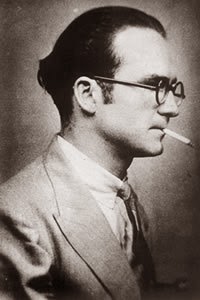
He obliged, taking on the semblance of a professor with glasses in a fairly good suit with a vest. He told me that the biggest regret of his life was that he had failed to become a bestselling novelist. That was his great ambition. Becoming a world scholar of religion was his second choice.
     “But look at all you gave to the world.”
     He still nursed that regret. He counseled me not to miss my own opportunity to write new fiction that will seize a wide audience, drawing on my travels between the worlds. He urged me to read all of his fiction, and his journals from the time when he was writing fiction. I should re-read “The Gypsies” and feel free to borrow from its plot and techniques. I allowed that I might do this, but only when safely off the road, at home.    
 

    He changed appearance again. He became the young Mircea (“Murr-shah”, he corrected my pronunciation), a wild young man who made many mistakes, chasing women and rubbing shoulders with Iron Guard fascists. He did not regret going among women – he had life in him – but he felt bad about his early associations with the far right. He indicated that if I ever came across some memento of the Iron Guard and could bury it on his account, he would be grateful. This would lighten his burden.

Next day, I led our Romanians into the Magic Library. I wanted to resume my conversation with Mircea, so I transported myself to the used bookstore just off a busy square in Bucharest where I found an anthology containing his story “The Gypsies” in October 2012. The place seemed even dustier and moldier than before, the noise of traffic and construction outside even louder, and I sensed Mircea insisting that if I wanted a meet, I must choose a more salubrious setting.
    I thought of the Oriental Institute of the University of Chicago, where he was professor of religion. I was instantly transported to a room of Mesopotamian antiquities. I found myself in front of a marvelous Assyrian statue of a god of water. The carved stone streamed, like water, all down his body.
    Mircea appeared in a sport jacket. He now had some very specific research leads for me. He explained the significance and the location of a porphyry column that had featured in one of my dreams overnight. He suggested a book project that excites me; it will involve rewriting an ancient myth. I will not say more about that until I have worked on it.

I researched the Assyrian water god in the Oriental Institute and made a wonderful discovery. He is a guardian figure from an ancient temple of Nabu, god of writing and knowledge. He holds a vessel from which four streams of water flow. Two streams rise over his shoulders to flow down his back, Two flow down the front of his garment to his feet. A superb image of creative flow, associated with a god of writing. Yes, this was the right place to discuss new book projects. 

Now I am doing the first part of my assignments: reading and re-reading Eliade, especially the fiction, the memoirs, the journals. In his twenties, full of ideas that were bursting for expression, and a constant need to pay for the next meal or the next consignment of books, he wrote in a frenzy. He wrote from 2 PM to 8 PM, and again from 11 PM to 3 AM or later until his body was exhausted and his creative springs ran dry. In the first volume of his Autobiography, I found this passionate statement of creative will: "Nothing, absolutely nothing, can sterilize spiritual creativity so long as a man is - and realizes himself to be - free. Only the loss of freedom, or of the consciousness of freedom, can sterilize a creative spirit."
    Today I re-read "The Gypsies." This story is quite edgy for me. I read it for the first time on a plane from B
ucharest to Warsaw a year ago. I found it profoundly disturbing and disorienting. In the story, a man is drawn into a strange house that belongs to gypsy witches. Later, he is unable to find his way back to the time and place he came from. Twelve years have flown by; nobody knows him. They won't take his money on the tram because the currency has changed. When he stumbles back to the house of the gypsy girls, we get the impression that he has crossed into a land of the dead.
    With an anthology containing this story in my hand, I embarked from Bucharest airport a year ago full of good cheer. My journey rapidly devolved into craziness and confusion. Stranded overnight at Warsaw's Chopin airport thanks to a canceled connection, I found myself fog-bound in the morning and reached a point of desperation when I wondered whether I would ever be able to find my way home. There are stories that take possession of your reality. I found my way back, significantly, by working with elements from a half-forgotten dream.


In the anthology of Romanian Fantastic Tales translated by Ana Cartianu (Bucharest: Minerva, 1981) that got me into trouble in October 2012, Eliade's story "La Țigănci"  is simply titled "Gypsies". In the translation by William Ames Coates reprinted in Tales of the Sacred and Supernatural (Philadelphia: The Westminster Press, 1981) it is given the fuller title "With the Gypsy Girls". 

Friday, October 18, 2013

Time for the Night Watch

Russian fantasy scifi writer Sergei Lukyanenko has turned his Night Watch trilogy into a pentalogy, with publication of a fifth volume, New Watch, following a fourth, Last Watch,  that appeared a few years ago. New Watch is not yet in a U.S. edition, but I placed an order for the Heinemann edition from the U.K., because this is an author I like to follow. The previous books in the Night Watch series seized me with an urgent need to go from one volume to the next without drawing breath.
Lukyanenko’s theme in the Night Watch series is one of the eternal ones that is never out of date: the battle of Dark and Light. The Night Watch is composed of Light Others who keep the Dark side in check. Office hours are 20:00-8:00. The Day Watch consists of Dark Others who monitor and run interference on the Light. Office hours are 8:00 to 20:00. In Moscow (where much of the action takes place) the style of both is like that of hard-drinking, somewhat seedy secret agencies of the Russian government. The only non-drinkers are the vampires of the Day Watch, who can’t metabolize alcohol.
    The Others live much longer than humans and have the power of seeing and traveling through a world-behind-the-world known as the Twilight. The Others are described and graded as magicians. Only magicians of the higher levels can see or travel below the first and second levels of Twilight. We eventually learn that there are seven levels of twilight, but not even Gesar and Zabulon – Higher magicians and chiefs of the Night Watch and Day Watch, respectively - can go there.
The protagonist is Anton Gorodetsky a Light watchman with a sympathy for vampires and a girlfriend/wife (Sveta) who is a notably more powerful magician than he is, even after he becomes a Higher magician in book three (Twilight Watch).
Light and Dark Others are monitored by the Inquisition, also known at the Twilight Watch. The inquisitors are drawn from both Watches and their job is to police the rules of the treaty that is supposed to prevent the balance between Light and Dark from being overthrown.
In book three Dark and Light must combine to fight forces inimical to both. The plot centers on a book long held to be mythical – the Fuaran – that contains the secret of how to turn humans into Others. If all humans are turned into Others, the Others will cease to exist. We are given to understand that the most powerful magicians are actually those with the lowest personal energy, sucking in vitality from the humans all around them. In book four, we learn that the magician with absolute power is the “zero-point” magician, an interesting idea.
I like the way the Others enter into twilight by “pulling up their shadows”. This becomes banal in the movie version of Night Watch when they put on dark glasses, like Neo in The Matrix. I wish the film crew had spent a moment considering how to film the act of stepping into your own shadow. Sometimes, in unpropitious conditions, the only shadow available to Anton is the shadow of an eyelid. A wily adversary in book four (Last Watch) places himself in front of the window, preventing Anton from casting a shadow he could use to see into the twilight.
On the first level of twilight, the world goes gray apart from the “blue moss” which feeds and thrives on human emotions, especially fear and lust. Some structures appear as they do in the ordinary world, but leached of color and substance, so an Other can step through them. At the second level, the world is grayer and emptier, and travelers shed their normal appearance. The deeper you go, the more you risk losing your vital essence and the harder it is to come back. But higher magicians can practice rapid teleportation by diving through deeper levels of the twilight. On the fifth level, you learn the terrible truth about the Others – that they gain their power by stealing it from humans, as air rushes to fill a vacuum.

Lovers of old-fashioned books will enjoy the moment in Last Watch when Gesar, the chief of the Night Watch, gives a reason why books will never disappear: “We only use books for studying magic. When a text is typed into a computer, it doesn’t retain any of the magic.”

Monday, October 14, 2013

When he went looking for his lost universe


Pârâul Rece, Romania

"I have lost my universe," he told me.
    I said, "I know a place where you can find it."
    He gladly accepted the map I gave him.
    I told him a gray shaman with a gray wolf would be waiting for him.

    The map brought him to the gate of a walled market. Fierce gatekeepers blocked his passage. He would not be allowed to enter until he put down his weapons. He saw these as a sword, a dagger and a shirt of chainmail. Lighter, unarmed, he offered a prayer because the armored giants at the gate also seemed like angels.
    He crossed a drawbridge and entered a narrow passage that brought him to a market full of life and color. It seemed to contain all the riches of the world, yet safely contained and well organized within its four walls. He passed piles of grain and put handfuls in his pocket. He chose two apples, green and golden, at another stand, munched them as he walked, then kept what was left.
    He came to a stall in the market that was full of familiar things, toys and games from his childhood. He picked up a model plane and remembered how he had treasured this and been hurt when his parents gave it away without telling him. He threw the plane into the air, aiming at the far wall of the market. A opening appeared in the wall the exact shape of the plane, then the bricks of the wall fell apart in a complex pattern and a gray horse - an Arabian - trotted out.
   He got on the back of the horse and it treated him to a show of dressage before it galloped across an open space and became airborne. From the horse's back he looked down over islands. Each one contained a wealth of knowledge. He came to an island mountain whose peak jutted above the clouds. A great tent witith a pointed top had been set up for the reunion he was about to attend.
    A gray shaman was waiting for him on the mountain. He wore a soft gray robe with a hood, fastened by a simple cord. At his side was a gray wolf who looked a bit like a Husky dog.
    The shaman asked, "Why have you come?"
    He said, "I have come because I have lost my universe."
    "Why do you need a universe."
    "Because I feel I have important work to do, work that will help others. I feel I may even be worthy to become a teacher. But I cannot do this while I am living in a place of shadows."
     The gray shaman reached under his robe and brought out a stone ball he had hanging from his belt. He placed it in the seeker's palm. "Here is your universe. It has been kept safe. How you open it and what you will find in it are things that are up to you. You will find what your courage and imagination allow you to find, as you make this your daily practice. 

Sunday, October 13, 2013

The Journey to the Palace of Light upon the World


Pârâul Rece, Romania

"You cannot heal the body without healing the soul." The first time this statement is recorded is in a dialogue of Plato called the Charmides. The source of the quote is Zalmoxis, described as a "Thracian" god king who had established a unique school of soul healing. Zalmoxis was actually Dacian, and for the past four days we have been building a temple of soul healing in his country, now called Romania. We succeeded in journeying as a group on Saturday to his "palace of light upon the world" in an extraordinary collective experience that brought through tremendous light energy.
     The journey began when I invited the members of our circle to go on a walk in the woods, up the steep slopes of the mountain behind our villa. I told them they would find a wounded animal along the trail. They would follow it through the mountain mist to a blue lake where the animal would be healed in the waters. They would follow its example and plunge as deep as they needed to go for their own healing. They might find that the blue lake opened into another world.
    At the end of the drumming, a woman named Gabriela electrified us with her travel report.
    She started out up the forest trail, in the dappled sunlight. She saw something sparkling among the fallen leaves, then realized it was blood. She looked for a wounded animal and saw in the distance what she thought was a white eagle, a bird that had been her ally in the past. The message came, "Look closer, please." She looked again, and found the animal was a black mountain goat. She found it was injured in many places. The deepest wound was in the heart. When she reached out in an effort to help, her hand came away dripping with blood.
    Despite its wounds, the goat ran up the mountain, and she followed it, into deep fog in which she lost her bearings for a while. When the fog cleared, she saw the goat hurling itself into a blue lake. It was submerged for a long time, and she became worried it would not come up again. At last it surfaced and bounded away on the far side of the lake, apparently healed.
    Gabriela jumped into the lake. She feared she was drowning, then found she could breathe underwater. A guide she had met in previous journeys appeared to her and asked, "What do you want?" She replied, "I want to see." "Then open your eyes."
    She opened her eyes, deep underwater, and saw a clearing in the forest, in another world. Drumming sounded from the clearing, and she approached the source. She found shamans in animal masks and skins drumming and dancing around a great fire. She joined them for a time, then understood that she must go into the fire.
    When she stepped through the fire in the lake, she found herself in yet another world. She recognized 
Sarmizegetusa, the ancient capital of the Dacians, not in ruins but as it may have been at its apogee. She was drawn to the temple of Zalmoxis. It was blazing with light. She approached an immense being of light, and knew she was in the presence of Zalmoxis. "I knew him by his righteousness, by his light energy, by his endless desire to heal."
    Zalmoxis asked her, "Why have you come here?"
    "I have come to be healed."
    "Why do you wish to be healed?"
     The question shook her. She thought for a moment, then said, "I want to be healed so I can draw and make art. My drawings are my way of traveling."
     She felt that her response was accepted.
     She felt him encouraging her to step outside herself and look at her body from another perspective. She felt compassion, observing her body and noticing what it had endured.
     The god told her, "You must bring a gift to your body."
      She did not understand how to accomplish this until he gave her a further instruction, "Bring colors to your body."
     She felt a rain of light descending and saw it entering her body, streaming to the heart, where it coalesced and became a shining green crystal. From the green crystal at the heart a rainbow of colors radiated out, bringing specific but uncalculated healing energy to every part.


We were all seized with excitement by Gabriela's vivid report. With her permission, I took the key elements from her journey and turned them into a travel plan for our whole group. We would journey together to the city of Zalmoxis. We would find our personal responses to the question, "Why do you want to be healed?" - and they would need to be creative responses. We would seek the source of that tremendous light energy, and bring its gift to our bodies in a rainbow of colors.
     The group journey was extraordinary. I was now able to understand why Mircea Eliade told me (in a vision the previous day) that what is written about Zalmoxis in the Charmides is more important than the world understands and that even in his own immense research he had only began to scratch the surface.
      I believe we succeeded, as dream archaeologists, in traveling to the city of Zalmoxis and in experiencing something of what became available in his school of soul healing. 
The etymology of the name of that city, Sarmizegetusa, is uncertain. There are at least three versions. I like the version that gives its meaning as the Palace of Light Upon the World. That is where we found ourselves in our group journey. 
    After the final drumming, we stood in a circle, letting light energy flow hand to hand. We became a great wheel of light, as light burst from our hearts and streamed to the heart of our circle. We called down more and more light to the heart of our circle and sent it out to those in need.


Photos: (1) Ruins of the ancient Dacian capital of Sarmizegetusa by Ionut Vaida (2) Our neighborhood by Robert Moss