Showing posts with label Brigid. Show all posts

Saturday, February 1, 2025

May Brigid's blessings be with you


Blessings to you on the day of the High One, the Exalted One. That is the meaning of Brig, from which the name Brigid (also Brigit, Brighid, Brigantia of England and Brigindo of eastern Gaul) derives. The church made the goddess a saint, one of the most beloved saints of Ireland, with various biographies, the best of which is recollected in Kildare, where the flame of Brigid burned constantly until Henry VIII, and burns again today. She is a power of the land, and of the deeper world, that the church and the people can agree on. In Ireland and in Scotland, you feel her presence in stones and trees, in high places and in deep wells.
In the stories told at Kildare, the woman Brigid is born at sunrise, as her mother stands straddling a threshold, one foot out and one foot in. When Brigid’s head comes out, the sun’s rays crown her with flame. We can see why she is the patron of people who open doors between the worlds – of shamans, seers and poets – and of all who work with fire, in the peat, in the forge, in the cauldron of imbas, the fire of inspiration.
Marija Gimbutas wrote of her (in The Living Goddesses): “Brigid is an Old European goddess consigned to the guise of a Christian saint. Remove the guise and you will see the mistress of nature, an incarnation of cosmic life-giving energy, the owner of life water in wells and springs, the bestower of human, animal and plant life.” She is “Mary of the Gael”, and she is the Triple Goddess and Robert Graves’ Three-fold Muse. She is patron of poetry, healing and smithcraft. In Scotland she is Bride, and the White Swan and the Bride of the White Hills. In the Hebrides she is the protector of childbirth.
Lady Augusta Gregory, Yeats’s friend, described Brigid in Gods and Fighting Men as “a woman of poetry, and poets worshiped her, for her sway was very great and very noble. And she was a woman of healing along with that, and a woman of smith’s work, and it was she first made the whistle for calling one to another through the night.” We are now entering the prime time of this High One, when nature awakens around February 1.
She may appear as a snake from beneath the earth, even in Ireland, the country without snakes:
This is the day of Bride the Queen will come from the mound
This is the time of Brigid’s feast of Imbolc which coincides with the lactation of the ewes and the first signs of spring. You know the lambs are coming soon. You see snowdrops pressing up from the hard earth, perhaps through its white mantle. You offer the gifts of the goddess to the goddess: you pour milk on the ground, you bake and leave out special cakes. To she who spins and weaves life itself, you offer woven fabrics or offer a cloth – a handkerchief, a scarf, a pillowcase – to be blessed as it rests on the earth overnight. To this bringer of fire, you light a candle and offer your heart’s flame.
In the old country, in the old way, young girls carry her images – straw dolls or brideogs – in procession from house to house, and the goddess is welcomed and decked with finery. The dolls are laid on in “bride beds”, with a staff or wand of power resting beside them. At Imbolc, as on other days, you may raise the High One’s energy with poetic speech. Best to do this by a stream or a spring, or (if you know one) a sacred well. She does have a fine love of poets and those who bring fresh words into the world.
There is a legend that, in one of her womanly forms, Brigid married the great poet Senchan Torpeist,  foremost among the learned fili (bards) of Ireland. It was this same Senchan, it is said, who recovered the great poem known as the Táin Bó Cúailnge (The Cattle Raid of Cooley) when it was feared lost forever, by raising the shade of the druid poet Fergus to recite all of the verses.
Among the bevy of Celtic blessings in the great repository know as the Carmina Gadelica, collected by Alexander Carmichael in the Highlands and Islands of Scotland around 1900, some of the sweetest call on Brigid. In “Womanhood of Brigit” (#263 in the Carmina Gadelica)
Brigit of the mantles
Brigit of the peat-heap
Brigit of the twining hair
Brigit of the augury.
Brigit of the white feet
Brigit of calmness
Brigit of the white hands
Brigit of the kine.
Many kinds of protection are then asked of Brigid – safety from death or injury or mishap in many forms. Next comes a verse that makes it plain that Brigid is regarded, among all else, as a guardian of sleep and dreams:
Nightmare shall not lie on me
Black-sleep shall not lie on me
Spell-sleep shall not lie on me
Luaths-luis shall not lie on me.
I need someone more learned in Scots Gaelic than myself to translate Luaths-luis. Its literal meaning seems to be something like “fast-moving lice” for which our modern phrase might be “creepy-crawlies.” In the “Blessing of Brigit” (numbered #264 in the Carmina Gadelica) we have words that might please the Lady on her feast day, or any day:
I am under the shielding
Of good Brigit each day;
I am under the shielding
Of good Brigit each night.
Brigit is my comrade woman,
Brigit is my maker of song,
Brigit is my helping woman
My choicest of women, my guide
Brigid’s Day is also a fine time for courting, and a time to dream, and seek guidance from dreams.

Brigid's Flame

I dreamed this poem at Imbolc in 2020


May the radiance of her blue mantle
surround you and protect you
May you burn with her fires:
fire of seership,
fire of craft,
fire of inspiration,
fire of healing,
fire of transformation
fire of heart.
May you always stand ready
to wrest the killing irons
from evildoers and oppressors
and to take up the Sword of Light
in defense of the weak and the just
May you always be a lover of poets
and commit poetry every day.


Friday, April 1, 2022

Serpent from the Mound


The liminal space between sleep and awake is prime time for sacred encounters. In this twilight zone, before dawn two years ago, I received a visitation by a Celtic priestess, red hair streaming all about her, who took me deep into the realm of Brigid, the goddess and saint of Ireland. I was thrilled with delight. I spent most of the day that unfolded in a blaze of fresh research following the leads I had been given. I crafted a new class devoted to Brigid, with three new group shamanic journeys

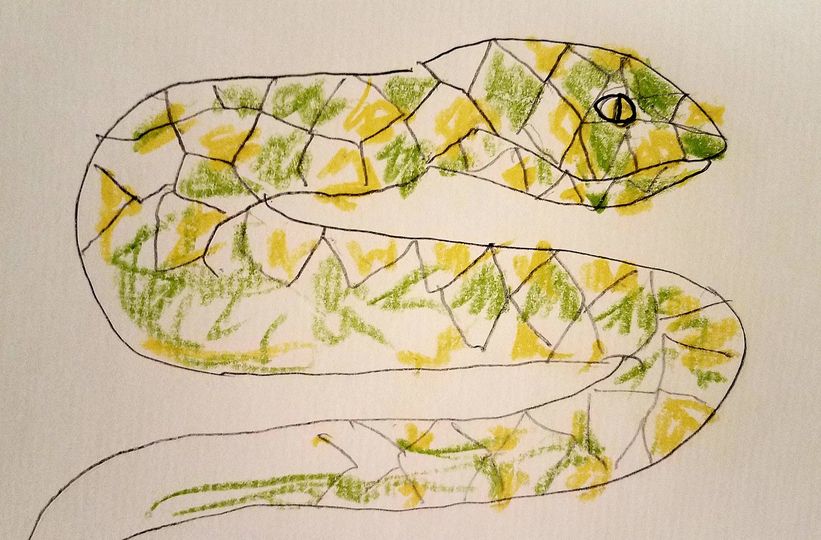
Drifting again in a liminal state the next morning, in a grey pre-dawn hour, I wondered if contact would be renewed. I again felt a presence in my room. It became vividly alive: an enormous green and gold serpent, so beautifully patterned that it might have been crafted by a jeweler. I felt entirely safe with it.

I wondered about the connection with Brigid - since famously there are no snakes in Ireland. Then I remembered that in Scotland Brigid is associated with snakes. There is an invocation in the Carmina Gadelica, the Scottish collection of charms and blessings, that speaks to Brigid as if she is a serpent coming of the mound at the end of winter:
On the day of Bride of the white hills,
The noble queen will come from the knoll,
I will not molest the noble queen,
Nor will the noble queen molest me.


Journal drawing by Robert Moss

Wednesday, May 13, 2020

Dreaming with footnotes

Where we go in dreams, as in life, has a great deal to do with our desires, our calling and our curiosity. In this time of pandemic, I am spending more time than ever in orgies of reading in the middle of the night, jumping from one partner to another; last night from Wendy Doniger O'Flaherty's study of what we learn from Other People's Myths to Jeffrey Kripal's book on Authors of the Impossible to a biography of Victor Hugo.
      I turned in a round 4:00 a.m., curious to see what might be waiting for me in the twilight state of hypnagogia. I set no agenda. I simply lay on my back, in horizontal meditation, ready to allow images to rise and fall. Here's what I recorded in my journal:


My inner screen is blank. No, that’s not quite true. It is illuminated by a dim light. It is the color of old parchment, quite flat, until a small grey shape appears near the top, It flutters and falls back, stirs a little, rises into the shape of a wing. A butterfly wing, drawn in pencil or with a fine brush. I think of Zhuang Zhou’s butterfly and of how it is depicted in paintings of the sage dreaming the butterfly or the butterfly dreaming the man.


     Count your breaths, I tell myself. Just watch what rises and falls. Notice when you lose count.
     The shape stirs again. Beyond it, still only a silhouette, I see a great bird with spread wings.
     There is the irruption of color. A blonde woman’s large rosy face and blue eyes, peering into mine. Who is she? She is gone before I can identify her.
     I picture myself landing at a European airport, riding to the hotel, wearing a face mask as I check in. This is fairly vivid, but seems like a set of updated memories. It lacks the spontaneity of the butterfly trying to take wing from the brush, or the blonde peeper
     Fifty breaths. I have already stumbled in my count a couple of times, switching from inbreath to outbreath. I have the impression of lots of shadow play, of figures and images flitting by too quickly for me to make an inventory. No big visitation tonight, it seems. No repeat of what unfolded around this time, in this room, ten days ago:

A Woman with a Face Like the Sun

She took form as soon as I lay down and closed my eyes: a tall, statuesque female figure wearing a long shimmering blue robe with a golden nimbus about her head.. She held a long golden staff that rises to head height. It was capped by a pair of birds, possibly doves, that came alive in a glory of fluttering wings.
     I thought of Brigid, and Mary, but did not need to settle on any single name. The Lady’s  face became a golden disc. It shone as bright as any sun except that I could contemplate it without turning away.
     I knew this was an epiphany and felt blessed.

However, I don't think this is the lady who looked in on me just now. Well,the body deserves some industrial rest.
     I roll on my left side ready for sleep.
     My inner screen lights up.
     I see letters and numerals in a broken column, printed on the left side of a page or screen. They look like academic citations, with many abbreviations. References to learned journals and books published by Brill in Leiden.
     There is an Arabic word, helpfully transliterated. Al-ruya. The true dream. And something in the non-Roman characters of another language. Amharic? Maybe this:

ሕልም

hlm, pronounced ḥilimi. Amharic for "dream". (I looked it up later.)
     With this, I have the vision of an elderly king. Dark-skinned, bearded, gaunt, with voluminous robes, a scepter and a high boxy crown. His vestments and his crown seem too big for him, or maybe he has shrunk since her first put them on. He reminds me of photos of Haile Selassie,the last emperor of Ethiopia..
      An inner voice tells me
     The king appears when you are able to step back into the dream

Later, in a sleep dream, I found myself as participant and observer in an exciting thriller plot. The action started to unfold on a pleasant urban street that may have been in Little Venice in London. The dream was so vividly real that I nearly failed to record it on waking. It felt just-so; been there, done that.

On the other hand, my more bookish adventures in hypnagogia have set me research assignments. Why Haile Selassie?  How are dreams approached in Ethiopian culture and how are they represented in Amharic literature? Can I follow that list of citations? What more do I need to learn about رؤيا , the true dream, in Islamic tradition?


Sunday, February 2, 2020

Brigid's flame

I dreamed overnight that I found and posted six images and blessings of Brigid beyond what I offered here in my last post. I just composed one more:

Brigid's Flame

May the radiance of her blue mantle
surround you and protect you
May you burn with her fires:
fire of seership,
fire of craft,
fire of inspiration,
fire of healing,
fire of transformation
fire of heart.
May you always stand ready
to wrest the killing irons
from evildoers and oppressors
and to take up the Sword of Light
in defense of the weak and the just
May you always be a lover of poets
and commit poetry every day.

- Robert Moss, Imbolc 2020


Icon of Brigid
One of the most powerful experiences of my life at a place of worship was at Solas Bhride in County Kildare, where the eternal flame of She who is both Goddess and Saint, joining the old religion and a newer one, is kept burning. She rose from her icon, suffusing the whole space with the blue aura of her robe. She plucked the sword from under her feet and held it up. She said, with blazing eyes, "I have kept the sword here not only to deny it to killers and evildoers but to offer it to those I call to be warriors for the Light." How can I not love a Goddess who born at a threshold in the fire of sunrise and is patron of those who work with the fires of metalwork and healing and poetic inspiration?

Sunday, January 31, 2016

On Brigid's day


Imbolc is the day of the High One, the Exalted One. That is the meaning of Brig, from which the name Brigid (also Brigit, Brighid, Brigantia of England and Brigindo of eastern Gaul) derives. The church made the goddess a saint, one of the most beloved saints of Ireland, with various biographies, the best of which is recollected in Kildare, where the flame of Brigid burned constantly until Henry VIII, and burns again today. She is a power of the land, and of the deeper world, that the church and the people can agree on. In Ireland and in Scotland, you feel her presence in stones and trees, in high places and in deep wells.
    In the stories told at Kildare, the woman Brigid is born at sunrise, as her mother stands straddling a threshold, one foot out and one foot in. When Brigid’s head comes out, the sun’s rays crown her with flame. We can see why she is the patron of people who open doors between the worlds – of shamans, seers and poets – and of all who work with fire, in the peat, in the forge, in the cauldron of imbas, the fire of inspiration.
     Marija Gimbutas wrote of her (in The Living Goddesses): “Brigid is an Old European goddess consigned to the guise of a Christian saint. Remove the guise and you will see the mistress of nature, an incarnation of cosmic life-giving energy, the owner of life water in wells and springs, the bestower of human, animal and plant life.” She is “Mary of the Gael”, and she is the Triple Goddess and Robert Graves’ Three-fold Muse. She is patron of poetry, healing and smithcraft. In Scotland she is Bride, and the White Swan and the Bride of the White Hills. In the Hebrides she is the protector of childbirth.
    Lady Augusta Gregory, Yeats’s friend, described Brigid in Gods and Fighting Men as "a woman of poetry, and poets worshiped her, for her sway was very great and very noble. And she was a woman of healing along with that, and a woman of smith's work, and it was she first made the whistle for calling one to another through the night." We are now entering the prime time of this High One, when nature awakens around February 1.
     She may appear as a snake from beneath the earth, even in Ireland, the country without snakes:

This is the day of Bride the Queen will come from the mound

This is the time of Brigid’s feast of Imbolc which coincides with the lactation of the ewes and the first signs of spring. You know the lambs are coming soon. You see snowdrops pressing up from the hard earth, perhaps through its white mantle. You offer the gifts of the goddess to the goddess: you pour milk on the ground, you bake and leave out special cakes. To she who spins and weaves life itself, you offer woven fabrics or offer a cloth – a handkerchief, a scarf, a pillowcase – to be blessed as it rests on the earth overnight. To this bringer of fire, you light a candle and offer your heart's flame.
    In the old country, in the old way, young girls carry her images - straw dolls or brideogs - in procession from house to house, and the goddess is welcomed and decked with finery. The dolls are laid on in “bride beds”, with a staff or wand of power resting beside them. At Imbolc, as on other days, you may raise the High One’s energy with poetic speech. Best to do this by a stream or a spring, or (if you know one) a sacred well. She does have a fine love of poets and those who bring fresh words into the world.
    There is a legend that, in one of her womanly forms, Brigid married the great poet Senchan Torpeist,  foremost among the learned fili (bards) of Ireland. It was this same Senchan, it is said, who recovered the great poem known as the Táin Bó Cúailnge (The Cattle Raid of Cooley) when it was feared lost forever, by raising the shade of the druid poet Fergus to recite all of the verses.
    Among the bevy of Celtic blessings in the great repository known as the Carmina Gadelica, collected by Alexander Carmichael in the Highlands and Islands of Scotland around 1900, some of the sweetest call on Brigid. In “Womanhood of Brigit” (#263 in the Carmina Gadelica)

Brigit of the mantles
Brigit of the peat-heap
Brigit of the twining hair
Brigit of the augury.
Brigit of the white feet
Brigit of calmness
Brigit of the white hands
Brigit of the kine.

Many kinds of protection are then asked of Brigid – safety from death or injury or mishap in many forms. Next comes a verse that makes it plain that Brigid is regarded, among all else, as a guardian of sleep and dreams:

Nightmare shall not lie on me
Black-sleep shall not lie on me
Spell-sleep shall not lie on me
Luaths-luis shall not lie on me.

I need someone more learned in Scots Gaelic than myself to translate Luaths-luis. Its literal meaning seems to be something like “fast-moving lice” for which our modern phrase might be “creepy-crawlies.” In the “Blessing of Brigit” (numbered #264 in the Carmina Gadelica) we have words that might please the Lady on her feast day, or any day:

I am under the shielding
Of good Brigit each day;
I am under the shielding
Of good Brigit each night.
Brigit is my comrade woman,
Brigit is my maker of song,
Brigit is my helping woman
My choicest of women, my guide

Brigid's Day is also a fine time for courting, and a time to dream, and seek guidance from dreams.
-
Art: "St Brigid's Path" by Carlos A. Smith.