Showing posts with label destiny. Show all posts

Wednesday, February 12, 2025

Wyrd and weirder


Read the Eddas (literally the “great-grandmothers”) and the Icelandic sagas with care, and you will find not only Viking battle stories, but some profound insights into the human condition and the interconnectedness of things.

The key word here is Wyrd, from which “weird” derives. Wyrd is often translated as “fate” or “destiny” but it is related to weohrtan, which means “to become”. Wyrd is best understood as a web of connection, joining everything that happens in this world to movements in other worlds. 

Events that may appear to be separate in time or space are connected by threads that are fine, supple and strong. Any movement in any part of the web may be felt anywhere else. Omens point to patterns, they are not just about something that is going to happen in the future. If you know the ways of Wyrd, you use them to read the patterns of connection. If you are a master of these things, you may be able to pull on the threads to change the patterns.

Wyrd is beyond the gods. The web precedes gods and men and lives after them. We call it a pattern, but like the Tao, as it plays through the Book of Changes, it is in constant motion. A lively guide to these matters is Brian Bates’ “documentary novel” The Way of Wyrd, where an Anglo-Saxon sorcerer instructs that “Wyrd itself is constant change, yet because it is created at every moment it is unchanging, like the still center of a whirlpool. All we can see are the ripples dancing on top of the water.” [1] Yet by studying the ripples you can detect what is moving at the bottom of the water, or far away across its expanse. 

Because we are part of Wyrd, we can never see the whole. So we look for ways to see enough to help us navigate. Carving and casting runes is a way. So are dreams, and those special moments when you awaken to the workings of the deeper pattern. “Man is touched by wyrd when he becomes involved in matters whose nature and origins extend beyond existence on earth,” Germanic scholar Paul Bauschatz explains. “There are times…when apparently ordinary activities acquire special significance, and it seems likely that at these times daily life is touched and colored with elements beyond our limited perceptions.” [2] There is room to re-weave the threads of Wyrd. 

Jenny Blain, who has participated in the revival of ancient Norse seiðr, or shamanic rituals, observes that “this concept of Wyrd is one that is being developed within the community. Though often translated as 'fate' and sometimes equated to 'karma', it has a more dynamic sense. People are active agents in the creation of their own personal wyrd, or ørlög. Their deeds and vows, strands of ørlög, become part of the fabric of Wyrd.” Those who work the seiðr  rituals feel they are “'reading' Wyrd, seeing along the threads of the fabric to possible outcomes. Others within the community consider that seiðr in the past involved active interception of the fabric, 'tugging' at the threads,"[3] 

In English, the word “weird” derives from Wyrd. It declined from common usage in England until Shakespeare revived it, with a sinister twist, with the Weird Sisters in Macbeth. It retained some of its original meaning a little longer in Scotland, where if you called someone “weirdless” you were saying that he was unlucky. 

In more recent times, to call something “weird” is to say that it is strange, uncanny, hard to explain and maybe spooky. A “weirdo” is someone who is very strange. Yet thanks to a campaign that started in Austin, Texas, “weird” has been making a comeback. Austin is the first North American city to sprout a poster campaign to keep the city weird. Keep Austin Weird. Other cities followed suit.

One of my favorite books on Northern European traditions is The Well of Remembrance by Ralph Metzner, who embarked on a quest to reclaim the mythic wisdom of his ancestors from the Nazi curse. He was drawn to Odin, not as a war god but as the poet-shaman wandering between the worlds, facilitating direct and personal revelation. In the course of his quest, he writes, “Often I felt as though I was seized, or inspired. I would think of Odin and get insights or answers to my questions, including questions about the meanings of certain myths. Or I would suddenly find pertinent myths that I had not known before. Strange though it may sound, I would have to say that much of what I am relating in this book has been directly given to me by Odin.” [4]    

I have had similar experiences since Tolkien told me in a dream, many years ago, “You must study Scandinavian mythology.” I was at first reluctant to follow that advice, partly because of the long shadow of the Nazi attempt to hijack the gods and symbols of the North.  As I began to walk this ancestral path (I have Scandinavian blood on both sides of my family) in my reading and travel and in my dreams, I was rewarded by special moments of encounter and discovery that left me in no doubt that forces beyond the veil of the world were in play. During a trip to Europe, I had a personal vision of Yggdrasil, the World Tree, from which I wrote a poem.

Since then I have had spontaneous encounters, usually in the fertile space between sleep and awake, with Odin and Freiyja, with Idunn and Loki, and with a powerful völva, or seeress, of the old ways.

The ancestors are calling, calling. And they can use the worldwide web as well as the web of the worlds. It is amusing to note that “wired” is an anagram for “weird”. A woman named Kim shared the following story. “Sprit likes the wires. The Web, in particular. The deities who work fate, don’t they spin and snip threads? My Mom's picture popped up on a dating app my ex-husband is on. He sent a screen shot. I'd just asked my Mom that morning for a sign that she was there. He had been on that app over a year, and he showed me how faces appeared as you scrolled through and how you could indicate interest or not. My Mom was never on a dating site, and certainly wouldn't be suitable to his selected age range. I think that via the Web, we can have communication with the Other Side.”


References

 1. Brian Bates The Way of Wyrd: Tales of an Anglo-Saxon Sorcerer (London: Century, 1987) 75

2. Paul C. Bauschatz, The Well and the Tree: World and Time in Early Germanic Culture (Amherst, MA: University of Massachusetts Press, 1982), 28

3.   3. Jenny Blain, Nine Worlds of Seid-Magic: Ecstasy and Neo-Shamanism in Northern European Paganism (London: Routledge, 2002), 15

      4. Ralph Metzner, The Well of Remembrance: Rediscovering the Earth Wisdom Myths of Northern Europe (Boston: Shambhala, 1994) 10
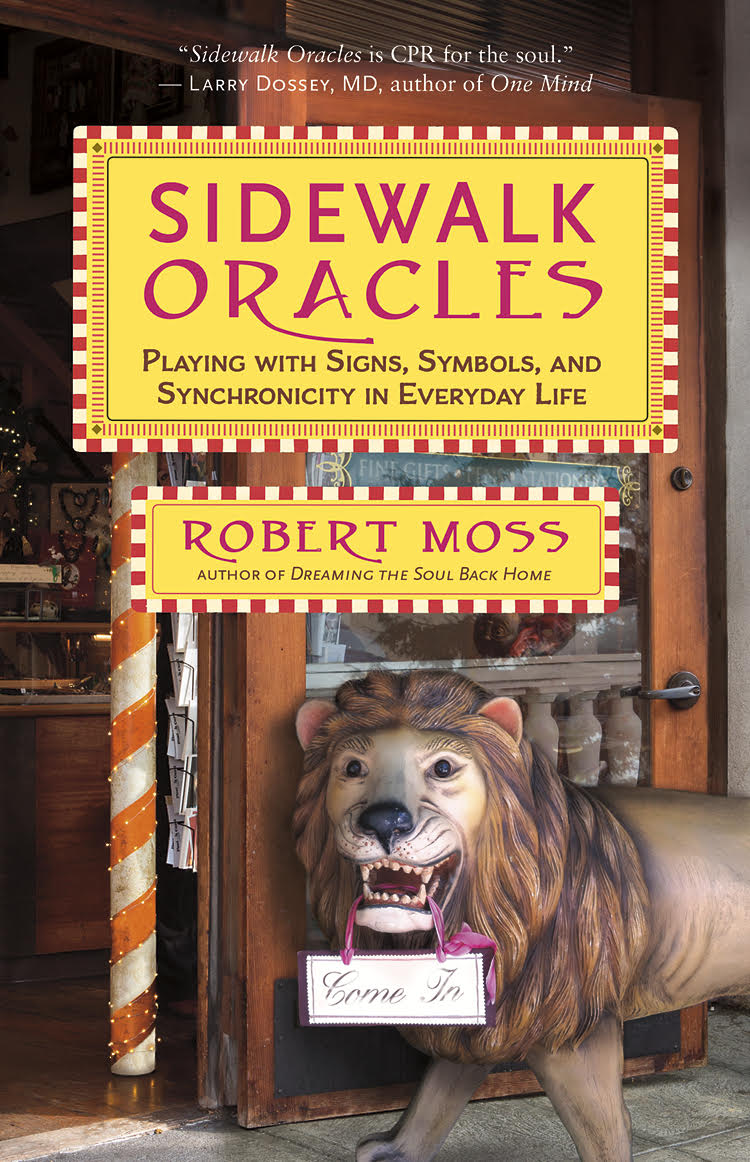


Text adapted from Sidewalk Oracles: Playing withSigns, Symbols and Synchronicity in Everyday Life by Robert Moss. Published by New World Library.

Saturday, November 9, 2024

The Apple of Fate


On a cool fall night, I lie down on my bed. As soon as I close my eyes, I see a form of the Great Earth Mother, vast and voluptuous. She rises before me, large as a mountain, and opens a fertile valley. I fly through this like a swallow, and come out in a world suffused by sourceless light.. There is a sense of being in a contained space, protected by translucent walls that are spirals of light. 
   There is a feminine presence. She lets me know she is willing to be a guide for me in this realm. She is very tall and slender, dressed in blue. Her name is of the North. Though the light is everywhere, she moves within a fine mist that makes her features hazy.
    She tells me this is a place of purification, of cleansing “down to the bone marrow.” She speaks to me of soul, and where it travels.“Where your desire goes, there you go in soul flight out of the body, and in the soul’s journey after death.”
    She shows me a ball fired high into the air, sailing up above the clouds. She tells me, “This is the Apple of Fate. When it returns to Earth, your present life will be over.” We agree I do not need to know the exact time or circumstances of its return.


Reading and reflecting on this report in my journal, from nearly thirty years ago, I am stirred again by the vision of the Apple of Fate. Now I am considering goddesses known to my Northern ancestors who were especially fond of apples. Idunn is a Nordic goddess who carries apples in a box crafted from ash wood. In the Prose Edda, when the gods start to feel old, they ask her to feed them her apples, which carry the magic of rejuvenation. This is why Idunn's name means Ever Young, or Rejuvenator. The Prose Edda contains the story of Idunn’s abduction and rescue, both the work of Loki) Idunn’s husband Bragi, the skaldic god of poetry, who gave his name to the cup (bragarfull) with which toasts to the mighty Viking dead were raised..
    In a story of the goddess Frigg in the Volsung Saga, an apple from the goddess can produce a new birth as well as fresh juice. When king Renr prays for a child, Frigg's messenger, a crow, drops an apple in his lap, and soon his wife is pregnant. Then there are the Apples of Hel, They are mentioned in an 11th century poem by the 
skald Thorbrion Brunarson, who saw the apple as food of the dead. 
     I do not find the phrase Apple of Fate in the Icelandic texts, or the excellent works of Hilda Ellis Davidson, the great English scholar of Nordic paganism. But I see that the intriguing Nehelennia is also depicted as carrying a supply of apples. With the breath of her name I feel a wind from the mythic ocean gusting through my study. Nehelennia, whose best-known temples were on the coast of the Netherlands, was a Celtic-Germanic goddess who was a special patron of voyagers, those traveling by sea or across the astral tides, and those making the crossing to the Otherworld and the afterworld. 
    Apple of Fate is a term that could fit the apple in the Garden of Eden, or the apple in the story of Paris' choice between the three goddesses, since in each of those stories a choice involving an apple determined a fate. But those stories don't resonate with me in relation to the blue lady and what she showed me. And anyway, the apple of Eve and the apple of Paris weren't apples as we know them. Apples were unknown west of Kazakhstan until some of the soldiers of Alexander the Great brought them back from his campaigns; even then, these "apples" were only small and tart, like crabapples.
    I wonder where my Apple of Fate is now, flying or falling or bumping along the ground. As the lady in blue suggested, I don't need an exact fix on that, at least, not yet….


Drawing by Robert Moss: Lady of Apples

I made the drawing after a vision in the hypnagogic zone on January 2, 2021. I heard the name "Idunn" quite distinctly. I was wafted into an enchanted apple orchard. I smelled the apple blossom in the golden hair of a lovely young woman who seems sweet and innocent.I let myself drift into a sleep dream in which I drove north, ever north, faster and faster with a young woman who seemed to be both my daughter and my research partner. The wind rushed past us as the beating of great wings. We were excited because we had found the key to a mystery.I drew Idunn by an apple tree with apple blossom in her hair, dressen in apple-green rather than blue and holding her golden apples in a basket rather than an ashwood box because that is the way I saw her this time.  


Wednesday, August 22, 2018

Soul remembering in Yoruba tradition

The Yoruba say that the individual soul, or ori, goes before the high god Olodumare before it joins a physical body. The ori kneels down before Olodumare to receive its destiny. It comes into the world to fulfill this destiny:

What the ori comes to fulfill
It cannot but fulfill it.

This personal destiny is known as iponri, which means “the ori’s portion or lot.” The more fortunate and evolved souls choose their own destiny at the feet of the high god. Most souls accept their fate, with only limited ability to negotiate the details. A third category have their destinies “laid on their backs” and come into the world reluctantly.
     In the Yoruba version, when a soul has received its destiny from Olodumare, it embarks on its journey toward physical birth. When the soul arrives at one of the gates between the worlds, it must answer the question of the Gatekeeper, the oni’bode.

Gatekeeper: Where are you going?
Journeyer: I am going into the world.
Gatekeeper: What are you going to do?
Journeyer: I will be born to a woman named X and a man named Y, in the town of Z.
I will be an only son….At the age of…I will…and will die in…and will be mourned by
all and given proper burial.
Gatekeeper: To. It is sealed. [1]

    The destiny is doubly sealed — at the feet of the high god and at the gates between the worlds.
    When souls come into this world, most forget their contract with the high god: the destiny that has been assigned to them.
    Can the destiny be changed? It can sometimes be changed for the better by divine intercession, especially with the help of Orunmila, the austere lord of divination who cannot be bribed. It can be changed for the worse through the interference of forces of evil. A destiny can be aborted through human weakness and impatience.
    One of the two most important insights, in the Yoruba version, is that “an unhappy destiny can be rectified if it can be ascertained what it is.” There is a story of a father who traveled to Ajiran — a town reputed to be a gate between the worlds — to discover why his children died young. In what was clearly a soul journey, he previewed the probable death of his surviving son from snakebite and was able to use his foreknowledge to prevent this from coming to pass.
    The other vital Yoruba insight is that we have an ally in heaven who is in no way alien to ourselves. This ally can help us remember our destiny — and coach us on how to fulfill it or modify it. The ori has a “double in heaven,” a personal daimon. When the Yoruba offer you the blessing “May ori go with you,” they are actually saying something like, “May you walk with your guardian angel, your own Higher Self.”
    Soul-remembering, in some of the Yoruba stories, is the key to weathering life’s ups and downs with grace and tenacity. There is a tale in the odu — the verse recitations that accompany Ifa divination — of a celebrated royal drummer who decided to commit suicide at the peak of manhood after suffering many misfortunes. He fainted during his suicide attempt.
    The drummer’s soul now comes face-to-face with a Gatekeeper who demands, “Why do you appear unbidden at the gate?”
    He recounts his troubles. The Gatekeeper shuts him up in a room and tells him to listen carefully.
    He hears footfalls as the people who are going to be born in the world come before the Gatekeeper. He listens as they recount their destinies.
   “Have you been listening?” the Gatekeeper demands. “This shows how one’s life is ordered.”
    The would-be suicide is reminded that what happened to him on earth happened in accord with his destiny.
    The Gatekeeper shows dim a house full of goods and a pen full of cattle that were to be his in the next year of his life, according to his destiny.
    The Gatekeeper shows him a house full of goods and a pen full of cattle that were to be his in the next year of his life, according to his destiny. “But through your impatience, you have forfeited everything.”
    The drummer wept and protested so strongly that at last Olodumare granted him an extension — ten more years in which to enjoy his predestined riches.[2]


1. E.Balaji Odowu, Olodumare: God in Yoruba Belief (New York: Wazobia, 1994
2. ibid, 180


Text adapted from Dreamgates: Exploring theWorlds of Soul, Imagination and Life beyond Death by Robert Moss. Published by New World Library

Image above: Ifa divination board. Ifa divination, under the patronage of Orunmila, may assist in remembering the soul's assignments,  opening the possibility that an unhappy destiny can be rectified if it can be ascertained what it is.