
The key word here is Wyrd, from which “weird” derives. Wyrd is often translated as “fate” or “destiny” but it is related to weohrtan, which means “to become”. Wyrd is best understood as a web of connection, joining everything that happens in this world to movements in other worlds.
Events that may appear to be separate in time or space are connected by threads that are fine, supple and strong. Any movement in any part of the web may be felt anywhere else. Omens point to patterns, they are not just about something that is going to happen in the future. If you know the ways of Wyrd, you use them to read the patterns of connection. If you are a master of these things, you may be able to pull on the threads to change the patterns.
Wyrd is beyond the gods. The web precedes gods and men and lives after them. We call it a pattern, but like the Tao, as it plays through the Book of Changes, it is in constant motion. A lively guide to these matters is Brian Bates’ “documentary novel” The Way of Wyrd, where an Anglo-Saxon sorcerer instructs that “Wyrd itself is constant change, yet because it is created at every moment it is unchanging, like the still center of a whirlpool. All we can see are the ripples dancing on top of the water.” [1] Yet by studying the ripples you can detect what is moving at the bottom of the water, or far away across its expanse.
Because we are part of Wyrd, we can never see the whole. So we look for ways to see enough to help us navigate. Carving and casting runes is a way. So are dreams, and those special moments when you awaken to the workings of the deeper pattern. “Man is touched by wyrd when he becomes involved in matters whose nature and origins extend beyond existence on earth,” Germanic scholar Paul Bauschatz explains. “There are times…when apparently ordinary activities acquire special significance, and it seems likely that at these times daily life is touched and colored with elements beyond our limited perceptions.” [2] There is room to re-weave the threads of Wyrd.
Jenny Blain, who has participated in the revival of ancient Norse seiðr, or shamanic rituals, observes that “this concept of Wyrd is one that is being developed within the community. Though often translated as 'fate' and sometimes equated to 'karma', it has a more dynamic sense. People are active agents in the creation of their own personal wyrd, or ørlög. Their deeds and vows, strands of ørlög, become part of the fabric of Wyrd.” Those who work the seiðr rituals feel they are “'reading' Wyrd, seeing along the threads of the fabric to possible outcomes. Others within the community consider that seiðr in the past involved active interception of the fabric, 'tugging' at the threads,"[3]
In English, the word “weird” derives from Wyrd. It declined from common usage in England until Shakespeare revived it, with a sinister twist, with the Weird Sisters in Macbeth. It retained some of its original meaning a little longer in Scotland, where if you called someone “weirdless” you were saying that he was unlucky.
In more recent
times, to call something “weird” is to say that it is strange, uncanny, hard to
explain and maybe spooky. A “weirdo” is someone who is very strange. Yet thanks
to a campaign that started in Austin, Texas, “weird” has been making a
comeback. Austin is the first North American city to sprout a poster campaign
to keep the city weird. Keep Austin Weird.
Other cities followed suit.
One of my favorite books on Northern European traditions is The Well of Remembrance by Ralph Metzner, who embarked on a quest to reclaim the mythic wisdom of his ancestors from the Nazi curse. He was drawn to Odin, not as a war god but as the poet-shaman wandering between the worlds, facilitating direct and personal revelation. In the course of his quest, he writes, “Often I felt as though I was seized, or inspired. I would think of Odin and get insights or answers to my questions, including questions about the meanings of certain myths. Or I would suddenly find pertinent myths that I had not known before. Strange though it may sound, I would have to say that much of what I am relating in this book has been directly given to me by Odin.” [4]
I have had similar experiences since Tolkien told me in a dream, many years ago, “You must study Scandinavian mythology.” I was at first reluctant to follow that advice, partly because of the long shadow of the Nazi attempt to hijack the gods and symbols of the North. As I began to walk this ancestral path (I have Scandinavian blood on both sides of my family) in my reading and travel and in my dreams, I was rewarded by special moments of encounter and discovery that left me in no doubt that forces beyond the veil of the world were in play. During a trip to Europe, I had a personal vision of Yggdrasil, the World Tree, from which I wrote a poem.
Since then I have had spontaneous encounters, usually in the fertile space between sleep and awake, with Odin and Freiyja, with Idunn and Loki, and with a powerful völva, or seeress, of the old ways.
The ancestors are calling, calling. And they can use the worldwide web as well
as the web of the worlds. It is amusing to note that “wired” is an anagram for
“weird”. A woman named Kim shared the following story. “Sprit likes the wires.
The Web, in particular. The deities who work fate, don’t they spin and snip
threads? My Mom's picture popped up on a dating app my ex-husband is on. He sent
a screen shot. I'd just asked my Mom that morning for a sign that she was
there. He had been on that app over a year, and he showed me how faces appeared
as you scrolled through and how you could indicate interest or not. My Mom
was never on a dating site, and certainly wouldn't be suitable to his selected
age range. I think that via the Web, we can have communication with the Other
Side.”
References
1. Brian Bates The Way of Wyrd: Tales of an Anglo-Saxon Sorcerer (London: Century, 1987) 75
2. Paul C. Bauschatz, The Well and the Tree: World and Time in Early Germanic Culture (Amherst, MA: University of Massachusetts Press, 1982), 28
3. 3. Jenny Blain, Nine Worlds of Seid-Magic: Ecstasy and Neo-Shamanism in Northern European Paganism (London: Routledge, 2002), 15
4. Ralph Metzner, The Well of Remembrance: Rediscovering the Earth Wisdom Myths of Northern Europe (Boston: Shambhala, 1994) 10
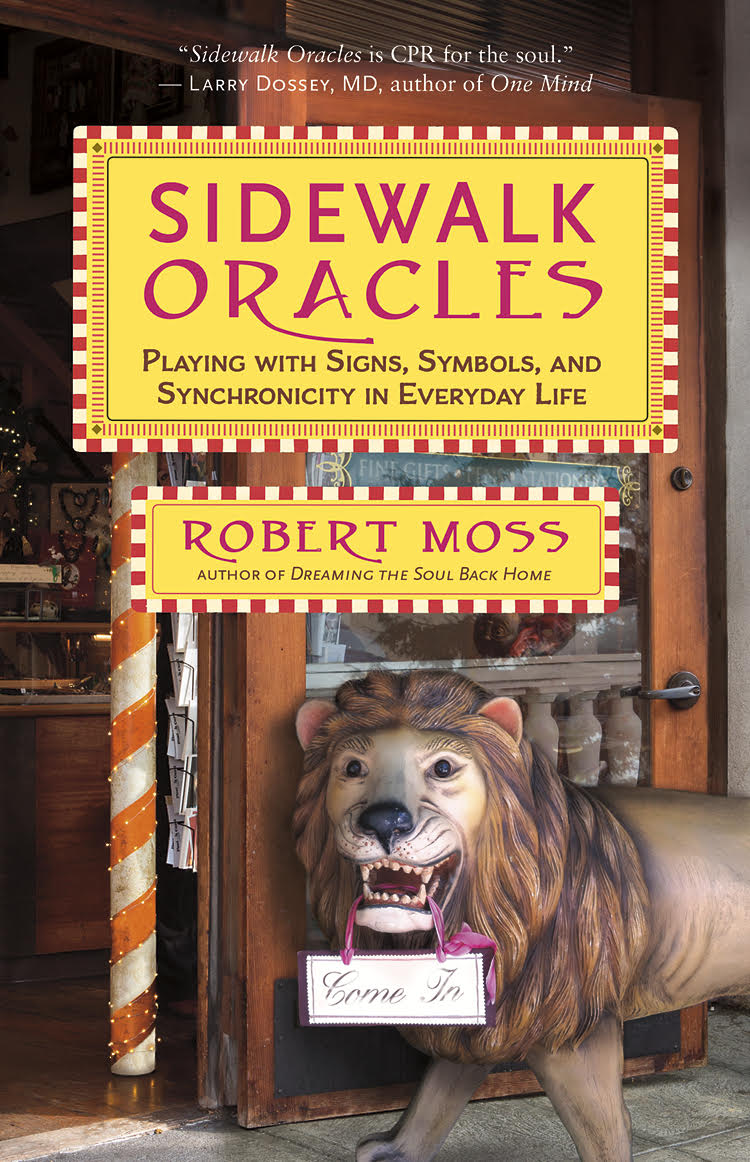
Text adapted from Sidewalk Oracles: Playing withSigns, Symbols and Synchronicity in Everyday Life by Robert Moss. Published by New World Library.


