Showing posts with label fairytales. Show all posts

Monday, August 28, 2023

Waking the Sleeping King


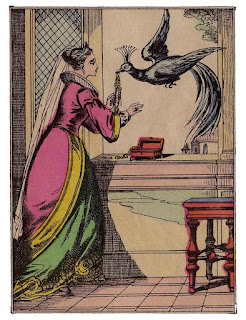
In one of Madame d'Aulnoy's classic fairy stories, “The Blue Bird” an abused princess survives incredible   trials and transformations. Disguised as a beggar girl, she at last manages to gain access to the Echo Chamber in the castle of King Charming, who loves her as she loves him but believes her lost. What is said in the Echo Chamber can be heard distinctly in the royal bedchamber above. The princess wails her story of love and loss, assuming it will awaken the king to the fact that she is alive and available and recall him to the pledges they exchanged.

But night after night, the king fails to hear. The princess has used up nearly all of the magic a good witch gave her — which has enabled her to buy entry to the Echo Chamber — before she learns that the king does not hear her because he takes a sleeping-draught every night. She manages to bribe a page to withhold the sleeping potion. Awake in the night, the king hears her love pleas, goes in search of her, and they are united.

This is a much more relevant story for our times than the theme of the sleeping princess. Here the woman has to wake up the man, as is so more often the case. How many “sleeping kings” do we know? How many forms do their “sleeping draughts” take? Whenever you run into a guy who has lost touch with his dreams, who may even say, “I don't dream”, remember you may be dealing with a sleeping king, and you may be called on to play the role of the awakener.

The very adult message in this story made me want to know more about the author. Where did her clarity of perception, amongst all the fantasy and finery (and raw horror, too) come from? The story of the author of “The Blue Bird” is fascinating, and takes us into the raw depth of lived experience from which the pre-Disney and pre-Victorian fairytales come — in this case, not from peasant folklore but from the no less brutal life dramas of France's real-life princesses.

 At age fifteen, Marie-Catherine le Jumel de Barneville was kidnapped from a convent school and raped under the pretext of an arranged marriage — the polite name for an arrangement by which her father sold her to a rich and depraved aristocrat three times her age. The Baron d'Aulnoy was odious, a heavy drinker and gambler with very unpleasant sexual penchants. Three years into the marriage, it looked like Marie-Catherine had found a way out of her cage when her husband was arrested on charges of high treason against the king. However, under torture two of the accusers confessed that they had invented the treason charges because they were Marie-Catherine's secret lovers. The baroness had to flee to Spain, where she restored herself to royal favor — over many years — by functioning as a secret agent for the French.

We derive the term “fairytale” from this extraordinary survivor, Marie-Catherine d'Aulnoy.. She titled her first collection, published in 1697, Les Contes des Fées. She spun her tales for adults, rather than children, in her seventeenth-century salon, in fashionable colloquial style, as reflected in the subtitle of her second collection, Les Fées à la Mode. Hers is a true-life story of spinning soiled hay into gold.


Text adapted from Active Dreaming by Robert Moss. Published by New World Library. 

      An English translation of "The Blue Bird" appeared in The Green Fairy Book, the third of Andrew Lang's Fairy Books of Many Colors, first published in 1892. 

Wednesday, December 8, 2021

Waking the Sleeping King


In one of Madame d'Aulnoy's classic fairy stories, “The Blue Bird” an abused princess survives incredible   trials and transformations. Disguised as a beggar girl, she at last manages to gain access to the Echo Chamber in the castle of King Charming, who loves her as she loves him but believes her lost. What is said in the Echo Chamber can be heard distinctly in the royal bedchamber above. The princess wails her story of love and loss, assuming it will awaken the king to the fact that she is alive and available and recall him to the pledges they exchanged.

But night after night, the king fails to hear. The princess has used up nearly all of the magic a good witch gave her — which has enabled her to buy entry to the Echo Chamber — before she learns that the king does not hear her because he takes a sleeping-draught every night. She manages to bribe a page to withhold the sleeping potion. Awake in the night, the king hears her love pleas, goes in search of her, and they are united.

This is a much more relevant story for our times than the theme of the sleeping princess. Here the woman has to wake up the man, as is so more often the case. How many “sleeping kings” do we know? How many forms do their “sleeping draughts” take? Whenever you run into a guy who has lost touch with his dreams, who may even say, “I don't dream”, remember you may be dealing with a sleeping king, and you may be called on to play the role of the awakener.

The very adult message in this story made me want to know more about the author. Where did her clarity of perception, amongst all the fantasy and finery (and raw horror, too) come from? The story of the author of “The Blue Bird” is fascinating, and takes us into the primal depth of lived experience from which the pre-Disney and pre-Victorian fairytales come — in this case, not from peasant folklore but from the no less brutal life dramas of France's real-life princesses.

At age fifteen, Marie-Catherine le Jumel de Barneville was kidnapped from a convent school and raped under the pretext of an arranged marriage — the polite name for an arrangement by which her father sold her to a rich and depraved aristocrat three times her age. The Baron d'Aulnoy was odious, a heavy drinker and gambler with very unpleasant sexual penchants. 

Three years into the marriage, it looked like Marie-Catherine had found a way out of her cage when her husband was arrested on charges of high treason against the king. However, under torture two of the accusers confessed that they had invented the treason charges because they were Marie-Catherine's secret lovers. The baroness had to flee to Spain, where she restored herself to royal favor — over many years — by functioning as a secret agent for the French. 

We derive the term “fairytale” from this extraordinary survivor, Marie-Catherine d'Aulnoy.. She titled her first collection, published in 1697, Les Contes des Fées. She spun her tales for adults, rather than children, in her seventeenth-century salon, in fashionable colloquial style, as reflected in the subtitle of her second collection, Les Fées à la Mode. Hers is a true-life story of spinning soiled hay into gold. 


Text adapted from Active Dreaming by Robert Moss. Published by New World Library.


Wednesday, August 14, 2013

Remember 398.2 when a library beast says that fairies aren't real


"If you believe," he shouted to them, "clap your hands; don't let Tink die."
    Many clapped.
    Some didn't.
    A few beasts hissed.

- from Chapter 13: Do You Believe In Fairies? in Peter Pan by J.M. Barrie


For the category of "beasts that hissed", I nominate the library person who told the young daughter of a friend of mine, yesterday, "You won't find books about fairies in nonfiction because fairies aren't real."
    My friend described this beast as a "librarian". However, a true librarian I know can't believe that any real librarian could have made such a statement. Why? Because besides being mean-spirited it is just plain wrong.
    Any trained librarian ought to know that under the Dewey system, fairytales are to be found under call # 398.2, which is NONFICTION
. You might be sitting at a librarian's desk, but if you don't know that, you are not a librarian.
     There are other things any good librarian would know, starting with the fact that there is a whole library of intriguing nonfiction books about fairytales (not forgetting that fairytales are themselves nonfiction!) In the English language, it starts with Robert Kirk's amazing Secret Commonwealth of Elves, Fauns and Fairies, written by an Anglican minister in Scotland in 1691. The list extends through W.B.Yeats' commentaries in his anthology of Irish Fairytales and Folklore, W.B. Evans-Wentz's remarkable The Fairy-Faith in Celtic Countries, replete with the narratives of the old ones from the Isle of Man to Brittany, through the investigations of Sir Arthur Conan Doyle, the scholarship of Katharine Briggs, the archetypal inquiries of Marie-Louise von Franz, and the spirited mythic work of John and Caitlin Matthews.
     A good librarian would also know how fairytales have fired the imagination of tremendous creative writers. C.S.Lewis declared that George MacDonald was his "master" and that MacDonald's Phantastes: A Farie Romance "baptized" his imagination. The beloved Color Fairy Books collected by Scottish scholar and folklorist Andrew Lang have fueled the imaginations of thousands of writers as well as millions of children.
     My friend's daughter went home in tears after the hissing beast in her library told her that fairies aren't real. What to do? I suggested she should be sure to carry that Dewey call # with her as a charm next time she goes to that library. 398.2.
    We might all make a wish that any bright spirit who is available should help to rescue the child in that library person who has been locked up in some Land of Lost Girls and Boys, and let her back into her mind and heart and imagination.
    Oh, yes. And any time some hissing beast tells us that fairies aren't real, we must clap our hands immediately.