Showing posts with label Artemis. Show all posts

Wednesday, March 29, 2023

Four Days in the Grip of the Bear Goddess


I have known since early in my long sojourn in North America that the Bear is a great medicine animal. A powerful dream that brought me personal healing reminded me that this was not unknown to early peoples in Europe, especially when the ancient way of the Great Goddess was most alive. Here is my unedited journal report from almost quarter of a century ago.


April 26 1999

Four Days in the Grip of the She-Bear


A she-bear is among us. I volunteer to deal with her. She is enormous, maybe six hundred pounds. Light in color, lighter than honey-brown. She grips my head in the crook of her arm, and holds it against her, close to her face. We spend four days in this intimate embrace. It is not uncomfortable, but I am aware that at any moment she could break my neck.

At the end of four days, the people who were with me at the outset gather around us again. One is a woman scientist or zoologist. They now have the means to release me. But the she-bear lets me go without a struggle, confident of our relationship. She shambles away into a space that had been prepared for her, in a room off the corridor of an institutional building, a hospital or teaching facility.

When I start talking about her, she returns to look at me. 

“You are Artemis,” I tell her. “I am Osiris.”


On waking, I noticed that troublesome symptoms that had been bothering me for days - headaches and wooziness - had left me. I felt charged with vitality, sure I had received personal healing, and grateful to the she-bear that delivered it.-

I was intrigued by the words my dream self had spoken to her. I could grasp why I might have identified myself with "Osiris", as candidates for initiation and travelers preparing for the next world were schooled to do in ancient Egypt. Osiris is one who dies and comes back, one who is dismembered and re-membered. I could find something of my finite story within his neverending one.-

But why did my dream self hail the she-bear with the name of the Greek goddess Artemis? I hit the books, especially the brilliant early studies of Jane Ellen Harrison, who had an intuitive grasp of the shamanic sources of Hellenic ritual practices. I rediscovered hat throughout ancient Greece, bears were sacred to Artemis. Well-born little Athenian girls danced as bears to Artemis of Brauronia, the Bear-Goddess. Jane Ellen Harrison observed they “could not but think reverently of the great might of the Bear.”-

More generally, Harrison wrote in  Themis: A Study of the Social Origins of Greek Religion, "The mystery gods…are never free of totemistic hauntings, never quite shed their plant and animal shapes. That lies in the very nature of their sacramental worship. They are still alive with the life-blood of all living things from which they sprang."-

I looked anew, with the eyes of a dream archeologist, at ancient images of the Bear goddess, including the 2nd century bronze statue of the Celtic bear goddess, found near Bern in Switzerland, who appears in the photo that accompanies this essay. The Romans called her Dea Artio. As far away as Britain, the Arthur, as consort of the Bear goddess, led his men into battle under her standard. In her human guise, in the Bern statue, the goddess offers fruit to her animal self.-

The link between Artemis and the Bear can be tracked through the myths, though we need dream sight to get to the heart of these stories. In the Greek version of the creation of the Bear constellations in the sky - Ursa Major and Ursa Minor - Zeus pursues Callisto, one of the nymphs of Artemis. Callisto keeps shapeshifting; the lusty god shifts just as fast, seeking to cover her in every form. The nymph of Artemis becomes a bear, and now Zeus, as a male bear, wraps her in his embrace and has his way with her. When Artemis later notices that her nymph is pregnant, she flies into a rage and kills her, but quickly repents and places Callisto and her daughter among the stars, as the Great Bear many call the Big Dipper, and the Lesser Bear.

Sunday, August 13, 2017

On the Ides of August, Honor the Goddess of the Grove


She is a huntress, at home in the wild, fleet as any animal, her quiver on her back, her hounds at her side. She is the Moon. She is queen of tides, in water and in the body. She dies every month and is reborn, so she is also queen of the Underworld.
    She is called Trivia, but don't confuse that with anything trivial. Feel her presence where three roads meet. In your life, this is where you come to a fork where a choice must be made. She is a maker of nets, a weaver of veils.
    She is a healer and midwife, the protector of pregnant mothers and newborn babies.
    She is a virgin yet she draws the passions of men. They come to her to be cleansed from guilt and released from the madness of deviant mind. If they get close to her, they pay a terrible price, but may be reborn under her aegis, as in the story of Virbius.
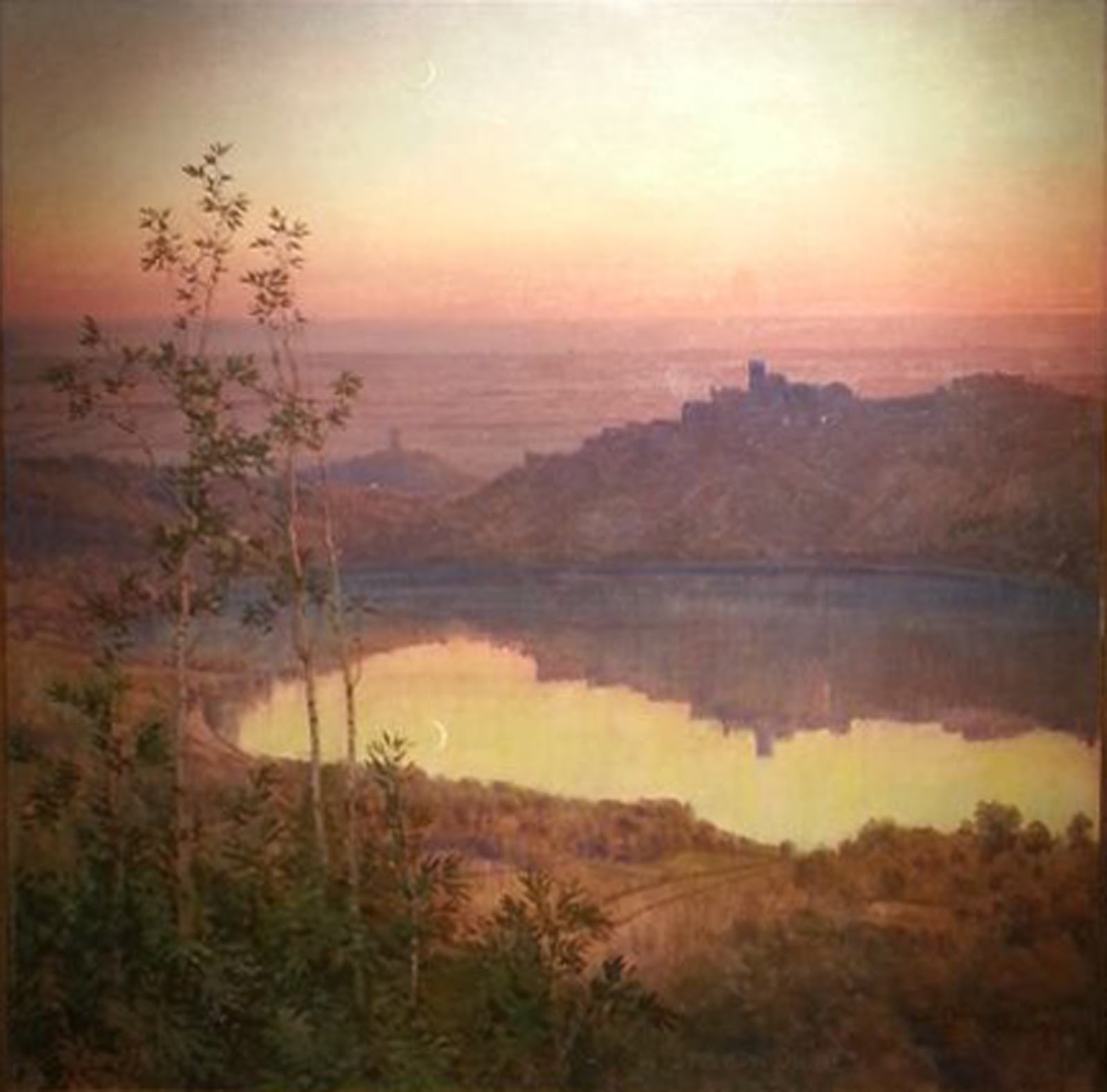
    She is Diana, also called Selene and Hecate and depicted with them as a triple goddess on Roman coinage. Her mirror, the Speculum Dianae, is Lake Nemi, a beautiful spring-fed lake inside the crater of a volcano. It is near the ancient town of Aricia (modern Ariccia).
    She was called Diana Nemorensis, Diana of the Sacred Wood, or Grove (nemus). Today, the Ides of August, is her special day. * This is the day of the Nemoralia, which became a holiday across Italy but was celebrated most elaborately at her temple beside Lake Nemi. Burning torches were carried in a procession around the lake, known as Diana’s Mirror. Those whose prayers had been answered at her shrine came wearing wreaths of flowers, to show their gratitude and fulfill specific promises made to the goddess. Dogs were garlanded and given special treats today. Nemoralia was a holiday for slaves, reflecting the alternations in status we see in the face of the Moon.
    We may be drawn to Diana as we are drawn to the Moon. She does not begin as Artemis, though they are closely twinned when the Romans start importing Greek deities, and their statues as young huntresses in tunics, with bows, become interchangeable. By one account, the first image of Diana, described by Ovid as  "a golden goddess fashioned by a barbaric hand" [1] was smuggled to Nemi, concealed in a bundle of sticks, from what is now the Crimea.
    The precinct of Diana did not grow into the vast world-city of Artemis of Ephesus. It remained a remote place in the wild woods, though not far from Rome if you were able to get up the steep slope of the volcano in order to get down into the crater. However, a beautiful Hellenistic temple complex developed, with baths and healing pools and a theater - where actors came up and down from a pit as from the Underworld - and granaries and the ancient version of a teaching hospital, one of the best in the world.
    Pilgrims and petitioners of all social classes came here to seek guidance and healing. As with the cult of Asklepios and his divine family, it must have been the experience of the numinous in this place - and the word that was spread about it - that kept the supplicants coming. In an excellent recent monograph, classical scholar C.M.C. Green observes that "the success of the cult was the result of the religious experiences of the people who came to the sanctuary for the goddess." [2]
    Votive statues from the temple of Diana depicting body parts and internal organs and newborn babies suggest some of medicine people came seeking. Some of the ex-votos are heads of Diana, maybe suggesting that they wanted to get the numen of the goddess into their heads. Green reminds us that supplicants did not come to the temple of Diana looking only, or even especially, for miracles. Treatments of every kind were offered here, offering state-of-the art pharmaceuticals and surgery, as well as dream incubation in the sacred night. This was a hospital for dogs as well as humans, with the best remedies for scabies and other canine complaints known in ancient times.
    The sanctuary of Diana was famous for treating or containing mental and psychospiritual complaints. We hear again and again about men who seek refuge in Diana's woods, tormented by Furies of guilt and despair, with what modern psychiatrist might call PTSD but which Horace - following the assistants of the Goddess - called fanaticus error, the obsession of the deviant mind. [3]
    Now we come to the baking. The precinct of Diana at Nemi included large granaries, the source of the flour used to form and bake untold numbers of strange deformed pastry dolls. These were sometimes called maniae, which usually means evil spirits, especially unclean spirits of the dead, and is the plural of mania, which speaks for itself.
    It seems that a key practice for spiritual cleansing and repair, in the healing rooms of Diana, was to encourage a patient to transfer the entities and energies that brought affliction into one or more of these doughboys, some of which were quite hideous. Think Fright Night gingerbread boys. The pastry figures would then be broken up, crushing and dispersing the unwanted energies. It is possible - this part is speculative - that the pieces might then be mashed together, reshaped and baked into a new and desirable form, representing the return of the patient to physical and mental health.


    Reflecting on the many faces of Diana, Green writes: "Diana's triple form...represented the multiplicity of her sacred experience. There was not one Diana. She belonged to the underworld, to the earth, and to the sky. That triple nature would also be exemplified by the sanctuary itself, the lake and the caves and the springs, leading to the underworld, and the crater as the circle of the earth, all ruled by the moon moving slowly across the sky." [4]   


References
1. Ovid, Heroides 12. 70-71
2. C.M.C. Green, Roman Religion and the Cult of Diana at Aricia (Cambridge: Cambridge University Press, 2007) 153.
3. Horace, Ars Poetica 454.
4. Green, op.cit.,291.


The Goddess and the King of the Woods

In the sacred wood, the hunter becomes the hunted. Perhaps this goes to the depth of the mystical relationship between the hunter and the game animals in hunter-gatherer cultures. It is an enduring feature of the cult of Diana, shocking to many ancient, as well as modern, minds.
   The savage ritual observed at Nemi was made famous by James George Frazer, who brought from it the title, opening chapter and ruling theme of The Golden Bough. The following brief account departs from Frazer, drawing on recent scholarship.
    In the woods at Nemi is a wild man who is nonetheless a king, rex nemorensis, the King of the Sacred Wood. He arrives here a fugitive, an escaped slave, a man without a country. Maybe only a man in his condition would be desperate enough to pay the price of kingship.
    First, he must find the evergreen oak in the depths of the forest where mistletoe hangs from an upper branch. This is called the golden bough because yellow blossoms of the mistletoe that grows on oak are that color year-round. He must separate the parasitic plant with his bare hands.
    Once he has done this, he is given a sword. Weapons are forbidden to all except the King of the Woods and his challenger in this sacred precinct. Two desperate men now stalk and hunt each other through the woods. Even if he is old, the reigning king has the advantage of knowing the forest well, The challenger has the advantage of relative youth. They meet in mortal combat and one dies.
    The survivor, maybe wounded, must drag the body of the slain contender to the funeral pyre. After, he must carry ashes and bones down into a deep cave, viewed as a mouth of the Underworld, to lay them in an ossuary of fallen kings. Down there, he will dream and see visions. When he returns to the world above he will not be the same because he has gone through the death and rebirth of the shaman.
    His reward may include becoming the mate of the Goddess - embodied by her priestess - in the hieros gamos, the sacred marriage. His life will always be lived on the edge, with death at his shoulder.


* In the Roman calendar, while the Ides of March notoriously falls on the 15th of the month, the Ides of August falls on the 13th. Julius Caesar has an interesting connection with Lake Nemi. He had a sumptuous villa built overlooking the lake. But when he came to inspect it for the first time he ordered it leveled to the ground. It may be that surveying the sacred wood, he suddenly felt fear at the sight of a place where royal succession was accomplished by assassination.


Art at top: Speculum Dianae by Enrico Coleman (1909)

Thursday, January 5, 2017

Healed in the grip of She Bear


A she-bear is among us. I volunteer to deal with her. She is enormous, maybe six hundred pounds. Light in color, lighter than honey-brown. She grips my head in the crook of her arm, and holds it against her, close to her face. We spend four days in this intimate embrace. It is not uncomfortable, but I am aware that at any moment she could break my neck.
   At the end of four days, the people who were with me at the outset gather around us again. One is a woman scientist or zoologist. They now have the means to release me.
    But the she-bear lets me go without a struggle, confident of our relationship. She shambles away into a space that had been prepared for her, in a room off the corridor of an institutional building, a university or teaching hospital facility.
   When I start talking about her, she returns to look at me.
    I stare into her beautiful eyes. 
    “You are Artemis,” I tell her. “I am Osiris.”


Feelings: I had been suffering persistent wooziness and blurred vision before the dream. These symptoms were now gone. I felt physically restored, confident about things, open to adventure.

Reality: I have come to know the Bear as the great medicine animal of North America, where I live. I knew that warriors in the Europe of my ancestors called on the power of the Bear as a fierce protector. I know that Osiris is the model of one who rises from death, under the wings of a goddess.
   For the connection between Artemis and the Bear, I turned to my personal library, and immediately found this, in the Jane Ellen Harrison's classic work Themis: A Study of the Origins of Greek Religion: "The well-born, well-bred little Athenian girls who danced as Bears to Artemis of Brauronia, the Bear-Goddess, could not but think reverently of the great might of the Bear.”
   Harrison added the important general insight that "the mystery gods…are never free of totemistic hauntings, never quite shed their plant and animal shapes. That lies in the very nature of their sacramental worship. They are still alive with the life-blood of all living things from which they sprang."

Comment: In my current state of hibernation (the literal meaning is simply "passing the winter") I am deep in old journals. The report above comes from my journal for April 1999. As I read the journal entry again, the memory of healing streams through me, sweet and bright as mountain honey.
Bear has come to me again and again, over many years, to offer healing for me and for others. Great Mother Bear has come to offer soul recovery healing for many who come to my workshops. I have seen it again and again: Within the supportive energy of a circle of active dreamers, you journey with the drum to find a missing part of yourself, perhaps that magical child who took leave of this world because it seemed too cold and too cruel, and has been living all these years in a Land of Lost Girls or Lost Boys. You find that child, but she won't come to live fully in your body and your present life unless you can convince her you are safe and you are fun. That's not so easy. But when you take her in your arms, and hold her, Great Mother Bear comes and wraps her great arms around both of you, holding you gently but firmly together until you are one.


Drawings by Robert Moss

Saturday, January 2, 2010

Four Days in the Grip of the Bear Goddess


I have known since early in my long sojourn in North America that the Bear is a great medicine animal. A powerful dream that brought me personal healing reminded me that this was not unknown to early peoples in Europe, especially when the ancient way of the Great Goddess was most alive. Down in my den of winter, going through old journals, I found this report:


April 26 1999
FOUR DAYS IN THE GRIP OF THE SHE-BEAR

A she-bear is among us. I volunteer to deal with her. She is enormous, maybe six hundred pounds. Light in color, lighter than honey-brown, as light as a polar bear. She grips my head in the crook of her arm, and holds it against her, close to her face. We spend four days in this intimate embrace. It is not uncomfortable, but I am aware that at any moment she could break my neck.
----At the end of four days, the people who were with me at the outset gather around us again. One is a woman scientist or zoologist. They now have the means to release me. But the she-bear lets me go without a struggle, confident of our relationship. She shambles away into a space that had been prepared for her, in a room off the corridor of an institutional building, a hospital or teaching facility.
----When I start talking about her, she returns to look at me. “You are Artemis,” I tell her. “I am Osiris.”
-
On waking, I noticed that troublesome symptoms that had been bothering me for days - headaches and wooziness - had left me. I felt charged with vitality, sure I had received personal healing, and grateful to the she-bear that delivered it.
-
I was intrigued by the words my dream self had spoken to her. I could grasp why I might have identified myself with"Osiris", as candidates for initiation and travelers preparing for the next world were schooled to do in ancient Egypt. Osiris is one who dies and comes back, one who is dismembered and re-membered. I could find something of my finite story within his neverending one.
-
But why did my dream self hail the she-bear with the name of the Greek goddess Artemis? I hit the books, especially the brilliant early studies of Jane Ellen Harrison, who had an intuitive grasp of the shamanic sources of hellenic ritual practices. I rediscovered hat throughout ancient Greece, bears were sacred to Artemis. Well-born little Athenian girls danced as bears to Artemis of Brauronia, the Bear-Goddess. Jane Ellen Harrison observed they “could not but think reverently of the great might of the Bear.”
-
More generally, Harrison wrote
-
The mystery gods…are never free of totemistic hauntings, never quite shed their plant and animal shapes. That lies in the very nature of their sacramental worship. They are still alive with the life-blood of all living things from which they sprang.[Themis 450]
-
I looked anew, with the eyes of a dream archeologist, at ancient images of the Bear goddess, including the 2nd century bronze statue of the Celtic bear goddess, found near Bern in Switzerland, who appears in the photo that accompanies this essay. The Romans called her Dea Artio. As far away as Britain, the Arthur, as consort of the Bear goddess, led his men into battle under her standard. In her human guise, in the Bern statue, the goddess offers fruit to her animal self.
-
The link between Artemis and the Bear can be tracked through the myths, though we need dream sight to get to the heart of these stories. In the Greek version of the creation of the Bear constellations in the sky - Ursa Major and Ursa Minor - Zeus pursues Callisto, one of the nymphs of Artemis. Calliasto keeps shapeshifting; the lusty god shifts just as fast, seeking to cover her in every form. The nymph of Artemis becomes a bear, and now Zeus, as a male bear, wraps her in his embrace and has his way with her. When Artemis later notices that her nymph is pregnant, she flies into a rage and kills her, but quickly repents and places Callisto and her daughter among the stars, as the Great Bear many call the Big Dipper, and the Lesser Bear.