Sometimes it so happens in this material world that great personalities, even great devotees, can also be controlled by the asuras.
- Srimad-Bhagavatam 7:4:14
Myth, it's been said, is what never happened but is going on all the time. In he collective dreams of humanity, an ancient myth may cast light on the forces at work behind the surface of events in our world. The great Hindu epic known as the Mahabharata, supposedly dictated by the seer Vyasa to the scribe Ganapati in the time when gods and humans were in daily communication, relates the actions of humans to forces at play in the larger reality. Its account of how a race of Asuras (demonic entities) instigated a war makes compelling and disturbing reading today.
A Danava Plan to Possess Human War Leaders
In Vedic literature, the Danavas are a race of Asuras engaged in constant warfare with the gods, and forever interfering in the affairs of humans. They are sometimes identified with pre-Aryan peoples of the subcontinent. In the Vedas, they defeat the gods and the gods turn to great rishis – celestial seers – to “burn” their armies and consign them to an underworld beneath the oceans.
In the Mahabharata the account of the abduction of King Duryodhana reveals certain modes of inhuman interference in human conflicts. Duryodhana, mortified that he was freed from captivity (among the Gandharvas) by his mortal enemy Arjuna, has decided to fast until death. This does not suit the agenda of the Danavas, who want to foment war between rival dynasties.
By chanting magic words (mantras) the Danavas manifest a demonic female, known as a Kriya. She is described as “a wondrous woman with a gaping mouth”. She goes to Duryodhana, enchants him, and then carries him to the netherworld by means of “mystical travel”, for which the Sanskrit terms are mano-java (in which the body is transferred by mental action, moving on “the wind of the mind”) and vihayasa, which involves the ability to move bodies or objects through matter.
Among the Danavas, the king is informed that his birth and his unusual powers were arranged by them as part of their plan for the world. He can’t take himself out of the game, because it is their game. The Danavas explain that Duryodhana and his clan will triumph in the coming battle with the Pandus because their warriors will be possessed by demons and given demonic strength:
The other Asuras will take possession of Bhishma, Drona, Kripa and the others; and possessed by them they will fight your enemies ruthlessly. When they engage in battle, best of the Kurus, they will give no quarter to either sons or brothers, parents or relatives, students or kinsmen, the young or the old.
Pitiless, possessed by the Danavas, their inner souls overwhelmed, they will battle their relations and cast all love far off. Gleefully, their minds darkened, the tiger-like men, befuddled with ignorance by a fate set by the Ordainer, will say to one another that – ‘ you will not escape from me with your life! ‘ Standing firm in their manly might in the unleashing of manifold weapons, best of the Kurus, they will boastfully perpetrate a holocaust.’
- J.A.B. van Buitenen (trans) The Mahabharata Books 2 &3 (Chicago: University of Chicago Press, 1975) p.692.
Duryodhana is now returned by Kriya to the place from which he was taken. After she leaves, he decides it was all a dream. He is left with the thought: “I shall vanquish the Pandus in battle.” The Danavas have instigated a war.
It would be comforting to dismiss this report as fantasy from demon-haunted primitives, but the transactions here do not seem remote from the recent history of warfare and terror.
Afterword: One people’s gods may be another people’s demons. The Danavas take their name from a feminine entity known as Danu. So do the Tuatha de Danaan, “The People of Danu”, in Ireland. Danu is the mother of demons in India, but in Ireland she is the great goddess
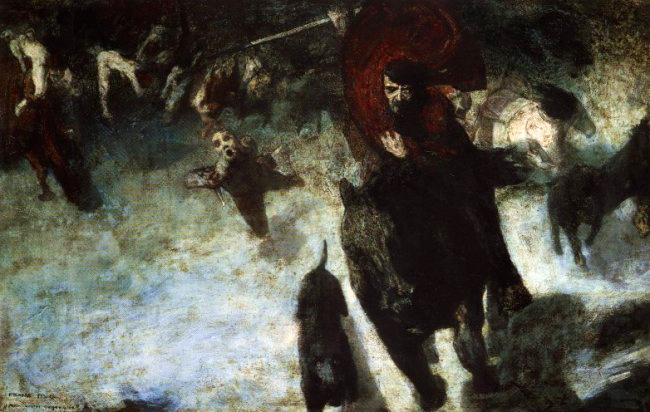
Graphic: Duryodhana ready for war