Showing posts with label The Man in the High Castle. Show all posts

Friday, December 24, 2021

Dreaming Parallel Worlds


I've long been fascinated by dream experiences of parallel lives. These can take many forms. We find ourselves in the situation of a person living in a different time. We seem to be enjoying - or not enjoying - a continuous life in another reality. We slip into the perspective and apparently the bodies of other people (including even members of other species) who may be living in our present world, but are not ourselves.

    The parallel life experiences that intrigue me most are those in which we seem to find ourselves traveling - in an alternate reality - along paths we abandoned in this lifetime, because of choices we made. Contemporary science speculates about the existence of (possibly infinite) parallel universes. In our dreams, we have the ability to gain first-hand experiential knowledge of this fascinating field.

    In my own dreams, I quite frequently find myself living in a city or a country where I used to live, doing the things I might well be doing had I stayed in a former line of work and a certain life situation. In these dreams, I am my current age, but my life has followed a different track from the one I have taken in my waking reality. Sometimes it seems I have joined a parallel self who has been following a path I abandoned - through my life choices - twenty or even thirty years ago. There is a "just-so" feeling about these dreams. I return from them thinking, "Well, that's how things might be if I had made a different choice." Sometimes I'm quite relieved that I made the choices I did; sometimes I feel a little tristesse for something or someone left on the "ghost trail" I've seen in my dream ; but most often my feelings are entirely non-judgmental.

    This theme is nicely explored in a novel titled The Post-Birthday World, by Lionel Shriver. Through alternating chapters, we follow alternate event tracks in the life of the heroine, depending on whether she did or did not kiss a man other than her partner on the night of his birthday. That night, her world split. We follow her double life, through those alternating chapters, and the dual narrative is beautifully wrought. At the end of the twin tellings, it's hard to make a value judgment between the alternate life paths. You can't really say that one is better or worse than the other; they are simply different. The movie "Sliding Doors" dramatizes a similar theme.

    Through a chance encounter that was the product of a missed airline connection, I once met a woman who told me she was living a double life of this kind every night (or every day, depending on your perspective). Every night, she went home to her husband at their comfortable house on an island off the North Carolina coast. They might go to their favorite restaurant, or to the mall or the country club. In the morning, they went off on their separate ways to work. The shocker was this. The man she went to every night in her dreams was a different husband, in a different house in a different island. "Whenever I close my eyes," as she told it, "I'm in a different world. It's the same as this world, but everything is different." Under the Many-Worlds hypothesis now widely entertained by physicists, it's possible that every choice we make results in the creation of two or more new universes.

     In Parallel Universes theoretical physicist Michio Kaku suggests that another universe may be floating just a millimeter away on a "brane" (membrane) parallel to our own. He explains that we can't see inside it because it exists in hyperspace, beyond the four dimensions of our everyday reality. But in fact, we can and do go there - in dreaming and in the imagination.

     Second only to dreaming, imaginative fiction is our best mentor on these matters. In Matt Haig’s brilliant recent novel The Midnight Library a young woman whose body is near extinction after an overdose is allowed to experience some of the parallel lives she is living in worlds where she made different choices, and determine whether she can make a firm commitment to any of them.

 In Borges' 1941 novella "The Garden of Forking Paths" a sinologist discovers a manuscript by a Chinese writer where the same tale is recounted in several ways, often contradictory. Time is conceived here as a "garden of forking paths", where things happen in parallel in infinitely branching ways. Borges conveys how all possible outcomes of a given event may take place simultaneously, each one opening a new array of possibilities.

    It's fascinating to speculate on what may happen if parallel selves, and their parallel worlds, bump up against each other. Could we combine the gifts of different life experiences, or would we compete with each other? One approach to this theme is a creaky old Roger Moore movie titled "The Man Who Haunted Himself", hilarious to watch now because of its silly, jingly circa-1970 musical score. An arrogant, power-mad, womanizing s.o.b. finds enlightenment, and becomes softer and kinder to the point where his family, his office and his girlfriend can't figure him out. When his other self - the s.o.b. in the Savile Row pinstripes - turns up, everyone accepts him as the true Roger Moore character, and Mr. Softer and Kinder is shut out of his home and his office.

     All the questions raised here apply to our collective world as well as our personal one. Just beside us, perhaps, is a parallel world - or a thousand of them - in which there is no pandemic and there was no insurrection at the U.S. Capitol on January 6th. And parallel worlds where there is still a Soviet Union or where (as in the Philip K. Dick novel The Man in the High Castle) the Axis won World War II and a Japanese commandant rules California. In another parallel world, we have evolved to the level of a Type III Kardashev civilization, with colonies established all over our home galaxy and the technology to tap the energy of a billion stars.

    Before Earth's ecosphere ceases to support life, Michio Kaku conjectures, we may have learned how to transport ourselves to a parallel world in the multiverse. Or maybe (as some scientists believe the Big Bang came about) everything will end and begin again through the collision of parallel "branes". Forking paths, dividing - and sometimes converging. To know more, let's go dream on it.


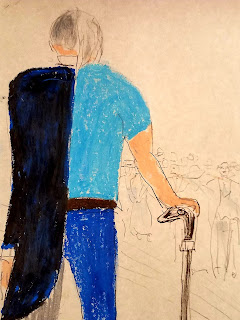
Illustration: "Alternate Lives" (c) Robert Moss


Thursday, April 8, 2021

The Way and the Changes


We find in China a word and a way of understanding synchronicity that are simple and profound. The word is Tao (also transliterated as Dao). It is sometimes translated as “way”, or the Way, which is good enough for me. If we are attuned to the Tao, then our ways are open.

    The Tao of Psychology, Jean Shinoda Bolen’s lively little book from 1979 is one of the very best expositions of the theory of synchronicity. She goes looking for an easier and more elegant way to explain the phenomenon Jung struggled to define. She found it waiting where it has been for thousands of years, in the Chinese understanding of the Tao, the Way that had no name but generates the ten thousand names. 

The Tao that can be told is not the eternal Tao
The name that can be named is not the eternal name.
The nameless is the beginning of heaven and earth
The named is the mother of the ten thousand things.[1]

     As Bolen observed, “the Eastern mind has considered the underlying connection between ourselves and others, between ourselves and the universe, the essential reality and called in Tao.” [2]  The I Ching is a way of invoking the Tao; its first successful Western translator, Richard Wilhelm, decided that the best one-word translation of Tao is “meaning.”
     Jung’s thinking about synchronicity flowered when Richard Wilhelm sent him the text of an ancient Taoist treatise, The Secret of the Golden Flower, for which Jung wrote a preface. Wilhelm also introduced Jung to the Book of Changes, or I Ching, for which he provided the first translation that made the Chinese oracle accessible for Western readers as a divination system. Jung studied I Ching closely, and realized he was entering the mind of a culture for which synchronicity — as the Way and its Changes — was the fundamental law of life, and the preferred way of understanding what wants to happen in life.
     The dynamic interplay between yin and yang is at the heart of I Ching. It is the interplay between the receiving and the creating forces, between dark and light, between cool and warm, forever intermingled and turning into each other.
    The emergence of the I Ching is wrapped in legend and mystery. By tradition, it was the ancient Dragon Emperor, Fu Tsi, who “noticed” patterns in the cracks of turtle shells, and distinguished these patterns as the eight trigrams (pa kua) that are the root of I Ching. Then later the “King of Writing”, Wu Wen amplified the system into the 64 hexagrams and the Confucius ordered and numbered the arrangement.
     Archaeology suggests an evolution over some 4,000 years. Under the Shang dynasty, shamans read auguries in the cracks that appeared in the bones of animals offered as burned offerings. It was believed that as the appeals of humans traveled upward in the smoke, messages and warnings from higher powers came down. The relation between patterns of cracks and subsequent events was noted, and cracked bones were kept in pre-literate “archives”. Later turtle shells were substituted. They provided a larger surface, and their shape was thought to resemble the dome of heaven above and the square fields of earth below. With the coming of the bronze age, turtle shells were cracked with bronze pokers. Patterns corresponding to later events began to be marked with simple symbols, suggesting fire or flood. From these symbols, Chinese writing emerged. Under the Chou dynasty — before the supply of turtles was exhausted — shamans and diviners began to record the code of the I Ching on strips of bamboo, tied together with silk ribbons. And the first books of China emerged.
    The ancient method for casting the I Ching involves a fistful of dried yarrow stalks. The yarrow most valued for early divination as found growing on the graves of past teachers and masters of I Ching, including Confucius. Early translator James Legge reported seeing yarrow growing on the grave of Confucius. The Chinese still believe that when a good diviner in the right state of mind is doing his/her stuff, there is communication with the spirits, whether you are using yarrow stalks or coins or grains of rice, which my first teacher recommended, after lighting some incense.
    The Great Treatise (one of the earliest long commentaries on the I Ching) maintains that the I Ching contains "the measure of heaven and earth" — ie, it is a microcosm of the whole cosmic game — and that if we place ourselves in exactly the right point in its revolutions, we move in synchrony with the workings of the universe and can help to shape events on every scale through our conscious participation. The Great Treatise suggests that you not only learn to meet every event in the right way but may be privileged “to aid the gods in governing the world.”
    The I Ching hexagrams are stacks of six lines, broken or unbroken. Variations on a single binary code. The unbroken lines are yang, the broken ones are yin. One way to understand them is to see an unbroken line as a portal that is opening, and a broken one as a portal that is closing. Through this binary code, the Book of Changes reveals the interplay of three realms: the earthly, the human and the heavenly. The two lowest lines of the hexagram relate to the Earth realm, the middle lines to the human, and the upper pair to Heaven.
    You don’t use I Ching for fortune-telling. It’s not about seeing the future; it’s about seeing when and how to manifest your hopes and plans for the future, which is actually much more interesting. This is a tool for helping you to create the future you choose. You bring your clear intention — your project — and you ask for guidance on current conditions and the strategy to be followed. The I Ching does not bind you to any determinist scheme of things. It gives you a diagnosis of how things are, with the world and with you now, whether this is the right time to pursue a goal and what strategy you should follow.
     Since Jung’s death, we have had access to a manuscript of the Book of Changes that is more ancient than those available in his lifetime. It is a broken text, and therefore not useable — without creative addition or fabrication — as a full oracle. Nonetheless, it makes very exciting reading for those interested in the shamanic origins of the oracle and the different levels on which it registers and provokes synchronicity.
      The text dates from about 175 BCE. It was discovered in the tomb of a duke of the Han dynasty at Mawangdui that also contained the text of the Tao Te Ching, clearly placing this version of the Changes in the ancient Way. The ordering of the hexagrams in the Mawangdui version is quite different from that of the familiar Duke Wen arrangement used by Wilhelm and other translators. The two primal hexagrams have different and sexier names. Among the “appended statements” to the text, in Edward Shaughnessy’s translation, we find this: 

The sage…takes the real characteristics of all under heaven to their extremes and causes them to reside in the hexagrams; drums [emphasis added] the movements of all under heaven and causes them to reside in the statements; transforms and regulates them and causes them to reside in the alternations; pushes and puts them into motion and causes them to reside in the unity; makes them spiritual and transforms them and causes them to reside in his person; and plans and completes them…and causes them to reside in virtuous action.[3] 

     Inspired by this, when I led a course in I Ching, we drummed the binary code of the lines, changing and constant, yin and yang, on our single-headed frame drums, and pictured early diviners doing something similar.
     We drummed the six lines of the twentieth hexagram, which is called Watching and whose shape is that of a watchtower, the kind that Chinese armies placed along the borders. We saw how rising up through the lines of the hexagram is like climbing steps from the lowest level of an observation tower to the very top, from a place of limited or impeded vision to a space from which we could see, without restriction, across time and space.
     A great revelation came when we worked, with drumming and also with body movements, with the 61st hexagram, Wind on the Lake, called Zhong Fu, or Inner Truth. The hole in the center of the hexagram can be seen as the opening of the heart, and also as the unveiling of a window between worlds.
      In Philip K. Dick’s fascinating novel of alternate realities, The Man in the High Castle, the casting of this hexagram brings a shift between parallel worlds. In the main narrative, we are in a world where the Axis powers were the victors in World War II, and North America is divided between Japanese and German occupation armies and other entities. Yet a subversive work of fantasy is circulating, a story in which the Allies won the war and everything is different. When Juliana casts Zhong Fu for Abendsen in the last pages of The Man in the High Castle, he understands (if only for a moment) that the alternate reality he thought was fiction is true, the real world. We see the observer effect working on a human, and even global scale. If only for a shimmering moment, as the coins roll and settle, we glimpse how it may be possible to switch worlds.
     The way we see reality generates our experience of reality. A method of seeing like the I Ching can make us co-creators of our worlds. The Great Treatise suggests that through deep study of the Book of Changes we not only learn to meet every event in the right way but may be privileged “to aid the gods in governing the world.” [4] The Mawangdui text asserts that the Book of Changes “knows the reasons for light and dark” [5]. It “strengthens beings and fixes fate, taking pleasure in the way of all under heaven…This is why the sage uses it to penetrate the will of all under heaven.” [6]

References

1. Lao Tsu, Tao Te Ching trans. Gia-Fu Feng and Jane English.
2. Jean Shinoda Bolen, The Tao of Psychology: Synchronicity and the Self  (San Francisco: Harper & Row, 1982) xi 
3. 
Edward L. Shaughnessy (trans and ed) I Ching: The Classic of Changes. (New York: Ballantine Books, 1997) 203
4. Richard Wilhelm and Cary F. Baynes, trans., The I Ching or Book of Changes (Princeton N.J.: Princeton University Press, 1990) 294.
5. ibid, 191
6. ibid, 199


Text adapted from Sidewalk Oracles: Playing with Signs, Symbols and Synchronicity in Everyday Life by Robert Moss. Published by New World Library.

Graphic: The precursor to I Ching as China's main system of divination (besides dream interpretation) was the Shang dynasty system for reading the "oracle bones": shoulder bones of animals and the plastrons from turtle shells.